Table of Contents
- The Quiet Birth of Stars: When Gravity Meets Balance
- The Cosmic Cradle: Where Stars Are Conceived
- The Role of Gravity: The First Pull
- Fragmentation: The Birth of Multiplicity
- From Protostar to Star: The Long Road to Equilibrium
- The End of the Cycle: When the Gas Runs Out
- The Bigger Picture: Star Birth as a Universal Process

The Quiet Birth of Stars: When Gravity Meets Balance
For centuries, humanity imagined star birth as a violent, explosive ignition—like a cosmic match struck in the void. But modern astronomy reveals a far more subtle and profound truth: stars are not born from sudden combustion, but from a delicate, slow dance of equilibrium. Deep within the cold, dark hearts of interstellar clouds, gravity pulls, gas cools, and pressure builds—not in a flash, but in a gradual convergence of forces. The birth of a star is less like a firework and more like a glacier forming: imperceptibly slow, yet unstoppable.
This process unfolds across millions of years, hidden from the naked eye by thick veils of cosmic dust. Only with the advent of powerful telescopes like the James Webb Space Telescope (JWST) and radio observatories such as ALMA have we begun to peel back these layers, revealing the intricate mechanics of stellar nurseries. What we now understand is that star formation is not a singular event, but a cascade of physical interactions—gravity, thermodynamics, magnetic fields, and turbulence—all converging toward a state of equilibrium.
Unlike the dramatic explosions of supernovae or the violent mergers of black holes, star birth is a quiet affair. It begins not with a bang, but with a whisper—a gravitational tug so faint it takes eons to gather momentum. Yet, this slow accumulation of matter is what ultimately gives rise to the brilliant beacons that light up galaxies.
The Cosmic Cradle: Where Stars Are Conceived
Star formation begins in the coldest, densest pockets of interstellar space—regions known as molecular clouds. These vast reservoirs of gas and dust, often spanning hundreds of light-years, are the nurseries of the cosmos. Within spiral galaxies like our Milky Way, these clouds are predominantly found in the spiral arms, where density waves compress gas and trigger collapse.
A typical molecular cloud is composed mostly of hydrogen molecules, with traces of helium and heavier elements. Despite their enormous size, these clouds are incredibly diffuse by Earth standards—a cubic centimeter might contain only a few thousand molecules, compared to trillions in Earth’s atmosphere. Yet, their sheer volume means they contain enough material to form thousands, even millions, of stars.
Star-forming regions emit light primarily in infrared and radio wavelengths, invisible to the human eye but detectable by space telescopes.
A single protostar can take 100,000 to 10 million years to fully form, depending on its mass.
Over 70% of stars form in clusters, not in isolation.
The Eagle Nebula’s “Pillars of Creation” are estimated to be about 4–5 light-years tall—roughly the distance from the Sun to the nearest star.
One of the most iconic examples is the Lobster Nebula (NGC 6357), a sprawling stellar nursery in the constellation Scorpius. Here, pinkish clouds of excited hydrogen glow under the ultraviolet radiation of newborn stars, while dark dust lanes obscure the deeper regions where new stars are still forming. These dark patches are not empty—they are dense enough to block visible light, hiding the earliest stages of star birth.
The Role of Gravity: The First Pull
At the heart of every star’s origin story is gravity—the invisible architect of cosmic structure. When a region within a molecular cloud becomes slightly denser than its surroundings, perhaps due to a passing shockwave from a supernova or the spiral arm’s compression, gravity begins to take hold. This overdensity starts to pull in neighboring gas, growing larger and more massive over time.
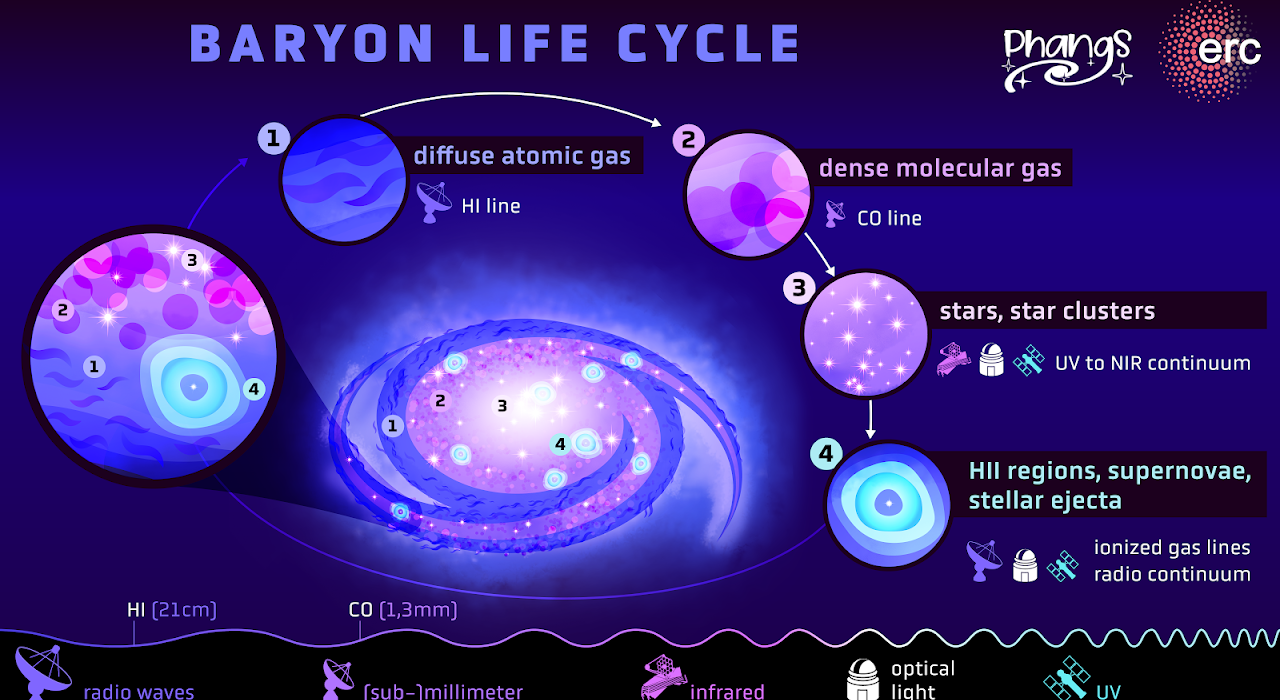
As the cloud contracts, its gravitational pull strengthens, accelerating the infall of material. But gravity doesn’t act alone. It must overcome internal pressure—the thermal motion of gas particles pushing outward. For collapse to continue, the cloud must lose energy, primarily through radiation. Molecules like carbon monoxide (CO) and dust grains act as radiators, emitting infrared light as they cool, allowing the cloud to shed heat and shrink further.

This cooling process is crucial. Without it, the gas would remain hot and pressurized, resisting collapse. Only when the cloud can efficiently radiate away its thermal energy can gravity win the tug-of-war and pull matter inward. This delicate balance between gravity and pressure is what allows star formation to proceed.
Fragmentation: The Birth of Multiplicity
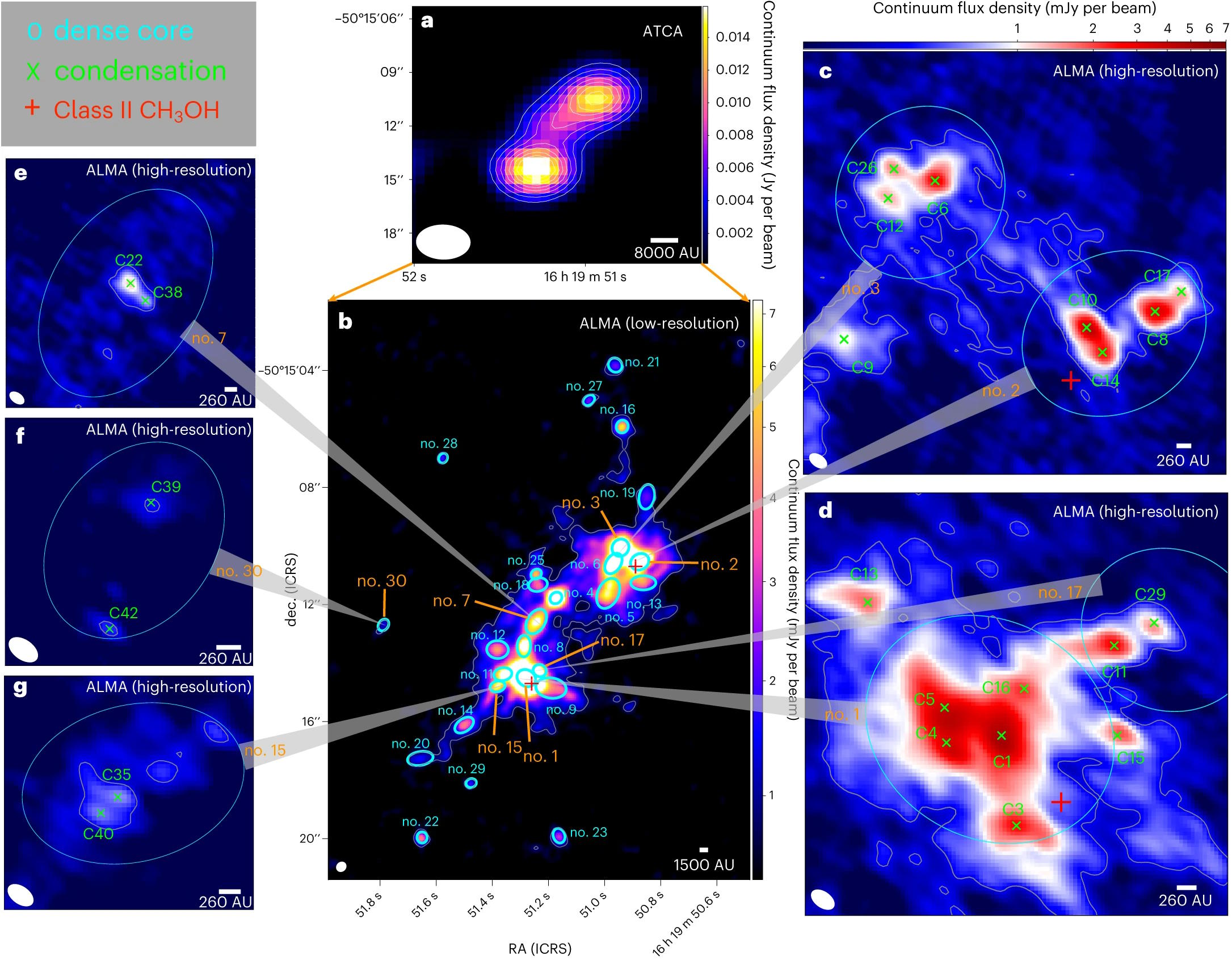
As the cloud contracts, it doesn’t collapse into a single, monolithic object. Instead, it fragments—breaking apart into smaller, denser clumps. This process, known as gravitational fragmentation, is driven by turbulence and density fluctuations within the cloud. The densest regions collapse fastest, forming protostellar cores that will eventually become individual stars or stellar systems.
Observations from ALMA (Atacama Large Millimeter/submillimeter Array) have revealed that these cores are rarely solitary. In regions like G333.23–0.06, a massive protostar cluster in the Milky Way, binary and multiple star systems dominate. Quaternary systems—four stars bound together—are common, and even quintuplets have been detected. Singletons, or single stars forming alone, are the exception, not the rule.
This multiplicity has profound implications for stellar evolution. Binary stars can exchange mass, trigger novae, or even merge to form more massive stars. In dense clusters, gravitational interactions can eject stars entirely, sending them hurtling through space as hypervelocity stars.

The Eagle Nebula, made famous by Hubble’s “Pillars of Creation,” is a textbook example of this fragmentation. Within those towering columns of gas and dust, dozens of protostars are embedded, each surrounded by a rotating disk of material—future solar systems in the making.
From Protostar to Star: The Long Road to Equilibrium
Once a core becomes dense enough, it forms a protostar—a hot, dense ball of gas that hasn’t yet begun nuclear fusion. At this stage, the protostar shines not from fusion, but from gravitational energy released as it continues to contract. This phase, known as the Kelvin-Helmholtz phase, can last tens of thousands to millions of years.
During this time, the protostar is surrounded by a rotating disk of gas and dust—the raw material for planets. Jets of material, known as bipolar outflows, shoot out from the poles, clearing away surrounding gas and regulating the star’s growth. These outflows are often associated with Herbig-Haro objects—bright patches of nebulosity where the jets collide with interstellar material at high speed.
As the protostar contracts, its core temperature and pressure rise. When the center reaches about 10 million Kelvin, hydrogen fusion ignites—marking the birth of a true star. But even this momentous event is not a sudden explosion. It’s the culmination of a long equilibrium: gravity has pulled matter inward, pressure has built up, and fusion now provides the outward force to balance it.
This balance—hydrostatic equilibrium—is what allows stars to shine steadily for millions to billions of years. Without it, stars would either collapse or explode.
The End of the Cycle: When the Gas Runs Out
Star formation is not eternal. It depends on a continuous supply of cold, dense gas. In spiral galaxies, this gas is replenished by inflows from the intergalactic medium and recycled material from dying stars. But once a galaxy exhausts its gas reservoirs—either through star formation, supernova winds, or being stripped away by gravitational interactions—star formation ceases.
This process, known as galactic quenching, marks the end of a galaxy’s active life. Elliptical galaxies, which are gas-poor and dominated by old stars, are thought to be the end result of such quenching. Even in spiral galaxies like the Milky Way, star formation rates are declining over cosmic time.
JWST and other telescopes in the PHANGS (Physics at High Angular resolution in Nearby Galaxies) survey are now mapping these processes across dozens of nearby galaxies, revealing how gas flows, star formation, and feedback from young stars interact on galactic scales.

The Bigger Picture: Star Birth as a Universal Process
What we observe in our galaxy is not unique. Across the universe, from dwarf galaxies to massive spirals, the same physical principles govern star formation. Gravity, cooling, fragmentation, and equilibrium are universal. The same molecular clouds, the same protostellar disks, the same binary systems—they all appear wherever conditions allow.
Yet, subtle differences exist. In low-metallicity environments—like the early universe or dwarf galaxies—star formation may have been more chaotic, producing more massive stars. In dense galactic centers, black holes and intense radiation fields can suppress star formation altogether.
Understanding star birth is not just about curiosity—it’s about understanding our origins. We are made of stardust, forged in the hearts of ancient stars. The elements in our bodies—carbon, oxygen, iron—were all created in stellar furnaces and scattered by supernovae. Without the slow, equilibrium-driven birth of stars, life as we know it would not exist.
In the end, the story of star birth is one of balance—of forces in tension, of time measured in eons, of quiet beginnings leading to brilliant endings. It reminds us that even the most luminous objects in the universe begin not with a roar, but with a whisper.
This article was curated from Star birth doesn’t come from ignition, but from equilibrium via Big Think