Table of Contents
- The Missing Mass Problem: Why We Need Dark Matter
- MOND: A Bold Challenge to Gravity Itself
- The Kinetic Sunyaev-Zel’dovich Effect: A New Cosmic Probe
- The Verdict: Dark Matter Holds, MOND Falters
- Why This Test Matters More Than Others
- The Future of Dark Matter: Detection and Beyond
- Conclusion: A Universe Built on Invisible Foundations

The Universe’s Hidden Blueprint: Dark Matter Survives a Cosmic Showdown as MOND Stumbles
For decades, cosmologists have been haunted by a profound mystery: the visible universe—stars, gas, dust, and galaxies—doesn’t add up. The math simply doesn’t balance. When scientists calculate the gravitational forces needed to hold galaxies together or explain the large-scale structure of the cosmos, they find that ordinary matter accounts for only about 15% of what’s required. The rest? Something unseen, something invisible, something we call dark matter. Yet, despite overwhelming indirect evidence, dark matter has never been directly detected in a lab. This absence has fueled skepticism and inspired alternative theories, most notably Modified Newtonian Dynamics (MOND), which proposes that gravity behaves differently on cosmic scales rather than invoking invisible matter.
Now, a groundbreaking new test has tipped the scales decisively in favor of dark matter. Using a subtle cosmic signal known as the kinetic Sunyaev-Zel’dovich effect, astronomers have conducted a novel experiment that pits dark matter against MOND in a cosmic duel. The results? Dark matter passes with flying colors, while MOND fails to match the observations. This isn’t just another data point—it’s a pivotal moment in our understanding of the universe’s hidden architecture.

The Missing Mass Problem: Why We Need Dark Matter
The story begins in the 1930s, when Swiss astronomer Fritz Zwicky observed the Coma galaxy cluster and noticed something deeply unsettling. The galaxies were moving far too quickly to be held together by the gravity of visible matter alone. He coined the term “dunkle Materie”—dark matter—to describe this unseen mass. Decades later, in the 1970s, Vera Rubin and Kent Ford provided even stronger evidence by measuring the rotation curves of spiral galaxies. Instead of stars at the edges moving slower than those near the center—as predicted by Newtonian gravity—they zipped around at nearly the same speed. This flat rotation curve implied a massive, invisible halo of matter surrounding each galaxy.
Since then, multiple independent lines of evidence have reinforced the dark matter hypothesis. The cosmic microwave background (CMB)—the afterglow of the Big Bang—shows tiny temperature fluctuations that match predictions only if dark matter makes up about 27% of the universe’s total energy density. Similarly, the way galaxies cluster across billions of light-years and the behavior of colliding galaxy clusters like the Bullet Cluster—where gravity and visible matter have visibly separated—all point to the existence of a non-luminous, non-interacting substance.
Despite this mountain of indirect evidence, dark matter’s elusive nature has kept the debate alive. No experiment has yet captured a dark matter particle, leading some scientists to explore alternatives. Enter MOND.

MOND: A Bold Challenge to Gravity Itself
In 1983, physicist Mordehai Milgrom proposed a radical idea: instead of invisible matter, perhaps our understanding of gravity is incomplete. MOND suggests that Newton’s laws break down at extremely low accelerations—those typical in the outer regions of galaxies. By tweaking the gravitational force at these scales, MOND can reproduce the flat rotation curves of galaxies without invoking dark matter.
For years, MOND was seen as a compelling alternative. It fit galaxy rotation data remarkably well and required no new particles. But its Achilles’ heel has always been its inability to explain phenomena on larger scales. While it works for individual galaxies, it struggles with galaxy clusters, the CMB, and the large-scale structure of the universe—unless it’s augmented with additional unseen components, effectively reintroducing a form of dark matter.
Now, a new test has emerged that finally puts MOND to the ultimate challenge—one that doesn’t rely on galaxy rotations or static gravitational fields, but on the motion of galaxy clusters through the cosmic microwave background.
The Kinetic Sunyaev-Zel’dovich Effect: A New Cosmic Probe
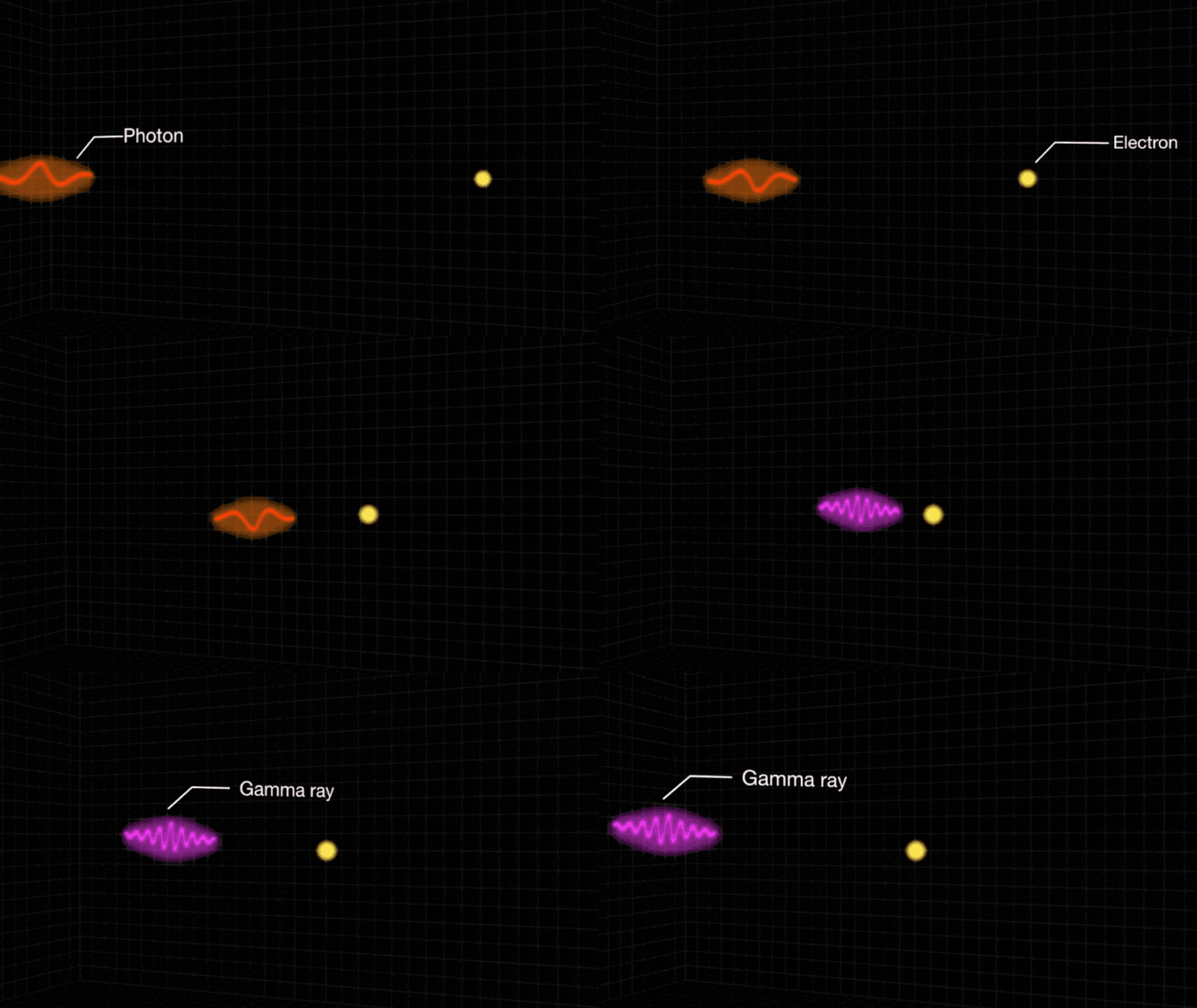
Enter the kinetic Sunyaev-Zel’dovich (kSZ) effect—a subtle but powerful tool in modern cosmology. When galaxy clusters move through the CMB, they scatter photons via inverse Compton scattering. If the cluster is moving toward or away from us, this motion imparts a tiny Doppler shift to the scattered photons, creating a detectable temperature fluctuation in the CMB.
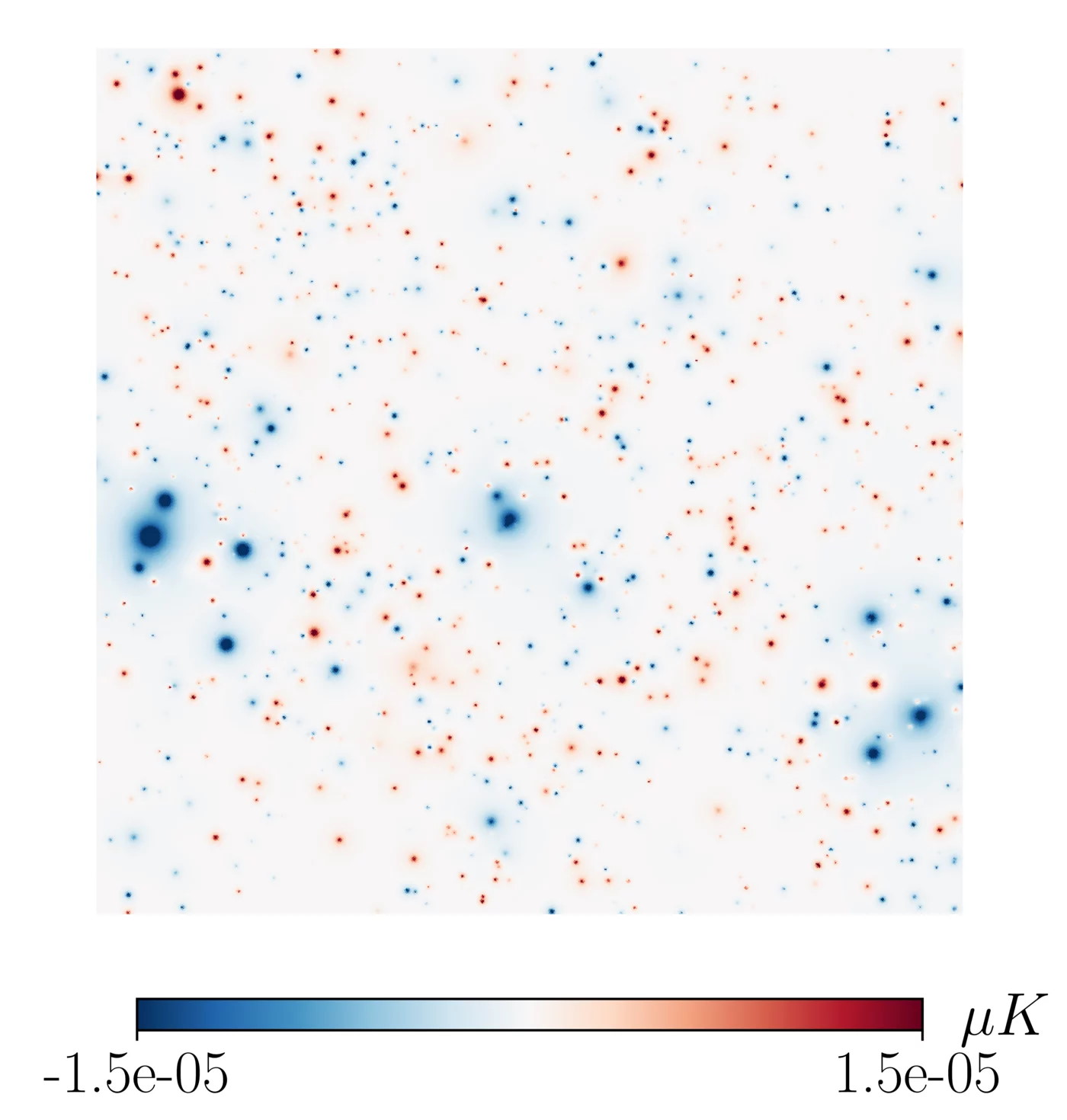
This effect is incredibly faint—on the order of microkelvins—but with modern instruments like the Atacama Cosmology Telescope and the South Pole Telescope, scientists can now measure it with precision. The kSZ effect is sensitive to the bulk motion of electrons in galaxy clusters, which are tied to the overall gravitational potential. In a universe dominated by dark matter, the motions of clusters should align with the distribution of dark matter halos. In a MOND universe, where gravity is modified, the predicted motions would differ.
For the first time, researchers used this effect to compare the observed motions of galaxy clusters with predictions from both dark matter and MOND models. The results were striking.
The Verdict: Dark Matter Holds, MOND Falters
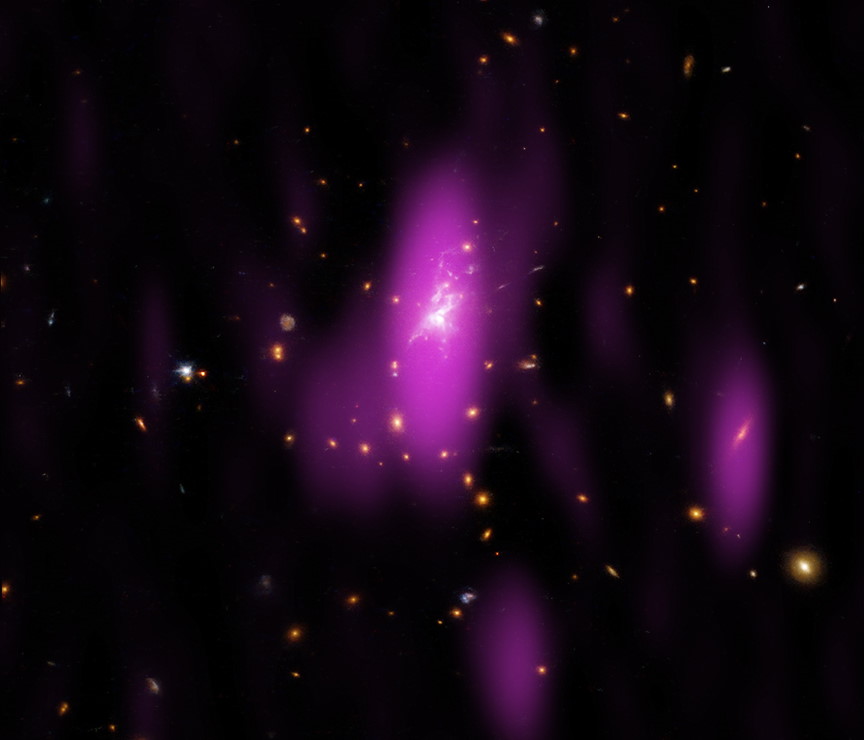
The study, published in a leading astrophysics journal, analyzed data from over 18,000 galaxy clusters. When compared to simulations based on the standard cosmological model (ΛCDM, which includes dark matter), the observed kSZ signals matched almost perfectly. The motions of the clusters were consistent with the gravitational influence of vast, invisible halos of dark matter.
In contrast, MOND-based models failed to reproduce the observed signal. The predicted motions were significantly off, suggesting that modifying gravity alone cannot account for the dynamics of galaxy clusters on these scales. Even when researchers tried to tweak MOND to include additional effects, the discrepancies remained.
This isn’t just a minor setback for MOND—it’s a fundamental challenge. The kSZ effect probes the kinematics of large-scale structure in a way that’s independent of traditional gravitational lensing or rotation curves. It’s a direct test of how mass moves in the universe, and dark matter passes with flying colors.
Why This Test Matters More Than Others
What makes the kSZ test so powerful is its model independence. Unlike galaxy rotation curves—which MOND was specifically designed to explain—the kSZ effect arises from the motion of entire galaxy clusters through the cosmic background radiation. It’s a large-scale, dynamic probe that doesn’t rely on assumptions about how galaxies form or evolve.
Moreover, the kSZ signal is sensitive to the total mass distribution, including both visible and dark matter. In the standard model, dark matter provides the gravitational scaffolding that pulls clusters together and determines their velocities. MOND, by contrast, lacks this scaffolding unless it’s artificially added—which defeats its original purpose.
This test also closes a loophole that MOND proponents have long exploited: the idea that dark matter might just be a placeholder for our ignorance. The kSZ effect shows that the motion of matter on cosmic scales is consistent with dark matter’s gravitational influence, not a modified law of gravity.
The kinetic Sunyaev-Zel’dovich effect measures the Doppler shift of CMB photons scattered by moving galaxy clusters.
Over 18,000 galaxy clusters were analyzed in the latest kSZ study.
MOND can explain galaxy rotation curves but fails on larger scales like galaxy clusters and the CMB.
The Bullet Cluster provided the first direct visual evidence separating mass from visible matter.
The Future of Dark Matter: Detection and Beyond
While this new test strengthens the case for dark matter, the quest to detect it directly continues. Experiments like LUX-ZEPLIN, XENONnT, and DARWIN are searching for Weakly Interacting Massive Particles (WIMPs), one of the leading dark matter candidates. Others are looking for axions or primordial black holes. So far, no confirmed signal has been found, but the search is far from over.
Meanwhile, theorists are exploring more complex dark matter models—such as self-interacting dark matter or fuzzy dark matter—that could resolve small-scale discrepancies while preserving the successes of the standard model. The kSZ result suggests that any viable alternative must still account for the large-scale gravitational effects currently attributed to dark matter.
Conclusion: A Universe Built on Invisible Foundations
The kinetic Sunyaev-Zel’dovich effect has delivered a decisive blow to MOND and reaffirmed the central role of dark matter in modern cosmology. This isn’t the end of the story—science thrives on challenge and refinement—but it’s a powerful reminder that the universe is far stranger and more complex than we can see.
Dark matter remains invisible, but its fingerprints are everywhere: in the rotation of galaxies, the echoes of the Big Bang, the dance of colliding clusters, and now, in the subtle shifts of ancient light. We may not yet know what dark matter is, but we know it’s there—woven into the very fabric of spacetime.
As we peer deeper into the cosmos, one truth becomes clear: the universe is not just what we see. It’s a grand, hidden symphony, and dark matter is its silent conductor.
This article was curated from Dark matter passes a new cosmic test, while MOND fails via Big Think