Table of Contents
- A Fashion-First Revolution in Wearable Tech
- The Power of Gemini: AI as the Invisible Assistant
- Samsung’s Hardware Muscle: The Engine Behind the Glasses
- Learning from Failure: Google’s Redemption Arc
- The Meta Challenge: Can Google Catch Up?
- The Road to 2 Million: What It Takes to Win
- The Future of Wearable Intelligence

In a bold pivot from past missteps, Google is positioning itself to challenge Meta’s dominance in the wearable tech space with a new generation of Android-powered smart glasses. Early forecasts suggest the tech giant could sell up to 2 million units of its upcoming Android XR glasses in 2026—a figure that would surpass Meta’s Ray-Ban Stories in its first year. This isn’t just a comeback story; it’s a strategic renaissance, blending fashion, AI, and hardware in a way that could redefine how we interact with the digital world through our eyes.
Google’s journey into smart eyewear hasn’t been smooth. The original Google Glass, launched in 2013, became a symbol of tech overreach—awkward, privacy-invasive, and socially awkward. But now, with lessons learned and a fresh playbook, Google is back with a vision that’s less “tech bro” and more “everyday essential.” By partnering with fashion-forward brands like Warby Parker and Gentle Monster, and leveraging Samsung’s hardware expertise, Google is crafting a product that doesn’t just function—it fits.
A Fashion-First Revolution in Wearable Tech
Gone are the days when smart glasses were bulky, futuristic contraptions that screamed “early adopter.” Google’s new Android XR glasses are designed to blend seamlessly into daily life, prioritizing aesthetics without sacrificing intelligence. This shift marks a fundamental departure from the company’s earlier approach, where form often followed function—sometimes at the expense of social acceptance.
The collaboration with Warby Parker, known for its stylish, accessible eyewear, and Gentle Monster, a luxury brand celebrated for avant-garde designs, signals Google’s intent to make smart glasses desirable, not just functional. These partnerships ensure that the glasses come in a variety of frames, colors, and styles, appealing to a broad demographic—from urban professionals to fashion enthusiasts.
By letting fashion brands handle the design, Google sidesteps the pitfall of creating another tech-heavy, socially awkward device. Instead, users get smart glasses that look like regular eyewear—until they activate Gemini, Google’s AI assistant, which can overlay real-time information, translate languages, or provide navigation cues directly in the wearer’s field of vision.
This fashion-first philosophy is not just about aesthetics—it’s about adoption. Studies show that consumers are more likely to embrace wearable tech if it doesn’t make them feel self-conscious. Google’s strategy acknowledges that the biggest barrier to smart glasses isn’t technology, but social perception.

The Power of Gemini: AI as the Invisible Assistant
At the heart of Google’s Android XR glasses is Gemini, the company’s most advanced AI model. Unlike Meta’s Ray-Ban Stories, which rely heavily on voice commands and smartphone integration, Google’s glasses are designed to be context-aware and proactive. Gemini doesn’t just respond—it anticipates.
Imagine walking through a foreign city. As you glance at a restaurant, the glasses subtly display the menu in your native language. Or during a business meeting, they discreetly pull up relevant data or suggest talking points based on the conversation. This level of ambient intelligence is made possible by Gemini’s multimodal capabilities, which can process voice, text, and visual input in real time.
Google’s focus on the “hardware experience” means that Gemini is deeply integrated into the glasses’ operating system, allowing for low-latency interactions and minimal battery drain. This is a critical advantage over earlier smart glasses, which often suffered from laggy performance and short battery life.
Moreover, Google is leveraging its vast ecosystem—Google Maps, Gmail, Calendar, and more—to make the glasses feel like a natural extension of your digital life. The glasses don’t replace your phone; they enhance it, acting as a heads-up display that keeps you connected without distraction.
Samsung’s Hardware Muscle: The Engine Behind the Glasses
While Google handles the software and user experience, Samsung is responsible for the internal hardware—a partnership that combines Google’s AI prowess with Samsung’s manufacturing excellence. This division of labor is strategic: Samsung brings experience in miniaturizing high-performance components, while Google ensures the software feels intuitive and responsive.
The glasses are expected to feature advanced sensors, including eye-tracking cameras, spatial audio, and low-power micro-OLED displays. These components must be packed into a frame that’s lightweight and comfortable for all-day wear—no small feat. Samsung’s experience with foldable phones and compact wearables gives it a unique advantage in this space.

Battery life remains a challenge, but early reports suggest the glasses will support up to 8 hours of active use, with a charging case providing additional power throughout the day. This is a significant improvement over Google Glass, which lasted only a few hours and required constant recharging.
Samsung’s involvement also signals confidence in the product’s scalability. With its global supply chain and manufacturing infrastructure, Samsung can produce millions of units efficiently—critical if Google hopes to meet its 2 million sales target.
Learning from Failure: Google’s Redemption Arc
Google’s first foray into smart glasses was a public relations disaster. Google Glass, with its protruding camera and “Glasshole” stigma, alienated users and raised serious privacy concerns. The device was banned in bars, restaurants, and even entire cities. It was a cautionary tale of tech innovation outpacing social readiness.
But Google didn’t abandon the vision—it evolved it. The company spent years refining its approach, focusing on user privacy, battery efficiency, and social acceptability. The new Android XR glasses include physical shutters for the camera, clear LED indicators when recording, and strict data encryption—all designed to rebuild trust.
This time, Google is entering the market not as a disruptor, but as a collaborator. By working with established eyewear brands and leveraging Samsung’s hardware expertise, it’s building a product that feels familiar, not futuristic. It’s a lesson in humility and adaptation—one that could finally make smart glasses mainstream.
The Meta Challenge: Can Google Catch Up?
Meta has a head start. Its Ray-Ban Stories, developed in partnership with EssilorLuxottica, have already sold over 2 million units by the end of 2024, with 7 million sold in 2025 alone. The glasses are praised for their sleek design, voice-activated AI, and seamless integration with Meta’s ecosystem, including Instagram and WhatsApp.
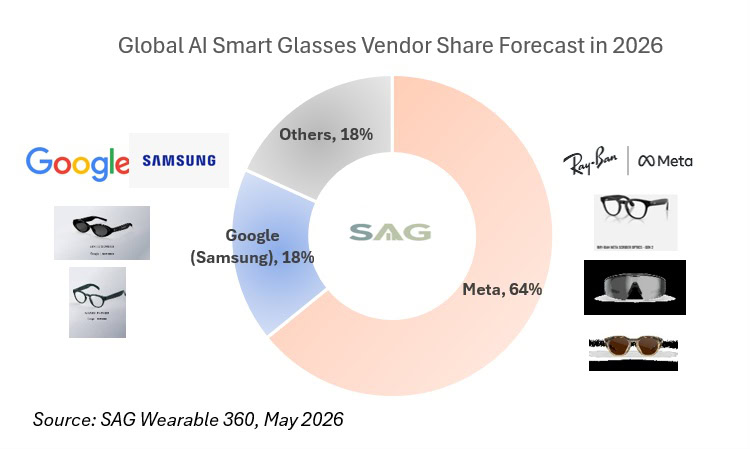
But Google isn’t trying to replicate Meta’s model—it’s aiming to surpass it. While Meta’s glasses are primarily communication tools, Google’s Android XR glasses are designed to be intelligent assistants. With Gemini’s contextual awareness and Google’s vast data ecosystem, they offer a more proactive, personalized experience.
They will support real-time translation in over 40 languages.
The glasses use a custom Android XR OS, optimized for low-power wearables.
Early prototypes include prescription lens compatibility.
Google plans to offer a subscription model for premium AI features.
Meta’s strength lies in social connectivity; Google’s lies in information and utility. This difference could define the next phase of the smart glasses war. Consumers may choose Meta for sharing moments and Google for getting things done.
The Road to 2 Million: What It Takes to Win
Selling 2 million units in a single year is no small feat—especially in a market still finding its footing. To achieve this, Google must overcome several hurdles: consumer skepticism, battery limitations, and the perennial question of “why do I need this?”
But the forecast from Smart Analytics Global suggests momentum is building. Early demos at Google I/O 2026 generated significant buzz, with attendees praising the glasses’ comfort, clarity, and AI responsiveness. Influencers and tech reviewers have called them “the first smart glasses that don’t feel like a prototype.”
Google is also betting on developer support. The Android XR platform will allow third-party apps to integrate with the glasses, creating new use cases—from fitness tracking to augmented reality gaming. This ecosystem approach could drive adoption beyond early adopters.
Ultimately, success will depend on whether consumers see value beyond novelty. If Google can position the glasses as essential tools—like smartphones were a decade ago—it could ignite a new wave of wearable adoption.
The Future of Wearable Intelligence
Google’s Android XR glasses represent more than a product launch—they’re a statement of intent. The company is betting that the future of computing isn’t on screens, but in our surroundings, mediated through intelligent, invisible interfaces.
If the forecasts hold, 2026 could mark the tipping point for smart glasses. With Google, Meta, and Apple all investing heavily in spatial computing, the race is on to define the next platform. And this time, Google isn’t just participating—it’s leading with fashion, AI, and a hard-learned humility.
The glasses may be small, but their implications are enormous. They could redefine how we work, learn, travel, and connect. And if Google gets it right, they might just become as common as smartphones—one stylish frame at a time.
This article was curated from Meta beware: Google could end up selling 2 million Android XR glasses this year via Android Authority