Table of Contents
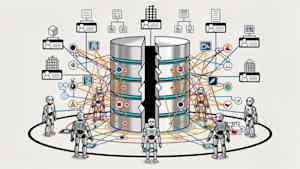
In the world of global commerce, few names carry the weight of Dun & Bradstreet. For nearly two centuries, the company has been the silent backbone of business intelligence, quietly powering credit decisions, supply chain risk assessments, and sales strategies for enterprises across industries. Its Commercial Graph—a sprawling digital ecosystem mapping 642 million businesses, their ownership structures, financial health, and interconnections—has long been the gold standard for commercial data. But as artificial intelligence began infiltrating corporate workflows, D&B faced an existential challenge: its masterpiece was built for humans, not machines.
The shift wasn’t just technological—it was philosophical. While human analysts could interpret ambiguous data, wait for slow queries, or manually resolve entity mismatches, AI agents demanded speed, precision, and real-time adaptability. When customers started deploying AI to automate credit evaluations, procurement decisions, and supply chain monitoring, D&B’s legacy architecture buckled. The system that had served nearly 200,000 clients for decades was suddenly obsolete. The company didn’t just patch the cracks—it tore down the walls and rebuilt from the ground up.
The Human-Centric Legacy of D&B
Dun & Bradstreet’s origins trace back to 1841, when Lewis Tappan launched the Mercantile Agency in New York to help merchants assess the creditworthiness of business partners. At a time when communication was slow and information scarce, Tappan’s network of local reporters provided handwritten reports on merchants’ reputations. This early system laid the foundation for what would become one of the most enduring data empires in history.
Over 180 years, D&B evolved from paper ledgers to digital databases, amassing a commercial graph that now includes not just company names and addresses, but 11,000 data fields per record—everything from payment histories and litigation records to supply chain dependencies and environmental risk scores. The database has nearly doubled in size over the past five years, expanding from over 300 million to 642 million business entities. This growth reflects the increasing complexity of global commerce, where multinational corporations operate through dozens of subsidiaries, joint ventures, and offshore entities.
Yet, despite its scale, the original architecture was never designed for automation. It was a patchwork of systems built for different markets and use cases—credit analysis in North America, procurement in Europe, sales intelligence in Asia—stitched together with custom integrations. Human analysts could navigate this fragmentation using SQL queries or pre-built dashboards, interpreting inconsistencies and resolving ambiguities on the fly. But AI agents, which operate at machine speed and require deterministic answers, found this environment chaotic and unreliable.
The AI Revolution Hits Commercial Data
The rise of AI agents in enterprise workflows marked a turning point. Companies began embedding intelligent systems into core operations—automating credit approvals, monitoring supplier risk in real time, and identifying sales leads with predictive analytics. These agents didn’t just need data; they needed instant, structured, and contextually rich information delivered at sub-second latency.
But D&B’s legacy systems couldn’t keep up. Queries that took minutes for human analysts were unacceptable for AI. Worse, the fragmented architecture meant that an AI agent querying a subsidiary’s ownership might get different results depending on which backend system it hit. In one instance, a procurement AI flagged a supplier as high-risk because it pulled data from a regional database that hadn’t been updated with a recent ownership change. The parent company, meanwhile, showed the supplier as low-risk in the global system. The discrepancy could have led to a costly contract cancellation—had a human not intervened.
“We realized we were serving two very different customer types,” said Gary Kotovets, Chief Data and Analytics Officer at D&B. “Our traditional users—credit analysts, sales teams—could tolerate some latency and ambiguity. But AI agents operate in a world of milliseconds and binary decisions. They can’t ‘figure it out.’ They need answers, now.”
This realization forced D&B to confront a fundamental truth: data built for humans is not data built for machines. The company’s Commercial Graph, once a triumph of human-centric design, had become a bottleneck in the age of automation.
Rebuilding for the Machine Age
The solution wasn’t incremental improvement—it was a complete architectural overhaul. D&B launched a multi-year initiative to rebuild its Commercial Graph from the ground up, with AI agents as a first-class consumer. The new system, dubbed D&B Compass, is designed for speed, consistency, and machine readability.
At the heart of the transformation is a unified data fabric that consolidates previously siloed systems into a single, real-time graph database. This allows AI agents to traverse corporate hierarchies, ownership chains, and risk relationships in milliseconds. Instead of querying separate databases for financials, litigation, and supply chain data, agents now access a single, synchronized source of truth.
But speed wasn’t the only challenge. AI agents also needed dynamic relationship modeling—the ability to track how changes in one part of the business ecosystem ripple through others. For example, when a CEO leaves a company, their track record and influence don’t vanish; they follow the executive to their new role. Similarly, when a subsidiary is sold, the risk profile of the parent company may shift. Legacy systems treated these as static links; the new architecture models them as living, evolving connections.
11,000 data fields per record
100 billion data quality checks performed monthly
5 years to nearly double the database size
Sub-second query response time required for AI agents
To achieve this, D&B implemented advanced graph algorithms that continuously update relationship weights based on real-world events—news reports, regulatory filings, transaction data. The system now runs approximately 100 billion data quality checks per month, ensuring that every record is accurate, current, and machine-ready.
The Ripple Effect Across Industries
The impact of D&B’s transformation extends far beyond its own systems. In the financial sector, banks are using AI agents to automate credit underwriting, reducing approval times from days to minutes. In procurement, companies like Siemens and Unilever have integrated D&B’s real-time risk data into their supplier monitoring platforms, flagging potential disruptions before they occur.
One notable example comes from a global manufacturing firm that used D&B’s updated graph to assess the risk of a key supplier in Southeast Asia. The AI agent detected a recent change in ownership and cross-referenced it with litigation records, revealing that the new parent company was involved in an environmental lawsuit. The manufacturer was able to diversify its supply chain before production was disrupted—saving an estimated $12 million in potential downtime.
The shift also benefits sales and marketing teams. AI-powered lead generation tools now use D&B’s enriched data to identify high-potential prospects based on firmographic signals, growth indicators, and relationship networks. A SaaS company, for instance, used the system to target mid-sized firms that had recently acquired a competitor—signaling expansion and increased IT spending.
The Broader Implications for Data Infrastructure
D&B’s journey underscores a broader trend in enterprise technology: the re-architecting of data systems for the AI era. Across industries, companies are discovering that databases built for human consumption—rich in context, tolerant of ambiguity, and optimized for visualization—are ill-suited for machine consumption.
This isn’t just a problem for commercial data providers. Healthcare systems, government agencies, and even social media platforms are grappling with similar challenges. Electronic health records, for example, were designed for doctors, not diagnostic AI. Similarly, public sector databases often lack the structure and real-time updates needed for automated policy enforcement.
The lesson from D&B is clear: to serve AI, data must be rethought from the ground up. It’s not enough to feed legacy data into machine learning models. The underlying infrastructure must be rebuilt for speed, consistency, and machine interpretability.
The concept of a “business graph” predates the internet. In the 1920s, D&B began mapping corporate relationships using paper files and index cards, creating one of the earliest forms of networked business intelligence.
Looking Ahead: The Future of Intelligent Data
As AI agents become more sophisticated, the demand for intelligent, real-time data will only grow. D&B’s rebuild is just the beginning. The company is now exploring predictive graph analytics, where AI not only queries relationships but anticipates future changes—such as predicting which companies are likely to default or which supply chains are at risk of disruption.
There’s also potential for decentralized data ecosystems, where businesses contribute anonymized transaction data to a shared network, enriching the graph while maintaining privacy. Blockchain technology could play a role here, ensuring data integrity and provenance.
Ultimately, D&B’s transformation reflects a larger shift in how we think about information. Data is no longer just a record of the past—it’s a dynamic, living system that powers the decisions of the future. And as AI becomes the primary consumer of that data, the companies that adapt will lead the next wave of innovation.
In rebuilding its Commercial Graph for machines, Dun & Bradstreet hasn’t just future-proofed its business—it has redefined what’s possible in the age of intelligent systems. The silent backbone of global commerce is now speaking the language of AI. And the conversation is just getting started.
This article was curated from D&B's database of 642 million businesses was built for humans, not AI agents. So they rebuilt it. via VentureBeat