Table of Contents
- The Weather Report from a World 700 Light-Years Away: JWST Reveals Cloudy Mornings and Clear Evenings on a Distant Gas Giant
- A Planet Frozen in Time: The Strange Reality of Tidal Locking
- A Giant Among Giants: The Unusual Size and Density of WASP-94A b
- The Power of Infrared: How JWST Peers Through the Cosmic Haze
- Clouds in the Morning, Clarity at Dusk: A New Model for Exoplanet Weather
- A Binary Star System: The Cosmic Dance That Shaped WASP-94A b
- The Bigger Picture: What This Means for the Search for Life
- Conclusion: A New Era of Exoplanet Meteorology
The Weather Report from a World 700 Light-Years Away: JWST Reveals Cloudy Mornings and Clear Evenings on a Distant Gas Giant
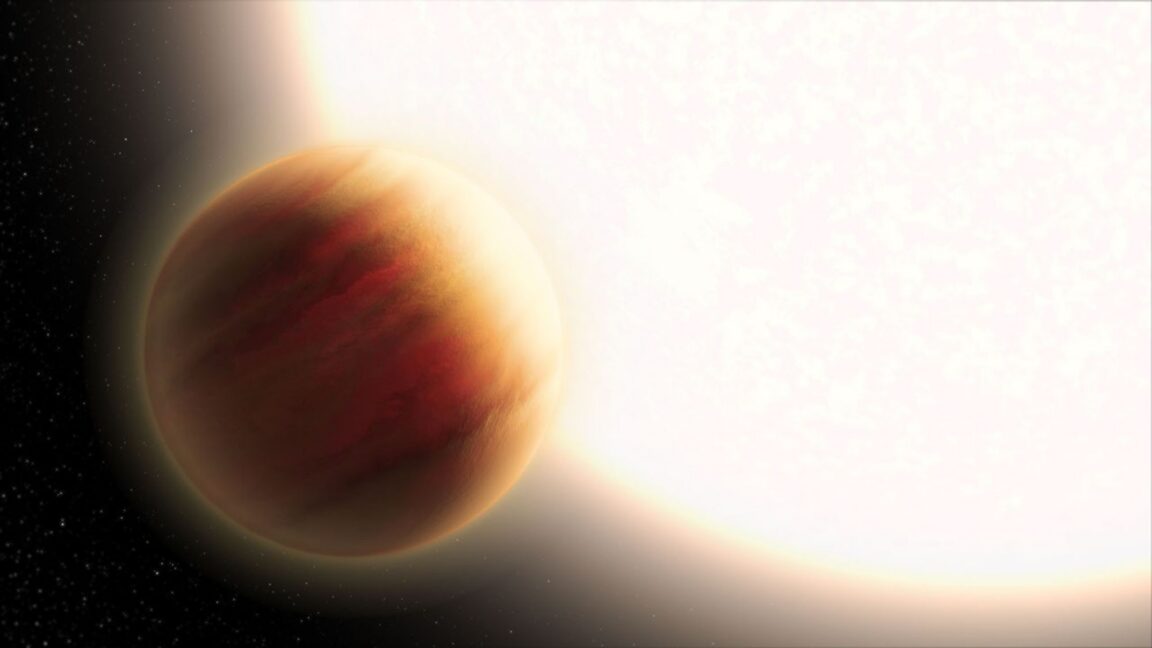
Imagine a planet where the sun never sets on one side, and never rises on the other. A world so close to its star that its year lasts less than two Earth days, where temperatures soar to over 1,500 degrees Celsius—hot enough to melt lead. Now imagine checking its weather forecast: Morning clouds, clearing by evening, with strong westward winds. This isn’t science fiction. Thanks to the James Webb Space Telescope (JWST), scientists have just delivered the first-ever detailed weather map of an exoplanet—WASP-94A b, a scorching gas giant located 690 light-years from Earth.
This groundbreaking discovery, published in the journal Science, offers an unprecedented look into the atmospheric dynamics of a distant world, challenging long-held assumptions about how exoplanet atmospheres behave. Led by astrophysicist Sagnick Mukherjee of Johns Hopkins University, the research team used JWST’s advanced infrared instruments to peer through the thick veil of space and decode the meteorological patterns of a planet that defies Earthly intuition.
A Planet Frozen in Time: The Strange Reality of Tidal Locking
WASP-94A b is a tidally locked planet, meaning one side perpetually faces its host star while the other remains in eternal darkness. This phenomenon, common among close-in exoplanets, creates extreme environmental contrasts. On Earth, day and night cycles drive weather through temperature differences that generate wind and storms. But on a tidally locked world, the usual rules don’t apply.
“We wanted to understand the atmospheres of such planets,” Mukherjee explains. “Are they static or dynamic? Do they have winds? Do they have clouds?” The assumption had been that such planets might have stagnant atmospheres, with hot air rising on the dayside and sinking on the nightside in a slow, predictable loop. But JWST revealed something far more complex.
Instead of a uniform climate, the team discovered a dynamic atmosphere with distinct weather patterns. The morning terminator—the boundary between night and day—is shrouded in thick clouds, while the evening side boasts clear skies. This asymmetry suggests powerful winds are transporting heat and moisture across the planet, creating a weather system unlike anything seen before.

A Giant Among Giants: The Unusual Size and Density of WASP-94A b
WASP-94A b is a true outlier in the planetary zoo. With a mass just under half that of Jupiter, it’s relatively lightweight for a gas giant. Yet its diameter is over 70% larger than Jupiter’s, making it one of the most inflated exoplanets known. This low density means its atmosphere stretches far into space, creating a puffy, extended envelope that’s easier for telescopes to probe.
“This means the planet has low density, and its atmosphere extends further out into space, which makes it easier to observe,” Mukherjee notes. This “puffy” nature acts like a cosmic magnifying glass, amplifying the signals JWST can detect. When the planet transits—passes in front of its star—starlight filters through its atmosphere, leaving behind chemical fingerprints in the spectrum.
This method, known as transmission spectroscopy, has been used for years to identify gases like water vapor, carbon dioxide, and methane in exoplanet atmospheres. But until now, most studies produced averaged atmospheric compositions, blending data from the entire limb of the planet. What JWST has achieved is far more precise: it captured time-resolved data, revealing how the atmosphere changes from one side to the other.
The Power of Infrared: How JWST Peers Through the Cosmic Haze
The James Webb Space Telescope’s superpower lies in its ability to observe in the infrared spectrum. Unlike visible light, infrared can penetrate dust, gas, and atmospheric haze, allowing scientists to detect heat signatures and molecular vibrations that are invisible to other telescopes.
For WASP-94A b, JWST used its Near-Infrared Spectrograph (NIRSpec) to monitor the planet during its transit. As the planet moved across the face of its star, the telescope captured subtle changes in the starlight’s spectrum. By comparing the light before, during, and after the transit, researchers could isolate the atmospheric signal.

But the real breakthrough came from analyzing the timing of these signals. The team noticed that certain wavelengths of light—those absorbed by water vapor—appeared stronger when the morning side of the planet was in view, and weaker when the evening side passed in front of the star. This indicated that clouds were blocking water vapor on the morning side, while the evening side had clearer skies.
“This asymmetry tells us the atmosphere is not uniform,” Mukherjee says. “It’s dynamic, with winds moving clouds and heat from one region to another.” The data suggests winds blow from the hot dayside toward the cooler nightside, but not in a simple loop. Instead, they appear to be deflected by the planet’s rapid rotation, creating complex circulation patterns.
The planet’s equilibrium temperature is approximately 1,530°C (2,786°F)—hotter than some stars.
Its atmosphere extends over 10,000 kilometers above the surface—nearly as wide as Earth itself.
JWST observed the planet for over 8 hours continuously, capturing multiple phases of its transit.
Clouds in the Morning, Clarity at Dusk: A New Model for Exoplanet Weather
The discovery that WASP-94A b has cloudy mornings and clear evenings颠覆了传统认知。Previously, scientists assumed that hot gas giants would have relatively uniform atmospheres, with clouds forming uniformly or not at all. But this planet’s weather pattern suggests a more nuanced reality.
The leading theory is that as air flows from the scorching dayside to the cooler nightside, it cools and condenses, forming clouds near the morning terminator. These clouds then evaporate as they move toward the evening side, where the atmosphere is slightly warmer due to residual heat. This creates a diurnal cycle—not of day and night, but of cloud formation and dissipation.
This finding has profound implications for how we interpret exoplanet atmospheres. If clouds are not evenly distributed, then previous studies using averaged data may have misidentified the chemical composition of these worlds. For example, water vapor might appear less abundant if clouds are blocking it on one side, leading to false negatives in detection.

“The fact that we didn’t know this already means we might have gotten the chemistry of this and many other exoplanets surprisingly wrong,” Mukherjee warns. This revelation underscores the importance of high-resolution, time-resolved observations—something only possible with JWST’s precision.
A Binary Star System: The Cosmic Dance That Shaped WASP-94A b
WASP-94A b doesn’t orbit just any star—it’s part of a binary system. Its host star, WASP-94A, has a companion star, WASP-94B, located about 350 astronomical units (AU) away—roughly nine times the distance between the Sun and Neptune. While the planet orbits only the primary star, the gravitational influence of the companion may have played a role in its formation and evolution.
Binary star systems are common in the galaxy, making up about half of all star systems. But planets in such systems face unique challenges. The gravitational tug-of-war can destabilize orbits, strip away atmospheres, or even eject planets into interstellar space. Yet WASP-94A b has survived, possibly because it formed far from the binary pair and migrated inward later.
“The presence of a companion star adds complexity to the system,” Mukherjee notes. “It could have influenced the planet’s migration or even its atmospheric composition through past interactions.” Future studies may reveal whether binary systems produce different types of planets than single-star systems.
The Bigger Picture: What This Means for the Search for Life
While WASP-94A b is far too hot and massive to host life, its weather patterns offer clues about atmospheric physics that could apply to more Earth-like worlds. Understanding how heat, wind, and clouds behave on extreme exoplanets helps scientists build better models for temperate, rocky planets—those that might harbor oceans, atmospheres, and potentially life.

Moreover, the techniques developed for this study can be applied to smaller, cooler exoplanets. JWST is already observing TRAPPIST-1’s seven Earth-sized planets, and future missions like the Nancy Grace Roman Space Telescope will expand our reach even further.
“Every planet we study teaches us something new about how atmospheres work,” Mukherjee says. “Even the most alien worlds have lessons to teach us about our own.”
Conclusion: A New Era of Exoplanet Meteorology
The weather report from WASP-94A b is more than just a curiosity—it’s a milestone in astronomy. For the first time, we’ve mapped the weather on a world beyond our solar system, revealing a dynamic, complex atmosphere shaped by extreme forces. Cloudy mornings, clear evenings, and supersonic winds paint a picture of a planet in constant motion, defying the static models of the past.
This discovery was made possible by the James Webb Space Telescope, a marvel of engineering that continues to rewrite the textbooks. As JWST peers deeper into the cosmos, we can expect more surprises—more alien weather, more unexpected chemistries, and perhaps, one day, signs of life.
In the grand tapestry of the universe, Earth’s weather may seem mundane. But on a scorching gas giant 700 light-years away, the skies tell a story of fire, wind, and clouds—a story we’ve only just begun to read.
This article was curated from JWST maps the weather on a hot gas giant 700 light-years away via Ars Technica – Science