Table of Contents
- The Power of Gravity: Shaping Objects from Dust to Worlds
- From Dwarf Planet to Gas Giant: The Mass Thresholds of Planetary Evolution
- The Stellar Threshold: When a Planet Becomes a Star
- Stellar Death and Rebirth: The Final Acts of Massive Stars
- The Exception That Proves the Rule: Why Black Holes Are Different
- The Cosmic Cycle: How Mass Shapes the Future of the Universe

The Cosmic Alchemy of Mass: How Adding Weight Transforms the Universe
From the tiniest pebble orbiting a distant star to the supermassive black hole anchoring the heart of a galaxy, the universe is a masterclass in transformation. But what if I told you that nearly every object in existence—from asteroids to stars, from planets to stellar corpses—can be fundamentally changed simply by adding more mass? It’s not magic. It’s physics. And the key to this cosmic alchemy lies in a single, elegant principle: mass dictates destiny.
Throughout the cosmos, objects don’t just happen. They evolve. And their evolution is governed by how much matter they contain. Whether it’s a wisp of interstellar gas or a collapsed star, the amount of mass determines everything—from shape and structure to temperature, luminosity, and even ultimate fate. This isn’t just a theory; it’s a universal law written in the fabric of spacetime. And the most astonishing part? You can transform almost any celestial body into something entirely new, just by piling on enough mass.
This article explores the profound role of mass in shaping the universe, from the birth of stars to the death of galaxies. We’ll journey through the thresholds that separate one type of object from another, uncovering the invisible lines that govern cosmic evolution. Along the way, we’ll discover how a humble asteroid can become a planet, how a failed star can ignite into brilliance, and how even the remnants of dead suns are subject to the relentless pull of gravity.
The Power of Gravity: Shaping Objects from Dust to Worlds
At the heart of cosmic transformation lies gravity—the silent architect of the universe. Gravity doesn’t care about chemistry or light; it only responds to mass. When enough matter gathers in one place, gravity begins to sculpt it. For small bodies—like asteroids or comets—gravity is too weak to overcome the rigidity of solid rock or ice. These objects remain lumpy, irregular, and chaotic in shape.
But once an object reaches a critical mass—typically around 500 kilometers in diameter for icy bodies and slightly larger for rocky ones—gravity wins. The object begins to pull itself into a sphere, achieving what scientists call hydrostatic equilibrium. This is the threshold where a celestial body becomes “round” due to its own gravity. Dwarf planets like Ceres and Pluto, along with moons like Earth’s Luna, all sit comfortably in this category.
The smallest known object in hydrostatic equilibrium is the asteroid Hygiea, about 430 km wide.
Over 100 moons in our Solar System are massive enough to be spherical.
Even some Kuiper Belt objects, like Makemake, are rounded by gravity despite their frigid temperatures.
This spherical transformation isn’t just cosmetic—it signals a fundamental shift in an object’s internal structure. Once rounded, a body can develop layered interiors: a dense core, a mantle, and possibly even a subsurface ocean. Earth’s Moon, for example, has a small iron core and a silicate mantle, all shaped by the gravitational forces that acted over billions of years.
From Dwarf Planet to Gas Giant: The Mass Thresholds of Planetary Evolution
Once an object becomes spherical, the next question is: what kind of world is it? Here, mass continues to play the starring role. Rocky planets like Earth and Mars formed in the inner Solar System, where temperatures were high enough to allow metals and silicates to condense. But even among rocky bodies, mass determines atmosphere, tectonics, and magnetic fields.
Take Mars, for instance. With only 11% of Earth’s mass, Mars lacks the gravitational pull to retain a thick atmosphere. Its weak magnetic field and thin air led to the evaporation of surface water billions of years ago. In contrast, Earth’s greater mass allowed it to hold onto water, sustain plate tectonics, and maintain a protective magnetic shield.
But the real transformation begins when a planet grows massive enough to capture vast amounts of hydrogen and helium from the protoplanetary disk. This is the birth of a gas giant. Jupiter, with a mass 318 times that of Earth, didn’t just grow—it dominated. Its immense gravity pulled in gas from across the Solar System, becoming the largest planet by far.
Gas giants don’t stop there. Add even more mass, and you approach the boundary of brown dwarfs—objects too massive to be planets but not quite massive enough to sustain hydrogen fusion like stars. Brown dwarfs occupy a gray zone between 13 and 80 times the mass of Jupiter. They glow faintly from residual heat and can briefly fuse deuterium (a heavy isotope of hydrogen), but they never achieve full stellar status.
The Stellar Threshold: When a Planet Becomes a Star
The moment an object crosses the 80-Jupiter-mass threshold, something miraculous happens: nuclear fusion ignites in its core. Hydrogen atoms begin to fuse into helium, releasing enormous amounts of energy in the form of light and heat. The object is no longer a planet or a brown dwarf—it’s a star.
This transition is one of the most dramatic in astrophysics. A brown dwarf might shine dimly for a few million years, but a true star can burn for billions. Our Sun, a modest yellow dwarf, has been fusing hydrogen for 4.6 billion years and will continue for another 5 billion.
But not all stars are created equal. The more massive a star, the hotter, brighter, and shorter-lived it becomes. A star with 20 times the Sun’s mass will burn through its fuel in just 10 million years—a cosmic blink of an eye. In contrast, a red dwarf with only 10% of the Sun’s mass can shine for trillions of years, outlasting the current age of the universe many times over.
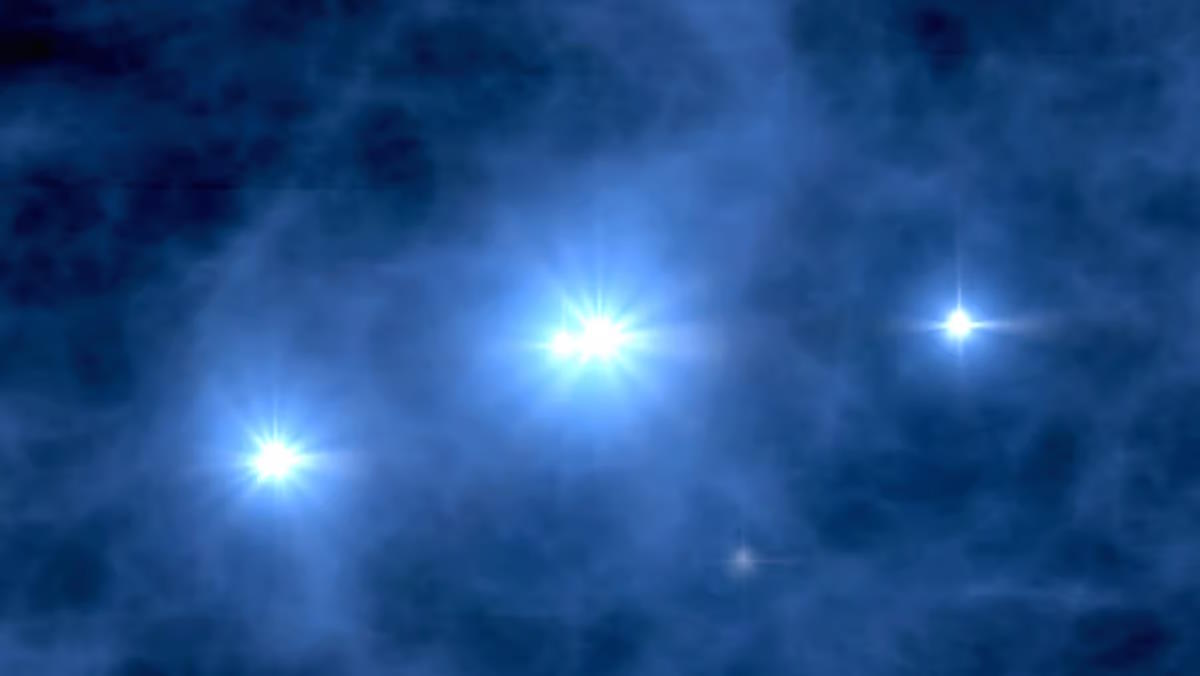
The formation of the first stars in the universe was even more extreme. Without heavy elements to help cool collapsing gas clouds, only the most massive clumps could form stars. These primordial giants—some over 100 times the mass of the Sun—lived fast, died young, and seeded the cosmos with the elements necessary for planets, life, and everything in between.
Stellar Death and Rebirth: The Final Acts of Massive Stars
When a star exhausts its nuclear fuel, its fate is sealed—but once again, mass decides the outcome. Low-mass stars like the Sun end their lives as white dwarfs, Earth-sized remnants made of degenerate matter that slowly cool over billions of years.

But for stars above 8 solar masses, the end is far more violent. These stars explode as supernovae, blasting their outer layers into space and leaving behind an ultra-dense core. If the core is between 1.4 and 3 solar masses, it becomes a neutron star—a city-sized object so dense that a teaspoon of its material would weigh billions of tons.
Add even more mass—beyond 3 solar masses—and gravity overwhelms all known forces. The core collapses into a black hole, a region of spacetime where gravity is so intense that not even light can escape.
Black holes are the ultimate endpoint of mass-driven evolution. Unlike other objects, you can’t “upgrade” a black hole into something else by adding mass—you can only make it bigger. But even here, mass plays a role: stellar-mass black holes (3–20 solar masses) form from dying stars, while supermassive black holes (millions to billions of solar masses) likely grow through mergers and accretion over cosmic time.
The Exception That Proves the Rule: Why Black Holes Are Different
While nearly every celestial object can be transformed by adding mass, black holes stand apart. You can’t turn a black hole into a star, a planet, or anything else—only into a larger black hole. This is because a black hole is not made of matter in the traditional sense. It’s a region of spacetime defined by its event horizon, the point of no return.

Once matter crosses this boundary, it adds to the black hole’s mass, increasing its gravitational pull and expanding the event horizon. But the original matter is lost to observation, compressed into a singularity at the center. There’s no fusion, no structure, no light—just gravity.
This uniqueness makes black holes the final stage in the mass-driven evolution of matter. They are the universe’s ultimate recyclers, consuming stars, gas, and even other black holes. And yet, they remain enigmatic—regions where our understanding of physics breaks down.
The Cosmic Cycle: How Mass Shapes the Future of the Universe
The story of mass isn’t just about individual objects—it’s about the universe as a whole. Every star that forms, burns, and dies contributes to the next generation of cosmic structures. The heavy elements forged in stellar cores—carbon, oxygen, iron—are scattered by supernovae, enriching interstellar clouds and enabling the formation of rocky planets and, eventually, life.
Even now, in distant galaxies, new stars are being born from clouds of gas and dust, their masses determining their lifespans and fates. Some will become black holes; others will live for trillions of years. And in the far future, as the universe expands and cools, only the smallest, longest-lived stars will remain—red dwarfs burning dimly in the cosmic dark.
Mass is the silent conductor of this cosmic symphony. It shapes galaxies, ignites stars, and governs the life cycles of planets. And while we may never witness the full transformation of an asteroid into a star, the principles are clear: add enough mass, and anything can change.
In the end, the universe isn’t just made of matter and energy—it’s a dynamic, evolving system where mass is the master variable. From the first stars to the final black holes, the story of everything is written in the language of gravity, fusion, and transformation. And it all begins with one simple truth: mass makes the universe go round.
This article was curated from Everything in the Universe changes by adding enough mass via Big Think