Table of Contents
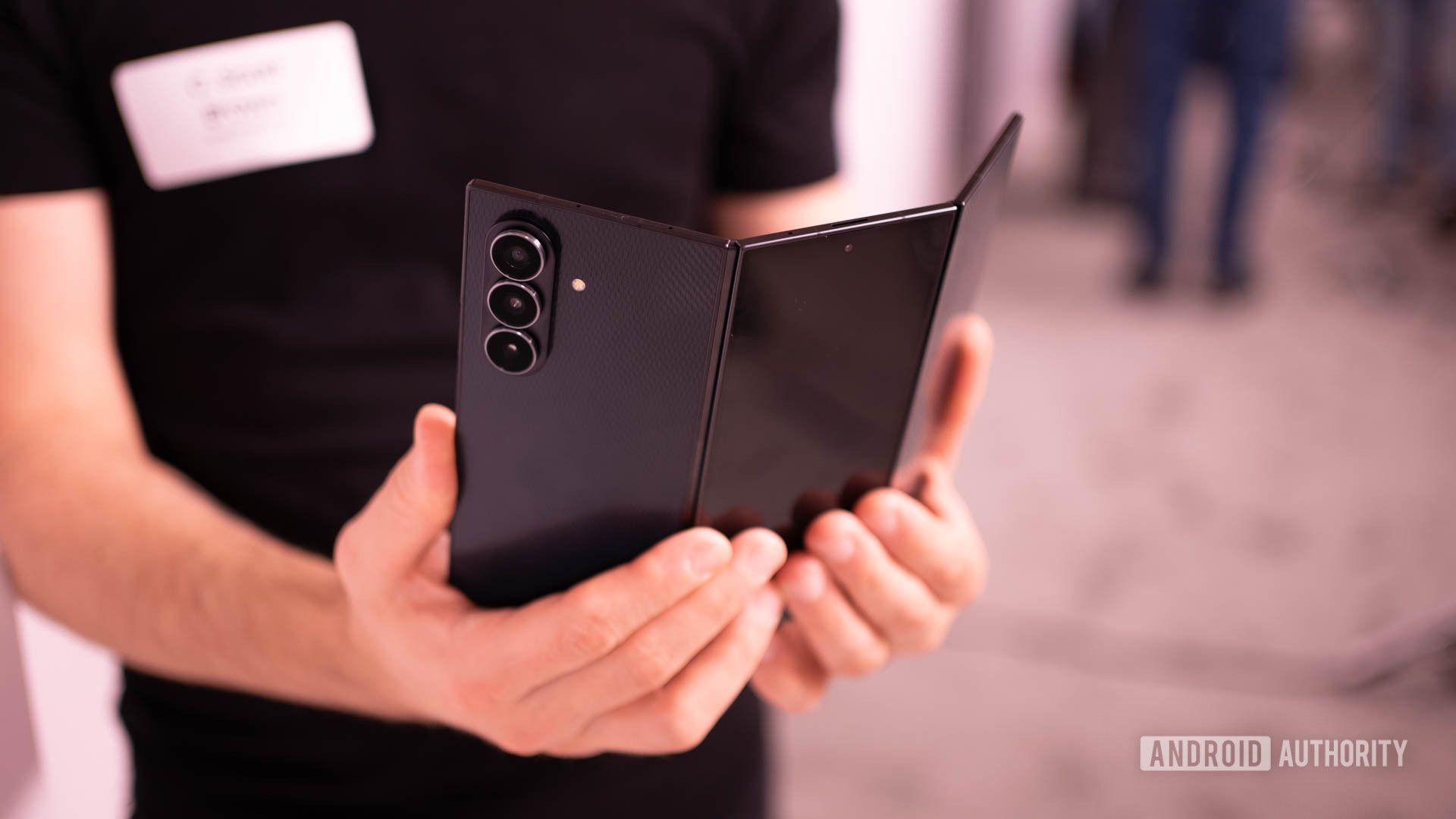
The Galaxy Z TriFold Was a Flash in the Pan—But Its Heir Is Already on the Horizon
When Samsung unveiled the Galaxy Z TriFold in late 2023, it wasn’t just launching another smartphone—it was introducing a glimpse into the future of mobile computing. With a jaw-dropping 10-inch unfolded display and a tri-fold design that collapsed into a pocketable form, the device was a technological marvel. Yet, despite its innovation, the Galaxy Z TriFold vanished almost as quickly as it appeared. After a brief window of availability and a final “last-call” sale in April 2024, Samsung confirmed the device is now completely sold out. But don’t mourn its passing just yet—rumors suggest its successor, the Galaxy Z TriFold 2, is already in development, promising to refine the original’s bold vision with a sleeker, smarter hinge system.
This isn’t just about another foldable phone. It’s about the evolution of a category that’s still finding its footing. The original Galaxy Z TriFold was a limited-run experiment, a high-risk, high-reward bet on the future of flexible displays. Now, with the lessons learned from that experiment, Samsung appears ready to double down—this time with a more refined, consumer-ready iteration.
The original TriFold’s limited availability wasn’t just a marketing gimmick—it was a strategic move. Samsung produced only a few thousand units, targeting early adopters, tech influencers, and collectors. The device quickly became a status symbol, with resale prices on secondary markets soaring past $5,000. But its scarcity also highlighted a key challenge: manufacturing complexity. The tri-fold design required not one, but two hinges, each needing to endure thousands of folds without degrading the delicate OLED panel. The result was a device that was not only expensive—priced at $4,500 at launch—but also thick and heavy, weighing in at over 300 grams.
Despite these challenges, the TriFold’s impact was undeniable. It demonstrated that consumers are willing to pay a premium for transformative form factors, especially when those forms unlock new use cases. From multitasking across three app panes to using the device as a portable tablet for sketching or reading, the TriFold offered a glimpse of a post-smartphone era.
A Hinge That Could Change Everything
At the heart of the rumored Galaxy Z TriFold 2 is a redesigned hinge—a seemingly small component that could make a world of difference. The hinge is arguably the most critical part of any foldable device. It’s the mechanical soul of the phone, responsible for smooth folding, structural integrity, and long-term durability. In the original TriFold, the dual-hinge system was robust but bulky, contributing significantly to the device’s thickness and weight.
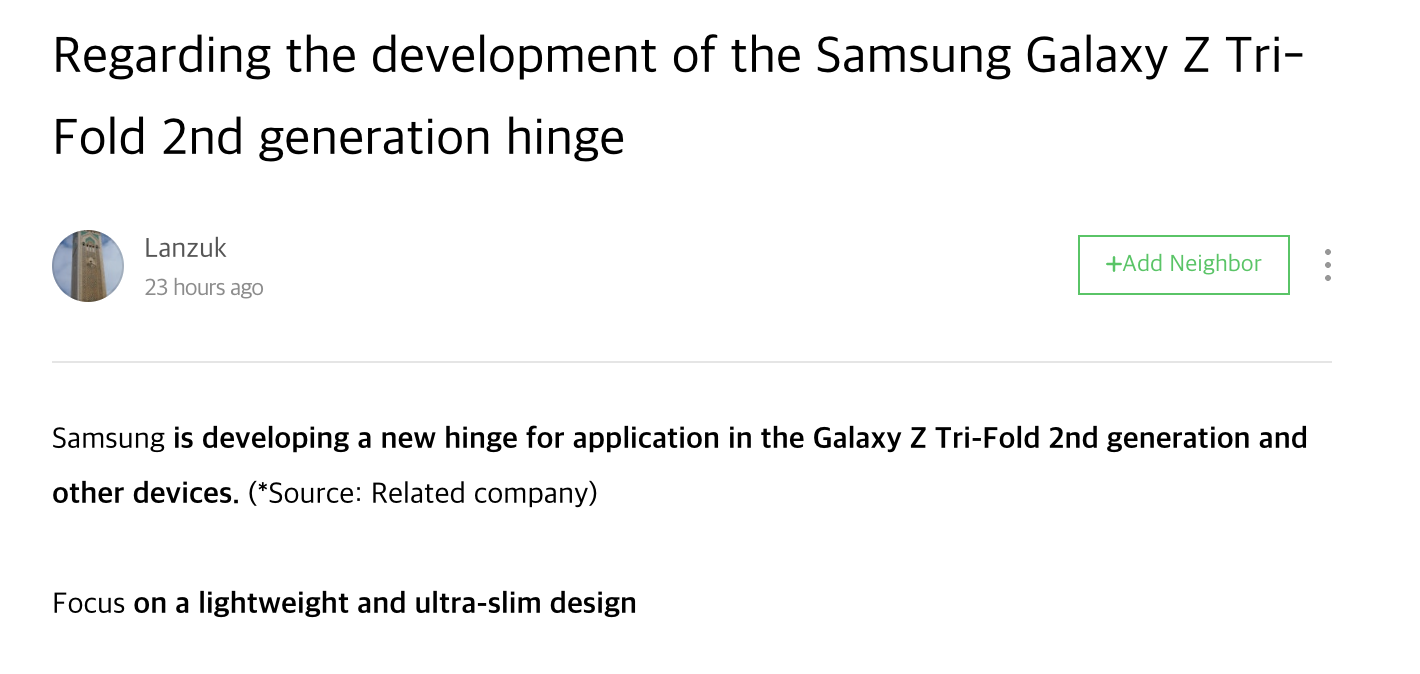
Leaker Lanzuk (known online as yeux1122) has hinted that Samsung is working on a new hinge mechanism specifically for the TriFold 2. While details remain scarce, the goal is clear: reduce both thickness and weight without sacrificing durability. Industry insiders suggest the new hinge could use advanced materials like titanium alloys or carbon fiber composites, which offer high strength with minimal bulk. Additionally, Samsung may be adopting a “teardrop” hinge design—similar to what we’ve seen in the Galaxy Z Fold 5 and Z Flip 5—which creates a curved fold that reduces stress on the display.
The implications of a lighter, thinner TriFold 2 are profound. For one, it would make the device more practical for daily use. The original model was impressive but unwieldy—imagine carrying a small tablet that doubles as your phone, but feels like a brick in your pocket. A sleeker design could finally bridge the gap between innovation and usability. Moreover, a refined hinge could lower production costs, potentially allowing Samsung to price the TriFold 2 closer to the $3,000 mark—still premium, but more accessible than its predecessor.
But Samsung’s ambitions may extend beyond the TriFold line. Rumors suggest that elements of this new hinge technology could trickle down to the more mainstream Galaxy Z Fold and Z Flip series. A less advanced version of the mechanism might appear in the Galaxy Z Fold 7 or Z Flip 7, helping Samsung maintain its lead in the foldable market. This kind of vertical integration—using cutting-edge tech in niche products before refining it for mass adoption—is a hallmark of Samsung’s strategy.

Why the TriFold Matters in the Foldable Ecosystem
At first glance, the Galaxy Z TriFold seems like a niche product—one for tech enthusiasts and deep-pocketed collectors. But its significance goes far beyond its limited run. The TriFold represents a bold experiment in form factor innovation, pushing the boundaries of what a smartphone can be. In a market where most foldables are either clamshells (like the Z Flip) or book-style (like the Z Fold), the TriFold introduced a third archetype: the multi-panel foldable.
This design isn’t just about screen real estate—it’s about rethinking how we interact with mobile devices. With three panels, users can run three apps simultaneously, each in its own dedicated space. Imagine watching a video on one screen, taking notes on another, and browsing the web on the third—all without switching windows or resizing apps. This kind of multitasking could be a game-changer for professionals, students, and creatives.
Moreover, the TriFold’s design hints at a future where phones aren’t just phones—they’re modular computing platforms. As 5G, AI, and cloud computing evolve, the need for larger, more versatile screens will grow. The TriFold is a stepping stone toward that future, proving that consumers are ready for devices that adapt to their needs, not the other way around.
But the TriFold also highlights the risks of innovation. Its high price, limited availability, and mechanical complexity made it a tough sell for the average consumer. Samsung’s decision to discontinue it after a single run suggests that even the world’s largest smartphone maker isn’t immune to the challenges of pioneering new form factors. Still, the lessons learned from the TriFold are invaluable. They’re shaping the next generation of foldables—not just at Samsung, but across the industry.

The Engineering Behind the Fold
To understand why the hinge is so crucial, it helps to look at the engineering challenges Samsung faced with the original TriFold. Flexible OLED displays are incredibly delicate. They’re made of multiple layers—including a plastic substrate, organic light-emitting diodes, and a thin-film encapsulation layer—that must remain intact through thousands of folds. Any sharp bend or uneven pressure can cause micro-cracks, leading to dead pixels or complete failure.
The hinge must therefore distribute stress evenly across the fold, prevent dust and debris from entering the mechanism, and maintain a smooth, consistent motion. In the original TriFold, Samsung used a dual-hinge system with metal gears and polymer dampers. While effective, it added bulk and weight. The new hinge rumored for the TriFold 2 could use a single, more sophisticated mechanism that folds the display in a continuous curve—similar to how a piece of paper folds naturally.
This kind of innovation doesn’t happen overnight. It requires years of R&D, materials science breakthroughs, and user testing. Samsung’s investment in foldable technology is estimated to exceed $10 billion over the past decade. That investment is now paying off, not just in consumer products, but in patents and manufacturing expertise that could give Samsung a lasting advantage.
The Future of Foldables: Beyond the TriFold
While the Galaxy Z TriFold 2 is generating buzz, it’s important to remember that it’s just one piece of a much larger puzzle. The future of foldables isn’t about a single device—it’s about an ecosystem of form factors, each tailored to different needs. Samsung’s broader foldable lineup already includes the Z Fold for productivity, the Z Flip for style and portability, and now, potentially, the TriFold for immersive multitasking.
But competitors aren’t standing still. Huawei, Xiaomi, and Motorola have all released their own foldables, and Apple is widely rumored to be working on a foldable iPhone. Google’s Android 14 introduced new APIs specifically for foldable devices, enabling better app continuity and multi-window support. These developments suggest that foldables are no longer a niche curiosity—they’re becoming a mainstream category.
The average foldable phone can withstand over 200,000 folds—equivalent to 10 years of daily use.
The Galaxy Z Fold 5’s hinge uses 67 individual components, including springs, gears, and sensors.
Flexible OLED displays can bend to a radius as small as 1.5mm without damage.
Samsung’s foldable factory in Vietnam can produce over 1 million foldable phones per month.
In this context, the Galaxy Z TriFold 2 isn’t just a successor—it’s a statement. It signals that Samsung is committed to pushing the envelope, even if it means taking risks. And with a redesigned hinge that promises to make the device thinner, lighter, and more durable, the TriFold 2 could finally deliver on the original’s promise.
As we look ahead, the real question isn’t whether the TriFold 2 will succeed—it’s whether foldables as a whole can evolve from novelties into necessities. With the right balance of innovation, usability, and affordability, the answer might just be yes. And Samsung, once again, is leading the charge.
This article was curated from Missed your shot at a Galaxy Z TriFold? A successor could be in the works with a new hinge via Android Authority