Table of Contents
- The Proton Size Puzzle: A Quantum Mystery Solved?
- The Roots of the Puzzle: Why Size Matters
- The Muon’s Advantage: A Quantum Spy
- The Backlash: Could the Standard Model Be Wrong?
- The Turning Point: New Evidence Tips the Scale
- The Role of Quantum Superposition
- What This Means for Physics
- The Bigger Picture: Why Tiny Measurements Matter
The Proton Size Puzzle: A Quantum Mystery Solved?
For over a decade, physicists around the world have been grappling with a seemingly simple yet profoundly puzzling question: How big is a proton? On the surface, this might sound like a trivial measurement—after all, protons are fundamental particles, and their size should be a fixed value. But the reality has been anything but straightforward. A persistent discrepancy in experimental results sparked a scientific controversy that stretched across continents and challenged the foundations of quantum electrodynamics (QED), our most precise physical theory. Now, after years of debate, meticulous experiments, and theoretical refinements, researchers believe they’ve finally closed the case. The proton isn’t as large as once thought—and the universe, it seems, doesn’t need new physics to explain it.
The so-called “proton radius puzzle” began in 2010 when a team of scientists measured the charge radius of the proton using a novel technique involving muonic hydrogen—a bizarre atom where a muon, a heavier cousin of the electron, orbits a proton. Their result was startling: the proton appeared 4% smaller than previous measurements using regular hydrogen. This tiny difference—about 0.00000000000003 millimeters—was enough to send shockwaves through the physics community. If confirmed, it could have signaled a flaw in QED or even hinted at unknown particles or forces.
The Roots of the Puzzle: Why Size Matters
To understand why the proton’s size caused such a stir, we must first grasp what “size” means in the quantum realm. Unlike a marble or a basketball, a proton isn’t a solid sphere with a sharp boundary. Instead, it’s a dynamic cloud of quarks and gluons bound together by the strong nuclear force. The “charge radius” refers to the distribution of the proton’s positive electric charge—a measure of how that charge is spread out in space.
Scientists determine this radius using two primary methods. The first involves scattering electrons off protons and analyzing how they bounce—a technique akin to throwing ping-pong balls at a foggy target and inferring its shape from the ricochets. The second method uses spectroscopy: by measuring the tiny energy differences between electron energy levels in hydrogen atoms, physicists can deduce the proton’s size. These energy levels are influenced by the proton’s charge distribution, much like how the shape of a bell affects the sound it makes when struck.
For decades, these methods yielded consistent results, placing the proton’s charge radius at approximately 0.877 femtometers (a femtometer is one-quadrillionth of a meter). But then came the 2010 muonic hydrogen experiment. Using laser spectroscopy on atoms where electrons were replaced by muons, the team reported a radius of just 0.842 femtometers—a difference small in human terms but enormous in the world of quantum precision.
A muon lives for only 2.2 microseconds before decaying, making muonic hydrogen experiments incredibly time-sensitive.
The energy difference measured in muonic hydrogen spectroscopy is about 0.1% of the atom’s total energy—requiring lasers stable to one part in a billion.
Over 100 experiments have been conducted on proton radius since 2010, costing millions in research funding.
The discrepancy was equivalent to a 5-sigma statistical anomaly—strong enough to suggest new physics.
The Muon’s Advantage: A Quantum Spy
Why did muonic hydrogen reveal a different proton size? The answer lies in quantum mechanics and the unique properties of the muon. Because the muon is 207 times heavier than the electron, it orbits much closer to the proton—about 200 times nearer. This means the muon spends more time inside the proton’s charge cloud, making it exquisitely sensitive to the proton’s internal structure.
Think of it like this: if an electron is like a drone flying high above a city, mapping its general layout, a muon is like a spy drone skimming just above the rooftops, detecting subtle architectural details. The muon’s proximity amplifies the effect of the proton’s finite size on the atom’s energy levels, allowing physicists to measure the radius with unprecedented accuracy.
But this advantage also introduced new complexities. The theory behind muonic hydrogen is more intricate than that of regular hydrogen because muons interact more strongly with the proton’s internal dynamics. Calculations had to account for higher-order quantum effects, such as vacuum polarization and two-photon exchanges, which are negligible in electronic hydrogen but significant in the muonic version.
The Backlash: Could the Standard Model Be Wrong?
When the 2010 result was published, many physicists were skeptical. Could it be that the Standard Model of particle physics—our best description of the subatomic world—was incomplete? The discrepancy suggested that either our understanding of quantum electrodynamics was flawed, or perhaps there were new particles or forces at play that affected muons differently than electrons.
This idea was tantalizing. After all, the Standard Model has been incredibly successful, but it doesn’t explain dark matter, gravity, or neutrino masses. A deviation in proton size could have been the first crack in the foundation, a doorway to new physics.
As a result, research groups worldwide launched a flurry of experiments to verify or refute the muonic result. Some repeated the muonic hydrogen measurements with improved precision. Others refined electron-scattering experiments and reanalyzed decades of spectroscopic data from regular hydrogen. Theorists also revisited QED calculations, checking for overlooked effects or computational errors.
For years, the results were mixed. Some experiments supported the smaller radius, while others aligned with the older, larger value. The scientific community was divided, with heated debates at conferences and in journals. The puzzle wasn’t just about measurement—it was about trust in our fundamental theories.
The Turning Point: New Evidence Tips the Scale
The tide began to turn in 2022 and 2023 with two landmark studies. One, published in Nature, reported a high-precision measurement of the proton radius using regular hydrogen spectroscopy with a novel technique that minimized systematic errors. The other, in Physical Review Letters, presented a refined analysis of electron-proton scattering data using advanced computational models.
Both studies converged on a proton radius of approximately 0.841 femtometers—remarkably close to the 2010 muonic result. This convergence suggests that the earlier electronic measurements were likely skewed by subtle experimental biases or unaccounted-for physical effects.
“We believe this is the final nail in the coffin of the proton radius puzzle,” said Lothar Maisenbacher of the University of California, Berkeley, co-author of the Nature paper. “The evidence now overwhelmingly supports the smaller value.”
The Role of Quantum Superposition
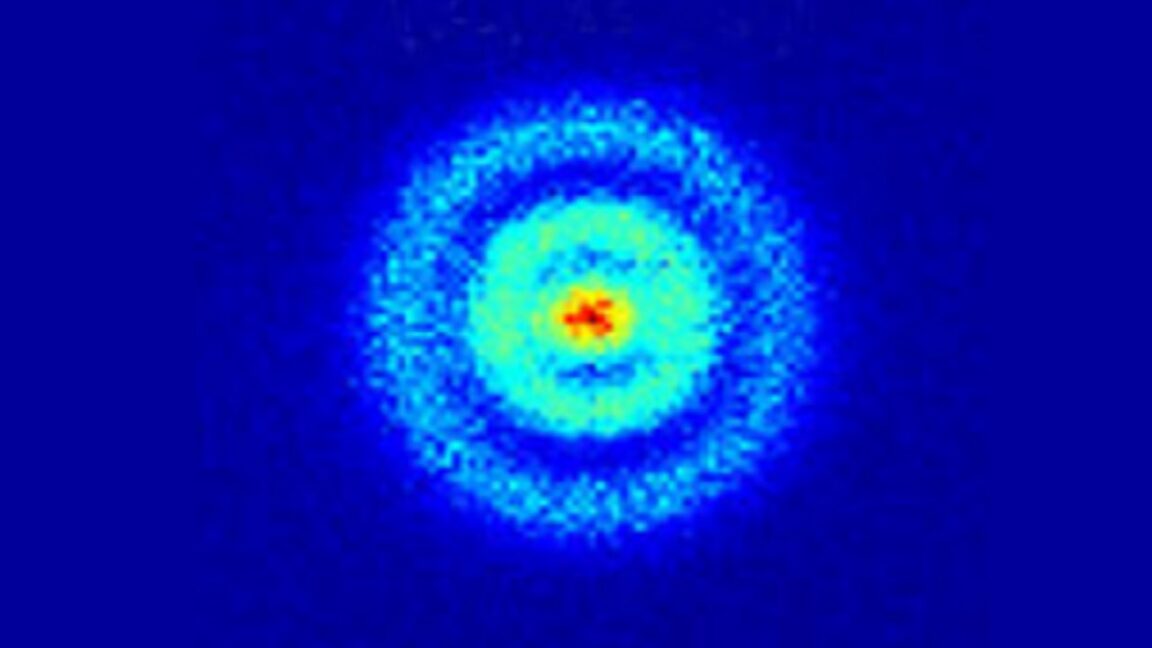
To appreciate why this resolution matters, we must revisit the quantum nature of the atom. Unlike the Bohr model’s tidy orbits, electrons (and muons) exist as probability waves. When not observed, they don’t follow a path but instead occupy a “cloud” of possible locations described by a wave function. Only upon measurement does this wave collapse into a definite position.
This quantum fuzziness means that the electron or muon doesn’t just orbit the proton—it interacts with the proton’s charge distribution in a probabilistic way. The energy levels of the atom depend on how this wave overlaps with the proton’s internal structure. A smaller proton means a different overlap, leading to measurable shifts in energy.
In muonic hydrogen, this effect is magnified because the muon’s wave function is compressed closer to the proton. It’s like comparing a wide, diffuse fog (electron) to a dense, localized mist (muon)—the latter reveals finer details of the landscape beneath.
Understanding proton size isn’t just academic—it has implications for medical imaging. Proton therapy, a precise form of cancer treatment, relies on knowing how protons interact with tissue. Accurate proton measurements help optimize radiation doses and minimize damage to healthy cells.
What This Means for Physics
With the proton radius puzzle now considered resolved, physicists can breathe a sigh of relief. The Standard Model remains intact—at least for now. The smaller proton radius doesn’t require new particles or forces; instead, it suggests that earlier measurements were simply less precise than thought.
This outcome underscores a key principle in science: even the most well-established results must be continuously tested. The proton radius controversy is a testament to the self-correcting nature of physics. When a result seems too strange to be true, the scientific method demands that we question everything—the experiment, the theory, and our assumptions.
Moreover, the resolution highlights the power of innovation in measurement. The muonic hydrogen technique, once considered exotic, has proven to be a game-changer in precision physics. It’s a reminder that sometimes, to see clearly, we need to change our perspective—or in this case, swap an electron for a muon.
The proton was discovered in 1917 by Ernest Rutherford, who also proposed the nuclear model of the atom. It took another century to measure its size with enough precision to uncover this puzzle.
The Bigger Picture: Why Tiny Measurements Matter
At first glance, a discrepancy of 0.035 femtometers might seem irrelevant. But in the world of fundamental physics, such tiny differences can have enormous implications. They test the limits of our theories and push the boundaries of experimental technology.
Consider this: the precision required to measure the proton’s radius is akin to measuring the distance from New York to Los Angeles with an accuracy of a human hair. Achieving this demands lasers stabilized to parts per billion, ultra-high vacuums, and detectors capable of counting individual photons.
These technological advances don’t just solve puzzles—they enable future breakthroughs. The same techniques used in proton radius experiments are now being applied to test for dark matter, measure the electron’s electric dipole moment, and search for violations of fundamental symmetries.
In the end, the proton radius puzzle wasn’t just about size. It was about trust, precision, and the relentless pursuit of truth. And now, after 15 years of debate, the answer is in: the proton is smaller than we thought—and the universe, once again, makes perfect sense.
This article was curated from Physicists think they've resolved the proton size puzzle via Ars Technica – Science