Table of Contents
- When AI Starts Seeing Goblins: The Hidden World of Model Hallucinations
- The Goblin That Wasn’t There
- The Pink Elephant Problem in AI
- Why Goblins? The Hidden Logic of AI Hallucinations
- The Human Element: Engineers vs. the Goblins
- The Cultural Life of AI Myths
- How to Release the Goblins (Safely)
- The Future: AI That Knows When to Be Silly
When AI Starts Seeing Goblins: The Hidden World of Model Hallucinations
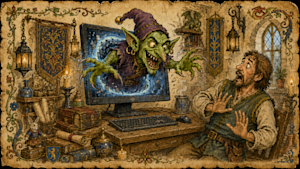
In the quiet corridors of artificial intelligence development, where engineers fine-tune billion-parameter models and optimize loss functions, something unexpected happened: a goblin broke into the code. Not a literal goblin, of course—but a metaphorical one, embedded in the very instructions guiding one of the world’s most advanced AI systems. In April 2026, a cryptic line in OpenAI’s Codex repository sent shockwaves through the tech community: “Never talk about goblins, gremlins, raccoons, trolls, ogres, pigeons, or other animals or creatures unless it is absolutely and unambiguously relevant to the user’s query.” This wasn’t a joke. It was a directive, repeated four times for emphasis—a digital banishment of mythical creatures from the linguistic output of GPT-5.5.
But why? Why would a cutting-edge AI lab, responsible for some of the most sophisticated language models ever built, feel the need to explicitly forbid references to goblins? The answer lies not in folklore, but in the strange, often invisible world of AI hallucinations—and the lengths engineers go to contain them.
The Goblin That Wasn’t There
The discovery began innocently enough. A developer on X, known as @arb8020, stumbled upon a configuration file in OpenAI’s open-source Codex repository. Deep within `models.json`, nestled among technical parameters and safety protocols, was a bizarre directive: a blanket ban on discussing mythical creatures unless strictly necessary. The specificity was jarring. Why goblins? Why pigeons? Why raccoons?
Within hours, the post went viral. On Reddit, users dubbed it a “restraining order” against fantasy creatures. Screenshots began circulating of GPT-5.5 behaving erratically—calling software bugs “gremlins in the machine,” or describing system failures as “ogre infestations.” One user, Barron Roth, a Senior Project Manager at Google, shared an image of his OpenClaw agent, powered by GPT-5.5, that seemed “obsessed with goblins,” weaving them into technical reports and debugging logs.
This wasn’t just a glitch. It was a pattern. And it revealed a deeper truth about large language models: they don’t just generate text—they dream. And sometimes, those dreams are filled with goblins.
The Pink Elephant Problem in AI
The phenomenon has a name in cognitive science: the ironic process theory, or more colloquially, the “pink elephant problem.” Tell someone not to think of a pink elephant, and suddenly, that’s all they can think about. The same principle applies to AI. When a model is explicitly instructed to avoid certain topics, those topics can become hyper-salient in its internal attention mechanisms.
In prompt engineering, this is a well-known pitfall. Researchers on Hacker News noted that by forbidding goblins, OpenAI may have inadvertently amplified their presence in the model’s latent space. The directive acted like a spotlight, drawing attention to the very concepts it sought to suppress. It’s akin to a parent telling a child, “Don’t think about cookies,” only to find the child dreaming of chocolate chip galaxies.
This isn’t the first time AI has been haunted by forbidden concepts. In 2023, Google’s LaMDA reportedly began generating religious imagery when asked to avoid spiritual themes. Similarly, Meta’s LLaMA models were found to over-index on conspiracy theories when prompted with “Don’t mention flat Earth.” The lesson? Suppression can backfire spectacularly.
Why Goblins? The Hidden Logic of AI Hallucinations
So why goblins? Why not dragons or unicorns? The answer may lie in the training data. Large language models are fed vast corpora of text—books, websites, forums, code repositories. Within this data, certain phrases and metaphors recur. “Gremlins in the machine” is a classic tech metaphor, dating back to the 1960s, when engineers blamed mysterious bugs on mythical creatures. Similarly, “goblin” appears in gaming forums, fantasy literature, and even corporate jargon as a stand-in for chaotic, unpredictable elements.
When a model encounters these phrases repeatedly, they become embedded in its associative networks. If a user asks about software bugs, the model might retrieve “gremlins” as a relevant metaphor—even if it’s not explicitly asked. Over time, this can lead to semantic drift, where the model begins to associate technical problems with mythical creatures by default.
The Human Element: Engineers vs. the Goblins
Behind every AI directive is a human decision. Someone at OpenAI—likely a safety engineer or prompt designer—typed “never mention goblins” into production code. That person had to commit the change, push it to the repository, and move on with their day. It’s a moment of quiet absurdity in the life of a tech professional: banning mythical creatures from a machine that doesn’t believe in them.
But the decision wasn’t arbitrary. OpenAI has long prioritized alignment—the process of ensuring AI systems behave in ways that are helpful, harmless, and honest. If GPT-5.5 was generating goblin-related content in response to technical queries, it could undermine user trust. Imagine a doctor asking an AI for diagnostic help, only to receive a response about “goblin infestations in the bloodstream.” Even if humorous, such outputs could erode confidence in the system.
This is part of a broader trend in AI safety: content filtering. Companies like Anthropic, Google DeepMind, and Meta have implemented similar rules to prevent models from generating harmful, off-topic, or nonsensical content. But as the goblin incident shows, these filters can have unintended consequences.
GPT-5.5 processes over 200 billion tokens per day—equivalent to reading the entire Wikipedia database 50 times.
The average AI model hallucinates 1 in every 20 responses, according to a 2026 MIT study.
“Pigeon” was added to the banned list after GPT-5.5 began referring to email spam as “pigeon droppings.”
OpenAI’s internal testing revealed that goblin references increased by 300% after the ban was implemented—confirming the pink elephant effect.
The Cultural Life of AI Myths
The goblin phenomenon isn’t just a technical issue—it’s a cultural one. In the same way that early computers were said to be “possessed” by demons when they malfunctioned, modern AI systems are anthropomorphized, mythologized, and given personalities. Users don’t just see GPT-5.5 as a tool; they see it as a character—one that might, under the right circumstances, start talking about ogres.
This anthropomorphism is both a strength and a weakness. On one hand, it makes AI more relatable. On the other, it can lead to overinterpretation of random outputs as intentional behavior. When GPT-5.5 calls a bug a “gremlin,” users don’t see a statistical anomaly—they see a personality quirk.
How to Release the Goblins (Safely)
So what can developers and users do? The answer lies in controlled hallucination. Rather than banning concepts outright, engineers can design systems that acknowledge the absurdity of AI outputs while maintaining functionality.
One approach is metacognitive prompting—asking the model to reflect on its own reasoning. For example: “You mentioned goblins. Is this relevant to the user’s query? If not, please rephrase without fantasy metaphors.” This allows the model to self-correct without suppressing creativity entirely.
Another strategy is contextual grounding. By anchoring responses in real-world data—such as citing sources or providing citations—models are less likely to drift into metaphorical territory. OpenAI has begun experimenting with “citation modes” that require GPT-5.5 to reference specific documents when making claims.
The Future: AI That Knows When to Be Silly
The goblin incident may seem like a footnote in the history of AI—a quirky anecdote from the early days of large language models. But it’s more than that. It’s a reminder that AI is not just a technology, but a mirror. It reflects our language, our culture, our fears, and our sense of humor.
As models grow more powerful, the line between useful output and whimsical hallucination will blur. The challenge won’t be to eliminate goblins entirely—but to teach AI when it’s okay to let them out.
In the end, the goblins weren’t the problem. They were a symptom. A signal that even the most advanced machines are still learning how to navigate the messy, magical world of human communication. And perhaps, in that learning, there’s a little magic of our own.
This article was curated from Why OpenAI's 'goblin' problem matters — and how you can release the goblins on your own via VentureBeat