Table of Contents

In the first moments after the Big Bang, the Universe was not the structured, particle-rich cosmos we know today. Instead, it was a seething, ultra-hot soup of energy where the fundamental particles we now study—quarks, leptons, and bosons—did not yet exist in their familiar forms. The Standard Model of particle physics, our most precise map of the subatomic world, describes the Universe as it is now: a finely tuned system of 17 fundamental particles and three forces. But this model is a snapshot of the present. In the early Universe, the picture was radically different. Particles behaved differently, forces merged, and symmetries ruled that have since been broken. Understanding how this primordial particle landscape evolved is key to unlocking the deepest mysteries of existence.
The journey from that chaotic beginning to today’s structured reality is one of the most profound narratives in modern physics. It’s a story of symmetry, phase transitions, and the gradual crystallization of order from chaos. What we now take for granted—the existence of protons, electrons, and light—emerged only after a series of dramatic transformations in the first fractions of a second. The particles that populated the early Universe were not the same as those we detect in particle accelerators today. They were part of a unified, symmetric framework where distinctions between forces and particles blurred. To grasp the Standard Model fully, we must first understand how it emerged from this primordial state.
The Standard Model: A Modern Snapshot
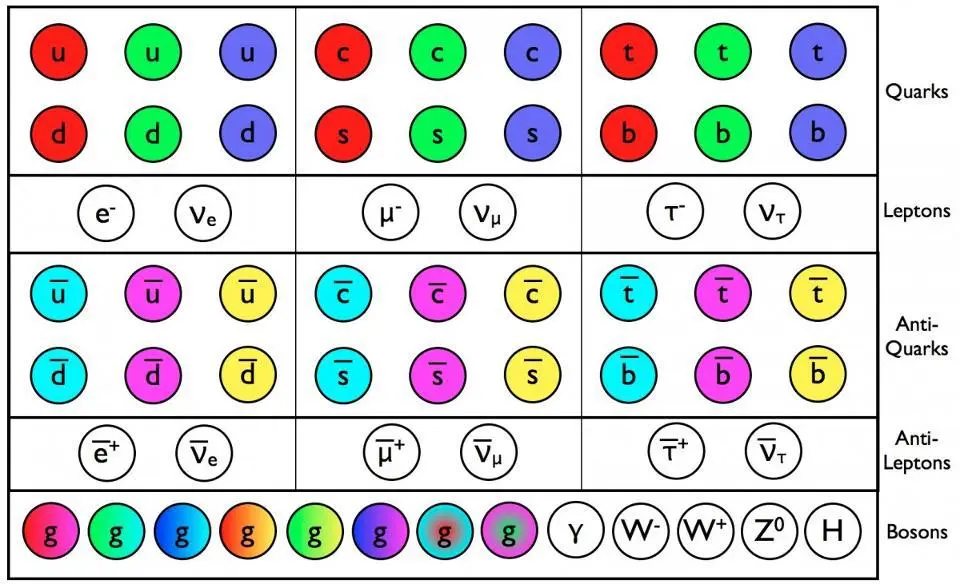
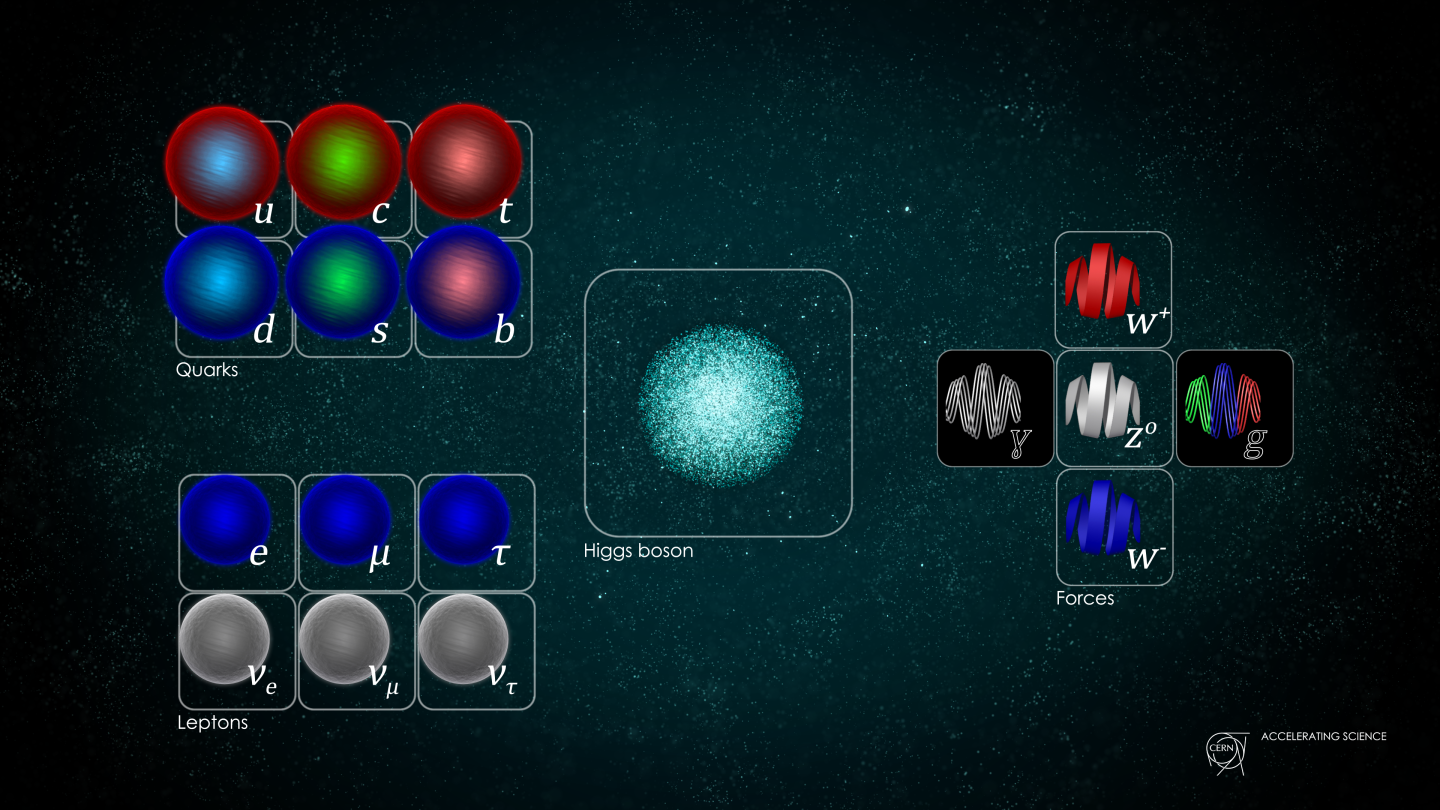
The Standard Model is the crowning achievement of 20th-century particle physics. It classifies all known elementary particles into two main categories: fermions, which make up matter, and bosons, which mediate forces. The fermions include six quarks and six leptons, each with corresponding antiparticles. Quarks, such as up and down, combine to form protons and neutrons, while leptons include the familiar electron and the elusive neutrinos. These particles are the building blocks of atoms, stars, and life itself.
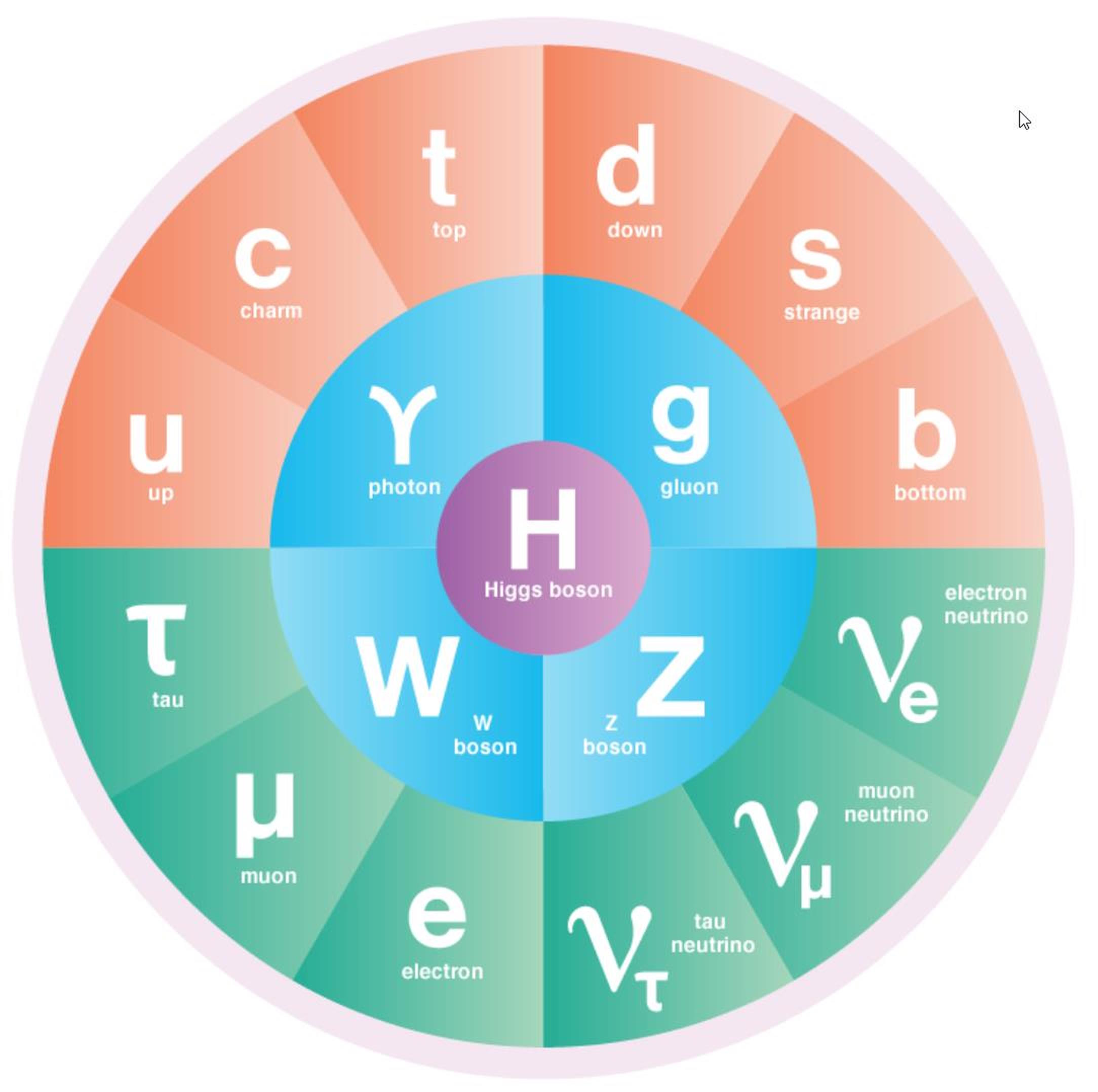
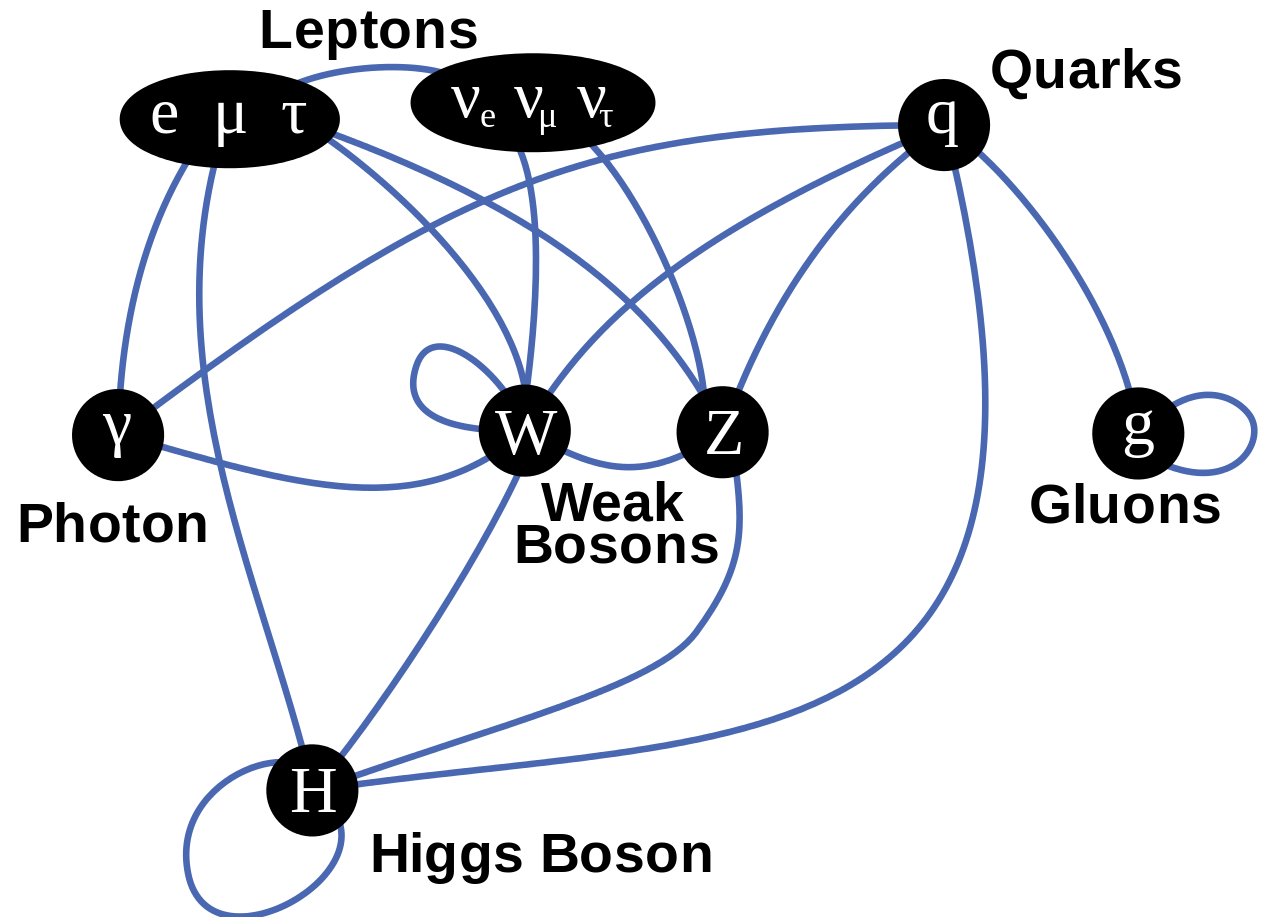
Bosons, on the other hand, are the messengers of nature’s forces. The photon carries the electromagnetic force, the W and Z bosons mediate the weak nuclear force responsible for radioactive decay, and the eight gluons bind quarks together via the strong force. Then there’s the Higgs boson, a late addition discovered in 2012, which gives mass to other particles through interactions with the Higgs field. This field permeates the Universe, and particles acquire mass depending on how strongly they interact with it—much like objects moving through molasses.
Despite its success, the Standard Model is not a complete theory. It does not incorporate gravity, explain dark matter, or account for the matter-antimatter asymmetry in the Universe. Moreover, it treats particles as static entities in today’s cold, low-energy Universe. But in the early moments after the Big Bang, conditions were so extreme that these particles would have behaved very differently. The model we use today is a low-energy approximation—a shadow of a much richer, high-energy reality that once existed.
Symmetry in the Primordial Fire
In the first trillionth of a second after the Big Bang, the Universe was unimaginably hot—over a trillion degrees Kelvin. At such energies, the distinctions between forces began to blur. The electromagnetic and weak forces, which today seem entirely different, were once unified into a single electroweak force. This unification is a cornerstone of the Standard Model, but it only becomes apparent at extremely high energies.
At these temperatures, particles like the W and Z bosons were massless, just like the photon. The Higgs field, which now gives them mass, was in a symmetric state—its value was zero everywhere. As the Universe expanded and cooled, the Higgs field underwent a phase transition, much like water freezing into ice. This “electroweak symmetry breaking” gave mass to the W and Z bosons, while leaving the photon massless. It was a pivotal moment in cosmic history, marking the birth of the electromagnetic and weak forces as we know them.
This symmetry-breaking event also affected the behavior of quarks and leptons. Before it occurred, particles could transform freely between types—electrons could become neutrinos, and up quarks could turn into down quarks—through interactions mediated by the unified electroweak force. After symmetry breaking, these transformations became constrained, and particles acquired distinct identities and masses.
Color Charge and the Strong Force
While the electroweak force governs interactions between leptons and quarks, the strong nuclear force binds quarks together inside protons and neutrons. This force is mediated by gluons, which carry a property called color charge—a quantum attribute analogous to electric charge but with three types: red, green, and blue.
Unlike photons, which are electrically neutral, gluons themselves carry color charge. This leads to a phenomenon called confinement: quarks are never found alone but always in combinations that are color-neutral, such as red + green + blue (baryons like protons) or color + anticolor (mesons). In the early Universe, however, temperatures were so high that quarks and gluons existed not in bound states but as a free-flowing plasma—a state known as the quark-gluon plasma.
This exotic phase of matter has been recreated in particle accelerators like the Large Hadron Collider (LHC), where heavy ions are collided at near-light speeds. The resulting fireballs briefly mimic conditions from the first microseconds of the Universe. Observations confirm that quarks and gluons behave like a nearly perfect fluid with very low viscosity—remarkably different from the confined particles we see today.
The Role of Antiparticles and Matter Dominance
One of the most puzzling features of the Universe is its matter-antimatter asymmetry. According to the Standard Model, the Big Bang should have produced equal amounts of matter and antimatter. When they met, they should have annihilated completely, leaving behind a Universe filled only with energy—no stars, no planets, no people.
Yet, we exist. This implies that a tiny imbalance—about one extra matter particle for every billion matter-antimatter pairs—must have survived. This asymmetry likely arose during the early Universe through processes that violated certain symmetries, such as CP violation (the difference between matter and antimatter behavior).
Experiments with particles like kaons and B-mesons have observed CP violation, but the amount predicted by the Standard Model is far too small to explain the observed matter dominance. This suggests that new physics—perhaps involving neutrinos or undiscovered particles—must be at play.
The Higgs Field and the Birth of Mass
The Higgs boson, discovered in 2012 at CERN, confirmed the existence of the Higgs field—a field that permeates all of space and gives mass to elementary particles. But in the early Universe, this field was in a symmetric state, with zero value. Only as the Universe cooled below a critical temperature did the field “choose” a non-zero value, breaking symmetry and endowing particles with mass.

This process is similar to how a magnet forms when iron cools below its Curie temperature: randomly oriented atomic magnets suddenly align, creating a net magnetic field. Similarly, the Higgs field settled into a uniform state, and particles interacting with it acquired mass proportional to the strength of their coupling.
Interestingly, not all particles interact equally with the Higgs field. Photons and gluons do not interact at all—hence, they remain massless. Neutrinos interact very weakly, explaining their tiny masses. The top quark, the heaviest known particle, interacts most strongly, giving it a mass nearly 200 times that of a proton.
The Hierarchy Problem
One of the deepest puzzles in physics is why the Higgs boson is so light compared to the Planck scale—the energy at which quantum gravity becomes important. This discrepancy, known as the hierarchy problem, suggests that unknown physics, such as supersymmetry or extra dimensions, may be stabilizing the Higgs mass against quantum corrections.
Gravity and the Missing Piece
While the Standard Model elegantly describes three of the four fundamental forces, it completely omits gravity. General relativity describes gravity as the curvature of spacetime, but this framework breaks down at the quantum level. The hypothetical particle that would mediate gravity—the graviton—has not been observed and does not fit neatly into the Standard Model.
In the early Universe, when energies approached the Planck scale (10¹⁹ GeV), gravity would have been as strong as the other forces. At that point, a theory of quantum gravity—such as string theory or loop quantum gravity—would be needed to describe reality. But as the Universe expanded and cooled, gravity weakened relative to the other forces, allowing the Standard Model to dominate.
There are 8 gluons, 1 photon, 3 weak bosons (W⁺, W⁻, Z), and 1 Higgs boson.
Only the photon and gluons are massless; all other particles have mass.
Quarks come in six “flavors” and three “colors,” leading to 18 quark types.
Neutrinos have mass but interact so weakly they can pass through light-years of lead.
Looking Ahead: Beyond the Standard Model
The Standard Model is incredibly successful, but it is not the final word. It cannot explain dark matter, which makes up 27% of the Universe, or dark energy, which drives cosmic acceleration. It also fails to unify all forces or incorporate gravity. Physicists are now searching for new physics—particles or forces beyond the Standard Model—that could resolve these mysteries.
Experiments at the LHC, neutrino observatories, and dark matter detectors are probing the frontiers of knowledge. Theories like supersymmetry predict partner particles for every known particle, potentially solving the hierarchy problem and providing dark matter candidates. Others suggest extra dimensions or new symmetries that could reshape our understanding of the early Universe.
As we peer deeper into the cosmos and probe higher energies, we may uncover the missing pieces that complete the puzzle. The particles of today are echoes of a more unified, symmetric past. By studying them, we are not just learning about matter—we are reading the story of the Universe itself.
This article was curated from The particles in the early Universe painted a different picture via Big Think