Table of Contents
- The Engines of Creation: Black Holes as Cosmic Power Plants
- From Quasars to Little Red Dots: Jets in the Early Universe
- Stellar Nurseries and Baby Jets: When Young Stars Fire Up
- The Invisible Light: Why We Need X-Rays and Radio to See Jets
- The Physics of Relativistic Beams: How Nature Focuses Energy
- Jets and the Fate of Galaxies: Cosmic Regulators at Work
- The Future of Jet Science: What’s Next?
The Universe’s Most Powerful Firehoses: How Supermassive Black Holes Launch Cosmic Jets
In the quietest corners of the cosmos, where gravity reigns supreme and light itself bends to unseen forces, nature unleashes some of its most spectacular phenomena: relativistic jets. These ultra-focused beams of plasma, traveling at nearly the speed of light, erupt from the hearts of galaxies, powered by supermassive black holes that weigh millions or even billions of times more than our Sun. Though invisible to the naked eye, these jets span thousands of light-years and emit more energy than all the stars in a galaxy combined. They are not mere cosmic curiosities—they are fundamental engines shaping the evolution of galaxies, influencing star formation, and illuminating the darkest reaches of space.
What makes these jets so extraordinary is not just their sheer power, but their precision. Unlike the chaotic outflows seen in stellar explosions, these jets are collimated—focused into narrow, stable beams that can maintain their structure across intergalactic distances. From quasars blazing in the early universe to young stars still cradled in protoplanetary disks, jets appear wherever matter spirals toward a gravitational abyss. And while they may seem like distant wonders, their physics echoes processes happening much closer to home—even in our own Milky Way.
The Engines of Creation: Black Holes as Cosmic Power Plants
At the center of nearly every large galaxy lies a supermassive black hole—a gravitational titan so dense that not even light can escape its event horizon. But paradoxically, these cosmic vacuums are also the most luminous objects in the universe. When gas, dust, and stars fall toward a black hole, they don’t vanish quietly. Instead, they form a swirling, superheated accretion disk, where friction and magnetic forces heat material to millions of degrees. This disk becomes a cauldron of energy, emitting X-rays, radio waves, and ultraviolet light.
But the real spectacle begins when some of this infalling matter is redirected. Instead of crossing the event horizon, charged particles are caught in the black hole’s intense magnetic fields and funneled along its rotational axis. These particles are accelerated to relativistic speeds—up to 99% the speed of light—and launched outward in twin beams. This process, known as the Blandford-Znajek mechanism, converts the black hole’s rotational energy into kinetic energy of the jet, much like a cosmic turbine.
These jets are not made of matter escaping the black hole itself—nothing can escape the event horizon. Instead, they originate from the region just outside, where magnetic fields twist and snap like rubber bands under extreme stress. The result is a self-collimating beam that can travel for hundreds of thousands of light-years, often ending in massive lobes of radio-emitting plasma that dwarf the host galaxy.
From Quasars to Little Red Dots: Jets in the Early Universe
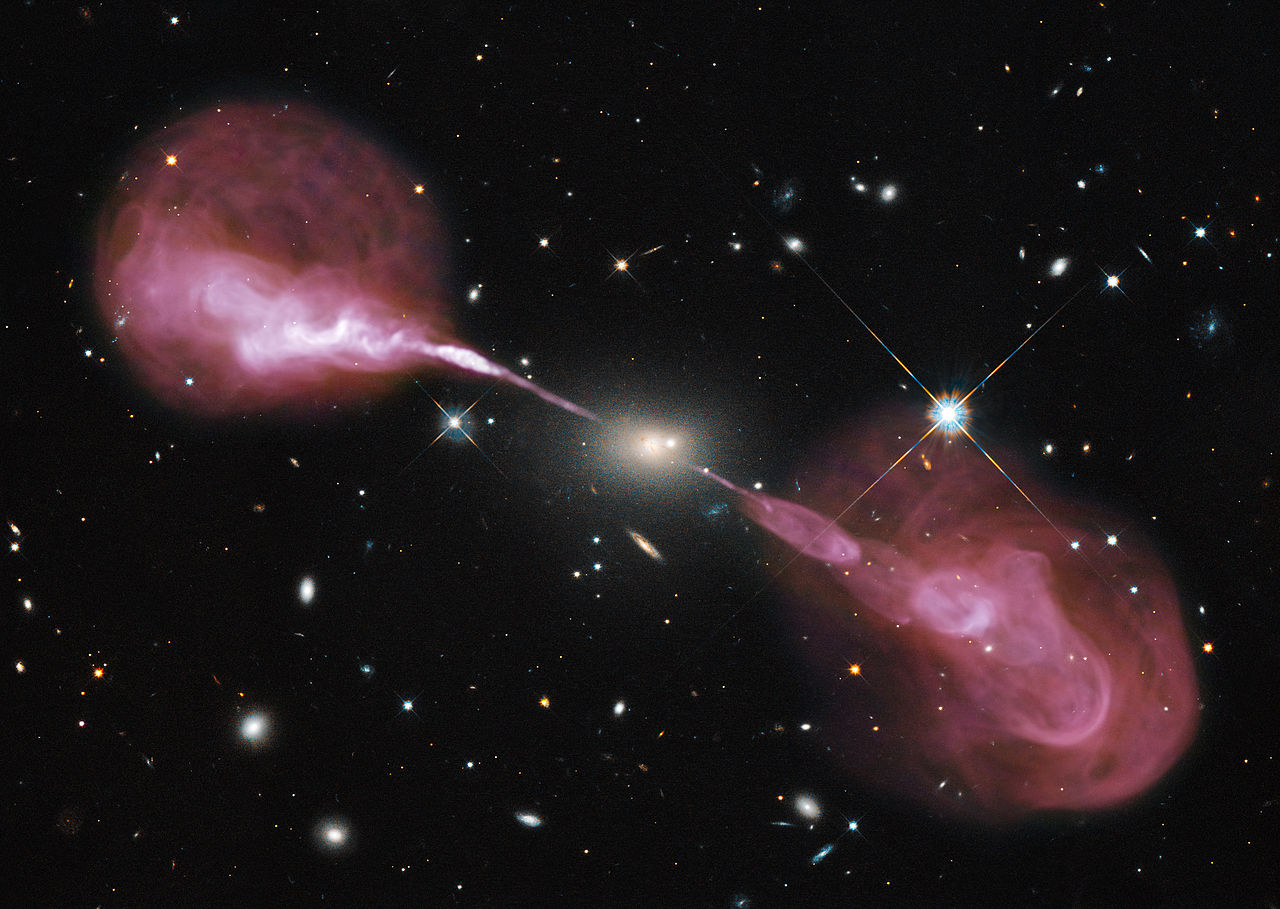
Quasars—quasi-stellar radio sources—are among the brightest and most distant objects ever observed. Powered by voracious black holes in the early universe, they shine with the light of trillions of stars, yet are smaller than our solar system. Many of these ancient beacons launch powerful jets that stretch across millions of light-years. One of the most striking examples is the galaxy Hercules A, located 2.1 billion light-years away. Images from the Hubble Space Telescope and radio observatories reveal twin jets erupting from its core, spanning 1.5 million light-years—larger than the entire Milky Way.
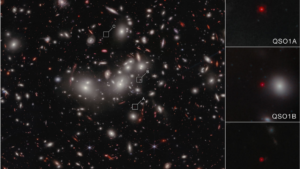
But quasars aren’t the only cosmic sources of jets. Recent observations by the James Webb Space Telescope (JWST) have uncovered a population of enigmatic objects known as “little red dots.” These compact, red-hued galaxies, seen just 700–800 million years after the Big Bang, appear dim in visible light but glow brightly in infrared. Scientists now believe many are powered by actively feeding black holes, with jets oriented directly toward Earth. This alignment amplifies their brightness through relativistic beaming—a Doppler effect that makes approaching jets appear much brighter than those moving away.

These early jets played a crucial role in shaping the universe. By injecting energy into the intergalactic medium, they helped regulate the growth of galaxies and influenced the distribution of matter on the largest scales. Without them, the cosmos might look vastly different—denser, more chaotic, and far less structured.
Stellar Nurseries and Baby Jets: When Young Stars Fire Up
While supermassive black holes dominate the headlines, smaller-scale jets are also common in the universe—especially around young stars. In star-forming regions like the Orion Nebula, astronomers have observed Herbig-Haro objects—glowing shockwaves created when jets from newborn stars collide with surrounding gas clouds. These jets, though far less energetic than their quasar counterparts, share the same fundamental physics: magnetic fields channeling material along rotational axes.
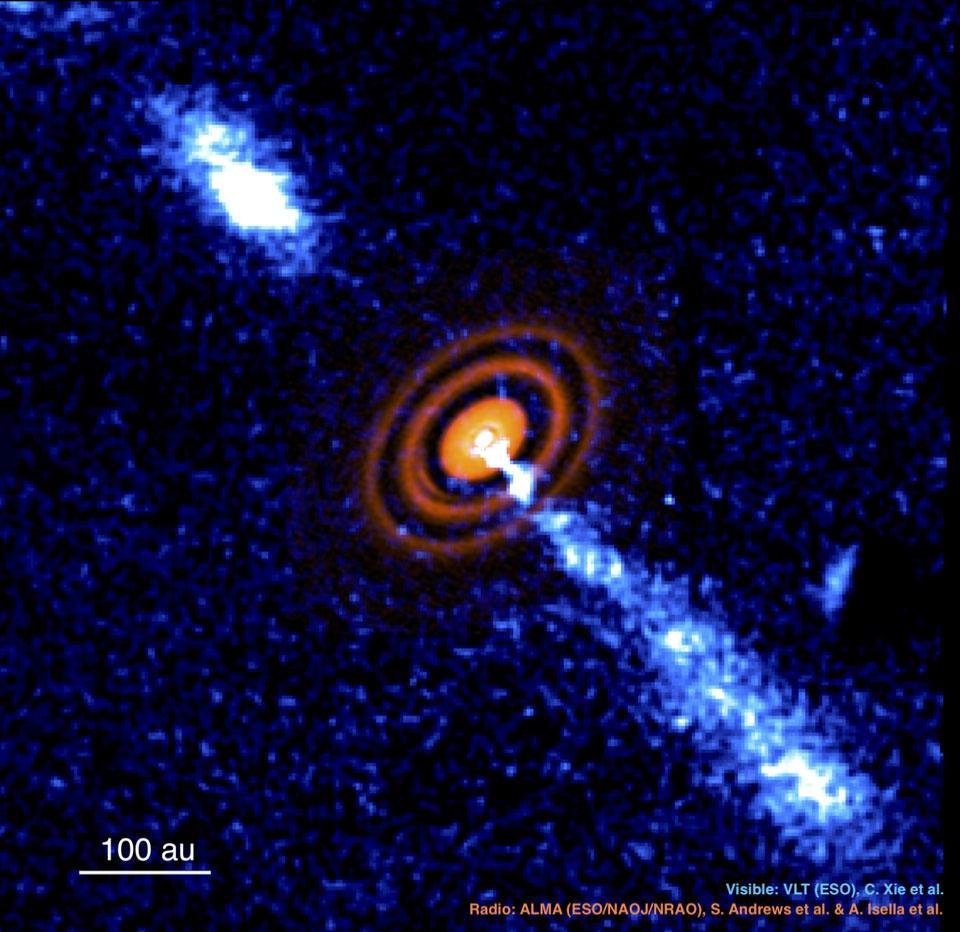
Take HD 163296, a young star 400 light-years away surrounded by a protoplanetary disk. Observations from the Atacama Large Millimeter Array (ALMA) and the Very Large Telescope (VLT) reveal not only gaps in the disk—likely carved by forming planets—but also a bipolar jet shooting outward at hundreds of kilometers per second. These jets help remove angular momentum from the system, allowing the star to continue accreting mass without spinning itself apart.
Interestingly, these stellar jets may also play a role in planet formation. The shockwaves they generate can compress nearby gas clouds, triggering the collapse that leads to new stars and planetary systems. In this way, jets are not just byproducts of star birth—they are active participants in the cosmic cycle of creation.
The Invisible Light: Why We Need X-Rays and Radio to See Jets
Most cosmic jets are invisible in optical light. Instead, they shine brightest in radio and X-ray wavelengths, revealing their true structure and power. Radio waves trace the synchrotron radiation emitted by high-energy electrons spiraling in magnetic fields—a hallmark of relativistic jets. X-rays, meanwhile, reveal the hottest and most energetic regions, often near the jet’s base or where it slams into surrounding material.
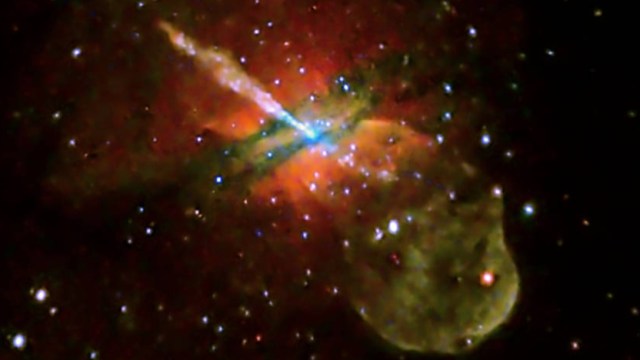
The galaxy Centaurus A, located 12 million light-years away, offers a stunning example. Its central black hole launches twin jets that extend over 1.6 million light-years. In radio images, these jets appear as luminous plumes; in X-rays, they show bright knots and shocks where the beam interacts with intergalactic gas. Only by combining data from multiple telescopes—like Chandra (X-ray), Hubble (optical), and ALMA (radio)—can astronomers piece together the full picture.
This multi-wavelength approach is essential. Just as a doctor uses X-rays, MRIs, and blood tests to diagnose a patient, astronomers rely on a spectrum of tools to understand the universe. Without radio and X-ray observatories, we would miss some of the most dramatic events in cosmic history.
The Physics of Relativistic Beams: How Nature Focuses Energy
One of the greatest mysteries of cosmic jets is how they remain so tightly collimated over vast distances. A beam traveling 100,000 light-years should naturally spread out—yet many jets remain pencil-thin. The answer lies in magnetic self-collimation and external pressure.
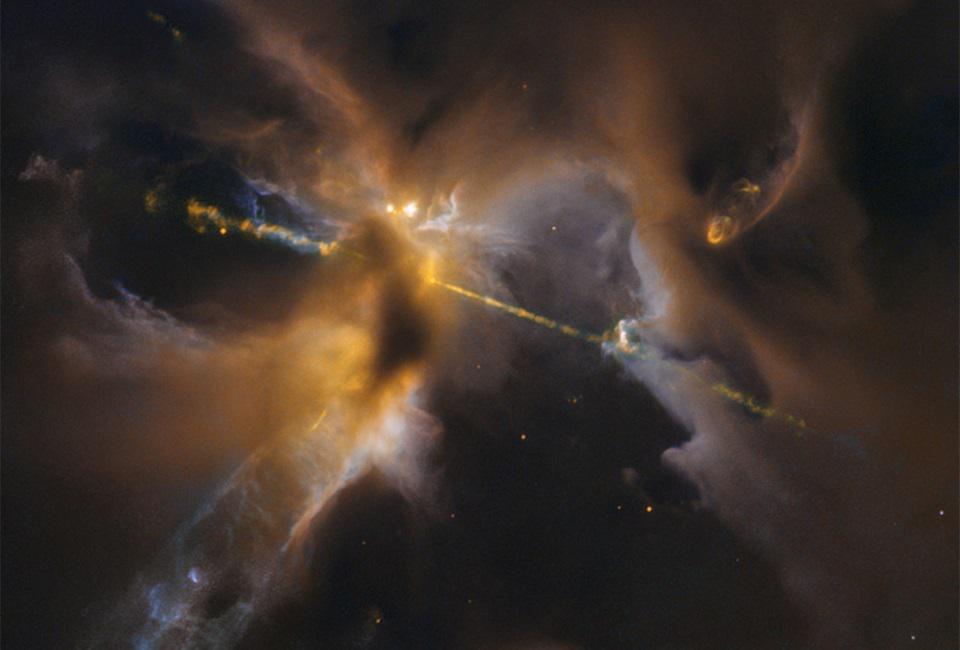
Inside the jet, twisted magnetic fields act like a cosmic nozzle, squeezing the plasma into a narrow stream. Meanwhile, the surrounding interstellar or intergalactic medium provides external pressure, preventing the jet from expanding. In some cases, the jet drills through dense gas clouds, creating shock fronts that emit intense radiation and accelerate particles to near-light speeds.
The fastest known jets move at 99.9% the speed of light.
Some jets precess (wobble) due to misalignment between the black hole’s spin and the accretion disk.
Magnetic fields in jets can be stronger than those in neutron stars.
Jets may carry more mass than all the stars in their host galaxy combined.
These beams are not just streams of plasma—they are laboratories for extreme physics. They test our understanding of relativity, magnetohydrodynamics, and particle acceleration. In fact, some scientists believe cosmic jets may be the source of ultra-high-energy cosmic rays, the most energetic particles ever detected.
Jets and the Fate of Galaxies: Cosmic Regulators at Work
Far from being mere cosmic fireworks, jets play a vital role in galaxy evolution. When a supermassive black hole becomes active, its jets can inject enormous amounts of energy into the surrounding gas. This process, known as AGN feedback, can heat or expel gas from the galaxy, halting star formation and preventing the galaxy from growing too large.
In galaxy clusters, jets from central black holes create giant cavities in the hot X-ray-emitting gas—visible as “ghost bubbles” in Chandra images. These bubbles rise like balloons, redistributing energy and preventing the cluster from cooling and forming stars. Without this feedback, the universe might be filled with massive, star-forming galaxies—instead of the diverse population we observe today.

In our own Milky Way, the black hole Sagittarius A* is currently quiet, but evidence suggests it launched powerful jets millions of years ago. These ancient outflows may have shaped the distribution of gas in the galactic center and influenced the formation of stars like our Sun.
The Future of Jet Science: What’s Next?
As telescopes grow more powerful, so does our ability to study cosmic jets. The Event Horizon Telescope has already captured the shadow of a black hole and the base of its jet in M87. Upcoming missions like the Square Kilometre Array (SKA) and the Lynx X-ray Observatory will map jets in unprecedented detail, revealing their magnetic fields, particle content, and interaction with the cosmos.
One of the biggest questions remains: How do jets launch and accelerate? While the Blandford-Znajek mechanism is widely accepted, the exact role of the accretion disk, magnetic reconnection, and plasma instabilities is still debated. Solving this puzzle could revolutionize our understanding of black holes and high-energy astrophysics.
In the end, cosmic jets remind us that the universe is not a static place. It is dynamic, violent, and awe-inspiring—driven by forces that stretch the limits of physics. From the birth of stars to the evolution of galaxies, these relativistic beams are not just spectacular to behold. They are the invisible architects of the cosmos.
This article was curated from Supermassive black holes launch the most powerful cosmic jets via Big Think