Table of Contents
- The Science of the Unseen: What Is Infrasound?
- From Haunted Houses to Human Perception: The Psychology Behind the Paranormal
- Real-World Hauntings: When Science Meets the Supernatural
- The Role of Environment: How Architecture and Technology Shape Our Experiences
- Beyond Hauntings: The Broader Implications of Infrasound

When Ghosts Aren’t Ghosts: How Infrasound Turns Ordinary Spaces into Haunted Halls
Imagine stepping into a dimly lit basement, the air thick with silence. Suddenly, a chill runs down your spine. You feel watched. A shadow flickers at the edge of your vision. Your heart pounds—could it be a ghost? Not so fast. What if the real culprit isn’t spectral at all, but something far more mundane—and far more scientific? A growing body of research suggests that the eerie sensations often attributed to paranormal activity may actually be the result of infrasound, a low-frequency sound wave inaudible to the human ear but powerful enough to stir deep-seated feelings of dread, unease, and even the illusion of a ghostly presence.
Infrasound—sound waves below 20 Hz, the lower limit of human hearing—has long been a silent player in our sensory environment. From the deep rumble of ocean waves to the mechanical hum of ventilation systems, these vibrations are all around us. Yet, because we can’t hear them, their effects on the human body and mind remain largely unnoticed—until they trigger something primal. A recent study published in Frontiers in Behavioral Neuroscience posits that infrasound may be a key factor in many reported hauntings, offering a compelling scientific explanation for experiences once dismissed as supernatural.

This revelation doesn’t just debunk ghost stories—it opens a fascinating window into how our brains interpret environmental stimuli. The feeling of being watched, the sudden onset of anxiety, or the sensation of a “presence” in an empty room may not be signs of the paranormal, but rather the brain’s response to invisible vibrations. As researchers continue to explore the intersection of physics, psychology, and perception, the line between the haunted and the physiological is becoming increasingly blurred.
The Science of the Unseen: What Is Infrasound?
Infrasound occupies the lowest end of the sound spectrum, with frequencies below 20 hertz—too low for the human ear to detect. Yet, just because we can’t hear it doesn’t mean we can’t feel it. These waves travel long distances and can penetrate solid materials with ease, making them pervasive in both natural and human-made environments. Thunderstorms, earthquakes, ocean waves, and even large animals like elephants use infrasound to communicate over vast distances.
But it’s not just nature that produces these vibrations. Modern infrastructure is a major source. Wind turbines, HVAC systems, traffic, and industrial machinery all generate infrasound as a byproduct of their operation. In urban environments, the cumulative effect of these sources can create a constant, low-level hum that remains undetected by our ears but may still affect our nervous system.
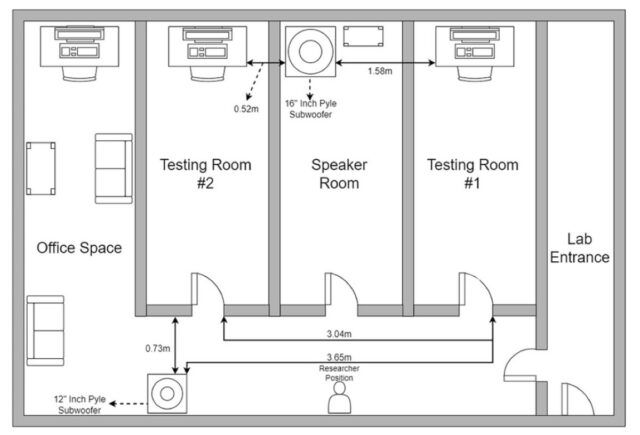
The human body is surprisingly sensitive to these vibrations. Studies have shown that exposure to infrasound can cause physiological changes, including increased heart rate, pupil dilation, and heightened stress hormone levels. The inner ear, particularly the vestibular system responsible for balance and spatial orientation, is especially vulnerable. When stimulated by low-frequency vibrations, it can send erroneous signals to the brain, leading to sensations of movement, disorientation, or even the illusion of a nearby presence.
This biological sensitivity may explain why people in certain locations—especially older buildings with poor insulation or mechanical systems—report more frequent paranormal experiences. The vibrations are there, whether we realize it or not, and our bodies are reacting in ways that feel deeply unsettling.
From Haunted Houses to Human Perception: The Psychology Behind the Paranormal
The idea that environmental factors can mimic supernatural experiences isn’t new. In 2003, psychologist Richard Wiseman conducted groundbreaking research at two famously “haunted” sites: Hampton Court Palace in England and the South Bridge Vaults in Edinburgh. Participants were asked to explore these locations and report any unusual sensations. Interestingly, people reported more ghostly experiences in areas that were already rumored to be haunted—even when they didn’t know the history of the site.

Wiseman discovered that these hotspots shared common environmental traits: fluctuating magnetic fields, variations in lighting, and changes in humidity. But perhaps most intriguing was the presence of infrasound. Areas with higher levels of low-frequency noise correlated strongly with reports of chills, anxiety, and the feeling of being watched. This suggests that our perception of hauntings is not just shaped by folklore, but by measurable physical stimuli.
The brain, in its quest to make sense of ambiguous sensory input, often fills in the gaps with familiar narratives—like ghosts. When infrasound stimulates the vestibular system, it can create a sensation of movement or presence without any visual confirmation. The brain, seeking coherence, interprets this as an unseen entity. It’s a form of apophenia—the tendency to perceive meaningful patterns in random data. In this case, the “pattern” is a ghost, and the “data” is an invisible vibration.
This psychological mechanism explains why hauntings often cluster in specific locations. It’s not that these places are inherently “haunted,” but that they contain the right combination of environmental triggers—infrasound, magnetic anomalies, and poor lighting—that conspire to create a perfect storm of eerie sensations.

Real-World Hauntings: When Science Meets the Supernatural
One of the most famous cases of alleged infrasound-induced hauntings occurred at a private home in England in the early 2000s. A family reported recurring phenomena: doors slamming, footsteps in empty rooms, and a persistent feeling of being watched. They called in paranormal investigators, who captured EVPs (electronic voice phenomena) and thermal anomalies. But when scientists analyzed the home, they discovered a faulty extractor fan in the attic producing a constant 19 Hz tone—right in the range known to cause psychological distress.
Once the fan was repaired, the “hauntings” stopped. The family’s experiences, once attributed to spirits, were revealed to be the result of a mechanical malfunction. This case, documented in multiple scientific reviews, is a textbook example of how infrasound can masquerade as the paranormal.
Another well-documented instance involves the “Ghost in the Machine” phenomenon at a university lab. Researchers working late at night reported hearing whispers, feeling sudden chills, and seeing movement in their peripheral vision. After ruling out pranks and psychological disorders, they discovered that a large air conditioning unit outside the building was generating strong infrasound waves. When the unit was turned off, the phenomena ceased.

The 19 Hz frequency is particularly effective at stimulating the vestibular system, often resulting in feelings of unease or presence.
Wind turbines, while quiet to the ear, can produce infrasound that travels for miles and may affect nearby residents.
Some concert halls and theaters have reported audience members feeling “ghostly” sensations during performances—later traced to subwoofers emitting infrasound.
The military has explored infrasound as a non-lethal weapon due to its ability to induce nausea, disorientation, and fear.
These real-world examples underscore a crucial point: what we perceive as supernatural is often the result of perfectly natural—if invisible—forces. The key is understanding how these forces interact with our biology and psychology.
The Role of Environment: How Architecture and Technology Shape Our Experiences
The design of a building can inadvertently turn it into a “haunted” space. Older structures, with their creaky floors, drafty windows, and outdated HVAC systems, are particularly prone to generating infrasound. But even modern buildings aren’t immune. Large ventilation ducts, elevator motors, and even nearby traffic can produce low-frequency vibrations that go unnoticed—until they affect human perception.
Architects and engineers are beginning to recognize the importance of acoustic design in creating comfortable, psychologically healthy spaces. By isolating mechanical systems, using sound-dampening materials, and carefully planning building orientation, it’s possible to minimize infrasound exposure. Some hospitals and schools now incorporate infrasound mitigation into their designs, recognizing that even inaudible noise can impact well-being.
Interestingly, cultural beliefs also play a role. In places with strong ghost lore, people may be more likely to interpret ambiguous sensations as paranormal. This creates a feedback loop: the more a location is said to be haunted, the more people expect to experience something strange—and the more likely they are to attribute normal sensations to the supernatural.
Beyond Hauntings: The Broader Implications of Infrasound
While much of the focus has been on ghostly experiences, the implications of infrasound research extend far beyond the paranormal. Understanding how low-frequency noise affects the human body could lead to better urban planning, improved building design, and even new therapeutic applications.
For example, some researchers are exploring whether controlled exposure to infrasound could help treat conditions like anxiety or PTSD. By understanding how these vibrations influence the brain, we might one day use them to calm the nervous system rather than disturb it.
Conversely, there are concerns about the long-term effects of chronic infrasound exposure. People living near wind farms or busy highways may be at risk for stress-related health issues, even if they don’t consciously notice the noise. As renewable energy expands, so does the need to study the full impact of technologies like wind turbines on human health.
Ultimately, the study of infrasound reminds us that our perception of reality is deeply intertwined with our environment. What we see, hear, and feel is not always what it seems. The next time you feel a chill in a supposedly haunted house, remember: it might not be a ghost—but a vibration you can’t hear, yet can’t escape.
This article was curated from Study: Infrasound likely a key factor in alleged hauntings via Ars Technica – Science