The Frozen Frontier: Why Triton and the Outer Solar System Deserve Our Attention
Beyond the familiar gas giants Jupiter and Saturn lies a realm of ice, mystery, and cosmic extremes—a region so distant and frigid that only two robotic explorers have ever dared to venture there. This is the outer solar system: home to Uranus, Neptune, and a vast population of icy bodies stretching into the Kuiper Belt and beyond. While we’ve sent orbiters to Jupiter and Saturn, and even landed on Mars and Titan, the outermost planets remain largely unexplored. Only Voyager 2 has flown by Uranus and Neptune, and only New Horizons has glimpsed Pluto. No dedicated missions are currently funded to return. Yet, within this frozen frontier, one world stands out—not just for its size, but for its bizarre, backward orbit and potential to rewrite our understanding of planetary formation: Triton, Neptune’s largest moon.
Triton is no ordinary moon. It’s the seventh-largest in the solar system, larger than Pluto and even Mercury in some dimensions. But what makes it truly extraordinary is its retrograde orbit—it circles Neptune in the opposite direction of the planet’s rotation. This is a telltale sign that Triton wasn’t born with Neptune. Instead, scientists believe it was once a dwarf planet from the Kuiper Belt, captured by Neptune’s gravity billions of years ago. This capture likely shattered Neptune’s original moon system, leaving behind only Triton as the dominant survivor. Today, Triton is slowly spiraling inward, destined to be torn apart by Neptune’s tides in about 3.6 billion years, potentially forming a spectacular ring system.
The surface of Triton is a frozen wonderland of nitrogen ice, water ice, and traces of methane and carbon dioxide. Its terrain is surprisingly young, with few craters, suggesting active geological processes. Dark geysers erupt from beneath the surface, spewing nitrogen gas and dark particles up to 8 kilometers high—similar to geysers on Earth but driven by solar heating rather than internal heat. These “cryovolcanoes” hint at a subsurface ocean, possibly warmed by tidal forces from Neptune. If confirmed, Triton could harbor one of the most promising environments for extraterrestrial life in the outer solar system.
Despite its scientific allure, Triton has only been visited once—by Voyager 2 in 1989. The spacecraft captured stunning images of its cantaloupe-textured terrain, polar ice caps, and active plumes, but its instruments were limited. We still don’t know the composition of its subsurface, the depth of any potential ocean, or the chemistry of its thin atmosphere. A modern mission could answer these questions, yet no such mission is currently funded. This lack of attention is puzzling, especially when we consider that Triton may be a prototype for the countless icy exomoons orbiting distant planets.
The outer solar system is not just a distant curiosity—it’s a cosmic laboratory for understanding planet formation, orbital dynamics, and the potential for life beyond Earth. Uranus and Neptune, often called the “ice giants,” are fundamentally different from Jupiter and Saturn. They contain less hydrogen and helium and more “ices” like water, ammonia, and methane. Their magnetic fields are oddly tilted and offset from their centers, suggesting complex internal dynamics. Yet, we’ve never sent a probe to study their atmospheres, interiors, or magnetospheres in detail.
Uranus, for instance, rotates on its side—its axis tilted at 98 degrees—as if it were knocked over by a colossal impact. This extreme tilt causes seasons that last 21 Earth years each. Meanwhile, Neptune radiates more heat than it receives from the Sun, a mystery that hints at residual formation energy or ongoing internal processes. Both planets have dynamic weather systems, including supersonic winds and massive storms, yet we’ve only observed them from afar.
Beyond the planets lies the Kuiper Belt, a vast reservoir of icy bodies left over from the solar system’s formation. Pluto, once considered the ninth planet, is now recognized as the largest member of this population. New Horizons revealed a complex world with glaciers, mountains, and a hazy atmosphere. But Pluto is just the beginning. The Kuiper Belt contains thousands of objects, including potential dwarf planets like Eris, Haumea, and Makemake. Some of these may have moons of their own, and a few—like Triton—may have been captured by giant planets.
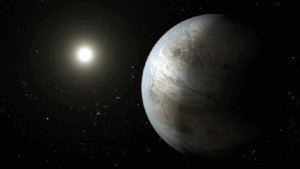
One of the most compelling reasons to explore the outer solar system is its relevance to exoplanet science. Ice giants like Uranus and Neptune are among the most common types of planets discovered around other stars. NASA’s Kepler and TESS missions have revealed that “mini-Neptunes”—planets slightly larger than Earth but smaller than Neptune—are abundant in the galaxy. Yet, we know almost nothing about their compositions, atmospheres, or potential for life. Studying Uranus and Neptune up close could provide critical insights into these distant worlds.
Triton, too, serves as a model for captured exomoons. As astronomers detect more exoplanets, the possibility of detecting exomoons grows. Triton’s retrograde orbit and captured origin suggest that such moons could be common. If they harbor subsurface oceans, they might offer habitable environments shielded from stellar radiation. A mission to Triton could test technologies and strategies for future exomoon exploration.
Despite the scientific imperative, funding and political priorities have kept the outer solar system on the back burner. The Voyager missions were flybys, not orbiters. New Horizons was a flyby of Pluto and a Kuiper Belt object, but it lacked the fuel and design to enter orbit. Future missions would require advanced propulsion, long-duration power sources (like next-gen radioisotope thermoelectric generators), and robust communication systems to transmit data across billions of kilometers.
There have been proposals. NASA’s Trident mission, selected in 2021, aims to fly by Triton in 2038, using a gravity assist from Jupiter. It would study the moon’s surface, atmosphere, and potential ocean. But Trident is a flyby, not an orbiter. A true Triton mission—one that could land, orbit, or even drill into the ice—would require international collaboration and sustained investment.
It orbits Neptune every 5.88 Earth days, always showing the same face to the planet.
Its thin atmosphere is composed mostly of nitrogen, with traces of methane.
Triton’s surface is 99% nitrogen ice, with patches of water ice and frozen carbon dioxide.
It may have a subsurface ocean up to 100 kilometers deep, kept liquid by tidal heating.
The outer solar system is not just a distant realm—it’s a frontier of discovery. Triton, with its captured origin, active geology, and potential ocean, is a scientific treasure trove. Uranus and Neptune, with their strange magnetic fields and dynamic atmospheres, challenge our models of planetary science. The Kuiper Belt holds clues to the solar system’s birth and the distribution of water and organics across the cosmos.
Yet, we remain largely blind to this region. Only two spacecraft have ventured beyond Saturn, and no return missions are funded. This is a missed opportunity. As we search for life beyond Earth, we must look not only to Mars or Europa, but to the icy moons of the outer planets. Triton, in particular, could be a key to understanding how water, chemistry, and energy combine to create habitable environments.
Exploring Triton and the outer solar system is not just about satisfying curiosity—it’s about expanding the boundaries of knowledge. Every mission teaches us something new: about gravity, chemistry, climate, and the origins of life. Triton, with its backward orbit and geysers of nitrogen, reminds us that the universe is full of surprises. It challenges our assumptions and invites us to ask deeper questions.
As we stand on the edge of this frozen frontier, the call to explore grows louder. The technology exists. The science is compelling. What’s needed now is the vision and the will to go. Triton awaits—not just as a moon, but as a gateway to understanding our place in the cosmos.
This article was curated from Starts With A Bang podcast #129 – Triton and the outer solar system via Big Think