Table of Contents
- A Celestial Slingshot: The Art of Gravity Assist Maneuvers
- Why Mars? The Strategic Role of a Planetary Pit Stop
- A Crescent Mars: Unusual Views from Deep Space
- Calibrating the Future: How Mars Images Prepare for Asteroid Psyche
- The Journey to a Metal World: What Makes Asteroid Psyche So Special
- A New Era of Space Exploration

NASA’s Psyche Spacecraft Turns Its Eyes to Mars in a Stunning Gravity Assist Preview
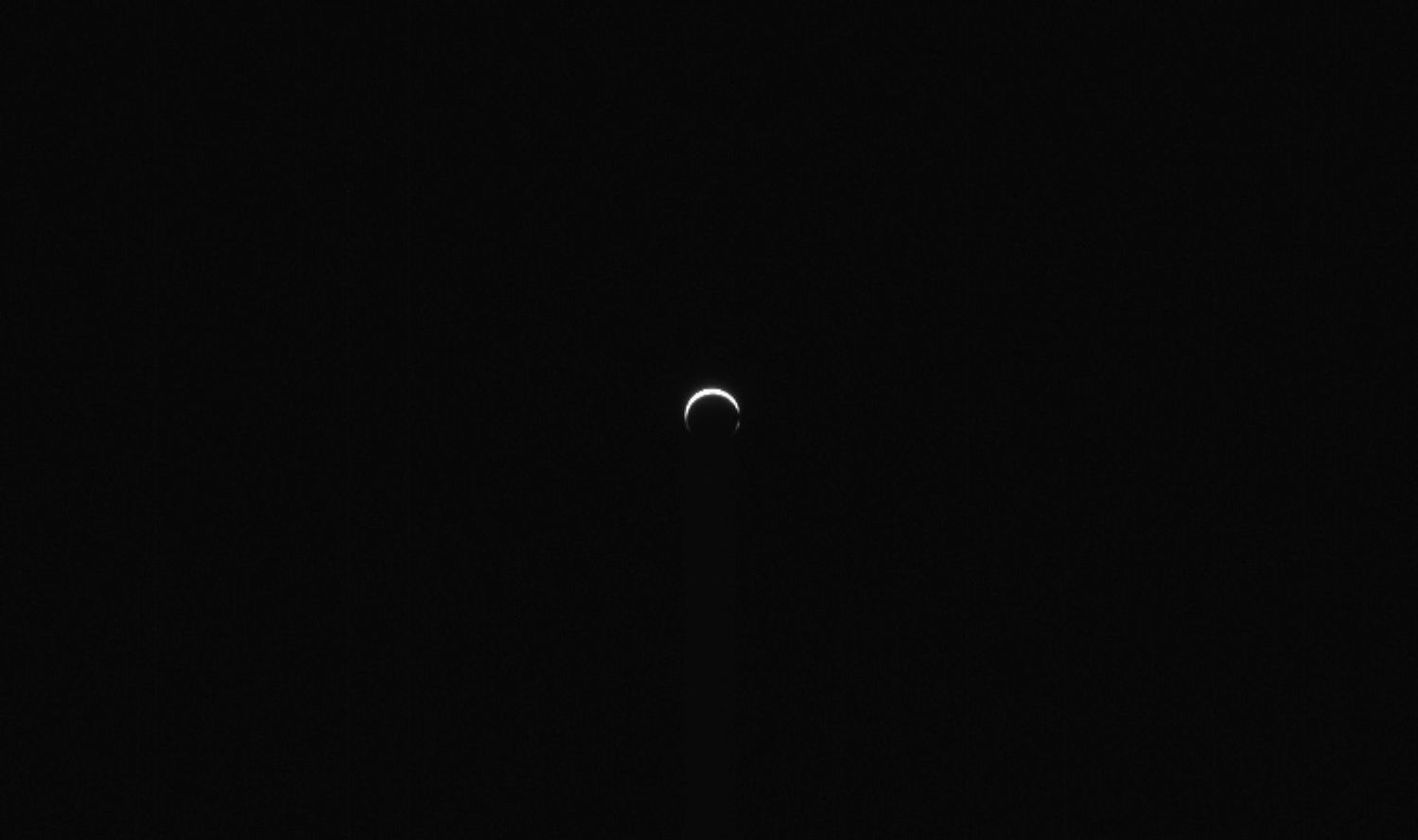
As NASA’s Psyche spacecraft hurtles through the inner solar system on a multi-year journey to a metal-rich asteroid, it recently paused to capture a breathtaking view of a familiar world: Mars. On May 3, 2026, from a distance of about 3 million miles (4.8 million kilometers), the spacecraft’s onboard imager snapped a vivid, color-enhanced image of the Red Planet—not in full glory, but as a delicate, glowing crescent. This wasn’t just a photo op; it was a critical scientific maneuver. The image marks a pivotal moment in the mission’s trajectory, as Psyche prepares for a gravity assist flyby of Mars on May 15, a celestial slingshot that will fine-tune its path toward its ultimate destination: the asteroid 16 Psyche, a mysterious world believed to be the exposed core of a long-destroyed protoplanet.
The crescent view of Mars, captured from a high-phase angle, is both scientifically valuable and visually poetic. From Psyche’s vantage point, the Sun lies just beyond the frame, illuminating only a sliver of the planet’s disk. This lighting creates a dramatic contrast, with the illuminated edge glowing brightly against the blackness of space. The image, taken using the spacecraft’s multispectral imager in a broadband filter, required just a 2-millisecond exposure—so short that even this brief burst of light overwhelmed parts of the sensor, resulting in oversaturated pixels. Yet, this very intensity reveals the dynamic nature of Mars’ atmosphere and surface, offering scientists a rare opportunity to study how sunlight interacts with Martian dust and ice.
A Celestial Slingshot: The Art of Gravity Assist Maneuvers
The May 15 Mars flyby is not just a visual milestone—it’s a masterclass in orbital mechanics. Gravity assists, also known as planetary flybys, are a cornerstone of deep-space navigation. By flying close to a planet, a spacecraft can harness the planet’s gravitational pull to alter its speed and direction without burning precious fuel. This technique, first used in the 1970s with missions like Mariner 10 and later perfected by Voyager, Galileo, and Cassini, allows spacecraft to reach distant targets with remarkable efficiency.
In Psyche’s case, the Mars gravity assist will increase the spacecraft’s velocity and adjust its trajectory toward the asteroid belt, where 16 Psyche orbits between Mars and Jupiter. Without this maneuver, the mission would require significantly more propellant, increasing cost and complexity. The flyby is so precise that engineers had to account for Mars’ exact position, velocity, and even the subtle influence of its thin atmosphere. A miscalculation of just a few kilometers could send Psyche off course, jeopardizing the entire mission.
The gravity assist will increase Psyche’s speed by about 2.5 kilometers per second (over 5,600 mph).
The maneuver saves an estimated 15% of the mission’s total fuel budget.
The spacecraft’s trajectory was calculated using data from over 100 orbital simulations.
Why Mars? The Strategic Role of a Planetary Pit Stop
At first glance, it might seem odd that a mission to an asteroid would swing by Mars. But the Red Planet plays a crucial role in interplanetary travel. Located at the inner edge of the asteroid belt, Mars serves as a natural “stepping stone” for missions heading deeper into the solar system. Its gravity is strong enough to provide a meaningful boost, yet its atmosphere is thin enough to allow close, safe flybys.
Moreover, Mars’ orbital period and position in 2026 created a rare alignment with the Psyche asteroid, making the gravity assist not just beneficial but essential. This kind of orbital synergy occurs only once every few years, and mission planners spent over a decade optimizing the launch window and trajectory to take advantage of it. The May 2026 flyby is the result of meticulous planning that began in the early 2010s, when the Psyche mission was first proposed.
A Crescent Mars: Unusual Views from Deep Space
The crescent image of Mars captured by Psyche is unlike anything seen from Earth. From our planet, we typically see Mars as a full or nearly full disk, especially during oppositions when it’s closest to us. But from deep space, especially when approaching from a high-phase angle, the planet appears as a thin, luminous sliver—much like the Moon during its new phase.
This perspective reveals subtle atmospheric effects that are invisible from Earth. The extended glow around the crescent is caused by sunlight scattering off dust particles suspended in Mars’ thin atmosphere. Mars is notorious for its global dust storms, which can engulf the entire planet for months. Even in quieter periods, dust is constantly lifted by winds, creating a hazy, extended atmosphere known as the “Martian twilight glow.”
Interestingly, the image shows a noticeable gap on the right side of the crescent. Scientists believe this is linked to the planet’s icy north polar cap, which is currently in the depths of winter. The cap, composed of water ice and frozen carbon dioxide, may be generating seasonal clouds and hazes that block sunlight from scattering through the atmosphere. This creates a “shadow” effect, making that region appear dimmer than the rest of the crescent.
Calibrating the Future: How Mars Images Prepare for Asteroid Psyche
While the Mars flyby is primarily a navigational maneuver, it also serves a vital scientific purpose: instrument calibration. The multispectral imager on Psyche was designed to study the surface of the metal asteroid 16 Psyche, which is thought to be the remnant core of a protoplanet that never fully formed. To do this effectively, the camera must be finely tuned to detect subtle variations in brightness, color, and texture.
The Mars images act as a “dress rehearsal” for the asteroid encounter in 2029. By analyzing how the imager captures light from a known planetary body, scientists can refine their models and adjust settings for optimal performance. For example, the oversaturated pixels in the Mars image help engineers understand the camera’s dynamic range and how to avoid data loss during high-contrast observations.
Moreover, the data collected during the flyby will improve our understanding of Mars itself. The scattering of light by atmospheric dust, the behavior of polar hazes, and the reflectivity of surface features all provide valuable insights into Martian climate and geology. These findings could benefit future Mars missions, including human exploration efforts.
The Journey to a Metal World: What Makes Asteroid Psyche So Special
The ultimate goal of the Psyche mission is to explore 16 Psyche, a unique asteroid located in the main asteroid belt. Unlike rocky or icy asteroids, Psyche is composed primarily of iron and nickel—materials typically found in the cores of terrestrial planets like Earth. Scientists believe it may be the exposed core of a protoplanet that was shattered by collisions billions of years ago, leaving behind a metallic relic.
Studying Psyche could unlock secrets about how planets form and evolve. On Earth, we can’t directly observe our own core, which lies thousands of kilometers beneath the surface. But Psyche offers a rare chance to study a planetary core up close. By analyzing its composition, magnetic field, and surface features, scientists hope to learn how planetary differentiation works—the process by which heavier elements like iron sink to the center while lighter materials rise to form the crust.
A New Era of Space Exploration
The Psyche mission represents more than just a journey to an asteroid—it’s a step toward a new era of space science. By combining cutting-edge technology with clever orbital mechanics, NASA is pushing the boundaries of what’s possible in planetary exploration. The Mars gravity assist is a reminder that space travel is not just about propulsion, but about understanding the delicate dance of gravity, light, and time.
As Psyche continues its voyage, each image and data point brings us closer to answering fundamental questions about our solar system’s origins. And with every milestone—like the stunning crescent of Mars—we’re reminded of the beauty and complexity of the cosmos.
It carries four scientific instruments: a multispectral imager, a gamma-ray and neutron spectrometer, a magnetometer, and an X-band radio science experiment.
The mission is managed by NASA’s Jet Propulsion Laboratory and led by Arizona State University.
The spacecraft uses solar electric propulsion, making it one of the most efficient deep-space vehicles ever built.
In the end, the image of Mars captured by Psyche is more than a snapshot—it’s a symbol of human curiosity, ingenuity, and the relentless pursuit of knowledge. As we peer into the crescent glow of the Red Planet, we’re not just seeing another world. We’re glimpsing the future of exploration.
This article was curated from NASA’s Psyche Mission Captures Mars During Gravity Assist Approach via NASA Breaking News