Table of Contents
- The Hidden Force Behind Yellowstone: Could a Lost Tectonic Plate Be the Real Power Source?
- The Farallon Plate: A Lost Giant Beneath Our Feet
- Rethinking the Mantle Plume Model
- A New Theory: Tectonic Stress, Not Deep Heat
- Evidence from Seismic Tomography and Geodynamics
- Implications for Volcanic Hazard Assessment
- A Broader View: Rethinking Intraplate Volcanism
- Conclusion: The Earth’s Memory Runs Deep
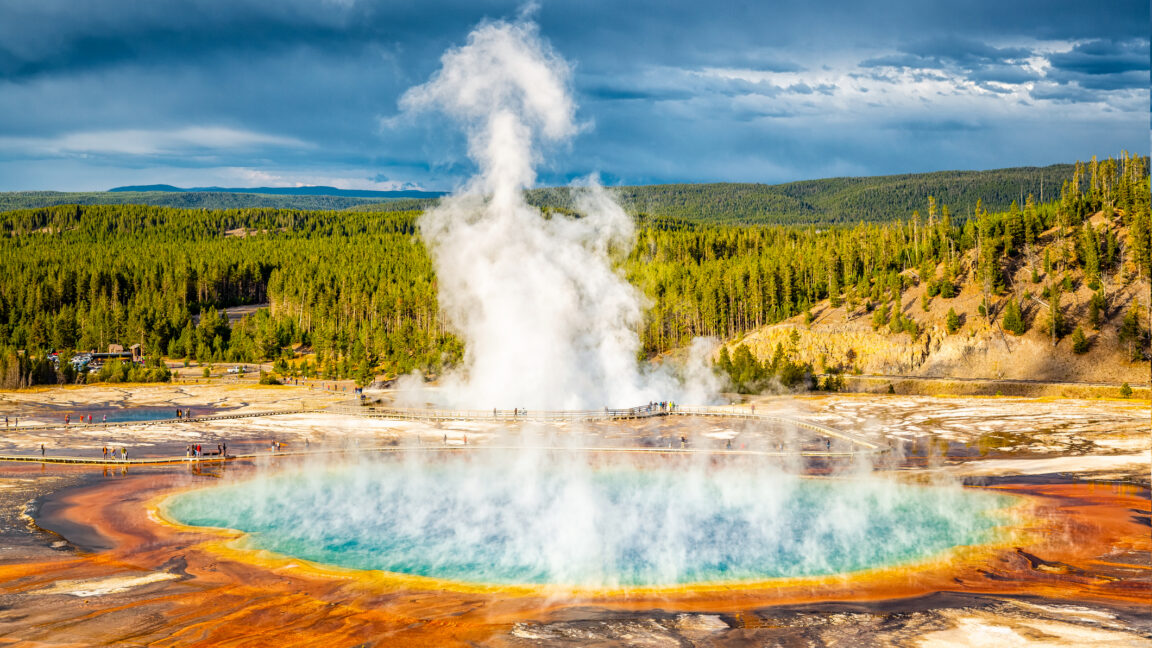
The Hidden Force Behind Yellowstone: Could a Lost Tectonic Plate Be the Real Power Source?
Deep beneath the steaming geysers and bubbling mud pots of Yellowstone National Park lies one of Earth’s most enigmatic geological puzzles. For decades, scientists have attributed the park’s volcanic fury to a classic geological phenomenon: a mantle plume—a towering column of superheated rock rising from the Earth’s core-mantle boundary. But a bold new theory is challenging this long-standing model, suggesting that the true engine behind Yellowstone’s fire may not be a deep-seated plume at all, but the lingering ghost of a vanished tectonic plate.
This radical idea, published in a recent study, proposes that the Farallon Plate—a massive slab of oceanic crust that once plunged beneath North America—may still be shaping the continent’s interior millions of years after its disappearance. Rather than a deep mantle plume, the researchers argue, it’s the tectonic scars and stresses left by the Farallon’s subduction that are now opening pathways for magma to surge toward the surface. If true, this rewrites not only our understanding of Yellowstone, but also how we interpret volcanic activity far from plate boundaries.
The Farallon Plate: A Lost Giant Beneath Our Feet
To understand the new theory, we must first grasp the colossal geological drama that played out over the last 200 million years. The Farallon Plate was a vast tectonic slab that once separated the ancient continents of Laurentia (precursor to North America) and Gondwana. As the Atlantic Ocean opened and North America drifted westward, the denser Farallon Plate began to dive beneath the continent in a process known as subduction.
This slow-motion collision didn’t just reshape the western edge of North America—it fundamentally altered its geology. As the Farallon Plate sank, it dragged oceanic crust and sediments deep into the mantle, triggering melting and fueling the formation of the Sierra Nevada and the Rocky Mountains. Island arcs, like the ones that now form parts of California, were scraped off and welded onto the continent in a process called accretion. Without the Farallon, the West Coast as we know it—complete with its rugged coastlines, fertile valleys, and volcanic arcs—might not exist.
But the Farallon’s influence didn’t end with mountain building. As the plate continued its descent, it fractured and broke apart, with some pieces stalling in the mantle and others continuing their journey toward the core. These remnants, now buried hundreds of kilometers beneath the continent, may still be exerting powerful forces on the overlying crust.
Rethinking the Mantle Plume Model
For over 50 years, the prevailing explanation for Yellowstone’s volcanic activity has been the mantle plume hypothesis. Proposed in the 1970s, this model suggests that a narrow, stationary upwelling of hot rock rises from the core-mantle boundary, piercing through the lithosphere like a blowtorch. As the North American Plate moves southwest over this fixed heat source, it creates a chain of progressively older volcanic features—the Snake River Plain, leading directly to Yellowstone.
The plume model elegantly explains the linear age progression of calderas stretching from Idaho to Wyoming. It also accounts for the high temperatures and seismic anomalies detected deep beneath Yellowstone. But the theory has faced growing skepticism. Recent high-resolution seismic imaging has failed to detect a continuous, narrow plume extending all the way down to the core. Instead, the data reveals a more complex, fragmented structure—more akin to a diffuse zone of hot material than a coherent column.
This has led some geophysicists to question whether a deep mantle plume is even necessary. “The plume model is simple and appealing,” says Dr. Lijun Liu, a geophysicist at the University of Illinois and co-author of the new study. “But nature is rarely that straightforward. What if Yellowstone isn’t powered from the bottom up, but from the side—by the lingering effects of ancient tectonics?”
A New Theory: Tectonic Stress, Not Deep Heat
The alternative model proposed in the new paper shifts the focus from deep Earth dynamics to shallow tectonic processes. According to the researchers, the Farallon Plate’s subduction didn’t just disappear—it left behind a web of fractures, weaknesses, and thermal anomalies in the lithosphere and upper mantle. As the plate broke apart, it created zones of extension and thinning in the overlying North American Plate.
These weakened zones, the theory goes, act like geological fault lines, allowing magma to rise more easily. The heat source, in this case, isn’t a deep plume but the residual warmth from the subducted slab itself, combined with localized melting triggered by decompression as the crust stretches. In essence, Yellowstone’s volcanoes are not the product of a deep Earth furnace, but of a tectonic “wound” that never fully healed.
This model also explains why Yellowstone sits so far inland—over 1,500 kilometers from the nearest plate boundary. Traditional plume theory struggles to account for such remote volcanic activity, but the Farallon remnant model offers a plausible mechanism: the stresses and fractures left by the ancient plate are still propagating eastward, creating pathways for magma.
Evidence from Seismic Tomography and Geodynamics
The new theory is supported by advanced seismic imaging techniques that act like CT scans for the Earth. These methods use earthquake waves to map variations in rock density and temperature deep within the mantle. Recent studies have revealed a broad, pancake-shaped zone of hot material beneath Yellowstone, rather than a narrow, vertical plume.
Moreover, geodynamic modeling shows that the remnants of the Farallon Plate are still present in the mantle transition zone—about 410 to 660 kilometers below the surface. These fragments are not only warmer than surrounding rock but also mechanically weaker, allowing them to deform and interact with the overlying lithosphere.
“Imagine the Farallon Plate as a crumpled-up piece of paper buried in the mantle,” explains Dr. Liu. “Even though it’s broken, it’s still there, still hot, and still influencing the flow of material above it. The stresses it creates can open cracks and channels that let magma through.”
This interpretation aligns with observations from other intraplate volcanic regions, such as the East African Rift and the New Madrid Seismic Zone, where tectonic stresses—not deep plumes—are believed to drive geological activity.
Yellowstone’s last major eruption occurred approximately 640,000 years ago, forming the Yellowstone Caldera.
The North American Plate moves at about 2.3 centimeters per year—roughly the speed fingernails grow.
Seismic imaging has detected Farallon remnants as deep as 1,500 kilometers beneath the continent.
The Yellowstone hotspot has produced at least three supereruptions in the past 2.1 million years.
Implications for Volcanic Hazard Assessment
If the Farallon remnant model is correct, it could have significant implications for how we assess volcanic risks at Yellowstone and similar intraplate volcanoes. Traditional plume models assume a relatively stable heat source, leading to predictable eruption patterns. But a tectonically driven system might be more erratic, with eruptions triggered by changes in stress, crustal deformation, or magma supply.
This doesn’t mean Yellowstone is more dangerous—it means we may need to rethink how we monitor it. Instead of focusing solely on deep mantle signals, scientists might need to pay closer attention to shallow crustal movements, fault activity, and gas emissions. Early warning signs could include increased seismicity along ancient fracture zones or changes in ground deformation patterns.
“We’re not saying Yellowstone is about to erupt,” emphasizes Dr. Liu. “We’re saying we need a more nuanced understanding of what’s driving the system. The more we know, the better we can prepare.”
A Broader View: Rethinking Intraplate Volcanism
The debate over Yellowstone’s origins is part of a larger shift in geoscience. For decades, mantle plumes were the go-to explanation for volcanic activity away from plate boundaries. But as imaging technology improves and models become more sophisticated, scientists are finding that tectonic forces—often from ancient events—play a far greater role than previously thought.
From the volcanic fields of the American Southwest to the hot springs of the East African Rift, evidence is mounting that Earth’s interior is shaped not just by deep convection, but by the long-term legacy of plate tectonics. The Farallon Plate, though gone, may be a prime example of how the past continues to shape the present.
Conclusion: The Earth’s Memory Runs Deep
The story of Yellowstone is not just one of fire and fury, but of deep time and geological memory. What we see at the surface—the geysers, the hot springs, the looming threat of a supereruption—may be the surface expression of forces set in motion millions of years ago. The Farallon Plate, though vanished from view, may still be writing the continent’s future from the depths below.
As scientists continue to probe the mysteries of Earth’s interior, one thing is clear: the planet’s history is never truly buried. It lives on in the rocks, the stresses, and the slow, relentless movements that shape our world. And in the case of Yellowstone, the past may be more powerful than we ever imagined.
This article was curated from New paper argues history, not mantle plume, powers Yellowstone via Ars Technica – Science