Table of Contents

The Cosmic Chicken-or-Egg Mystery: Webb Telescope Discovers Black Hole That Predates Its Galaxy
In the grand theater of the cosmos, a profound mystery has just taken center stage—one that challenges our understanding of how the universe evolved. For decades, astronomers have debated a fundamental question: Which came first, the galaxy or the black hole? The prevailing theory suggested that galaxies formed first, with massive stars collapsing into black holes that then grew over time. But now, NASA’s James Webb Space Telescope (JWST) has uncovered a startling anomaly—a supermassive black hole that appears to have formed before its host galaxy had even taken shape.
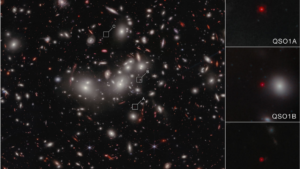
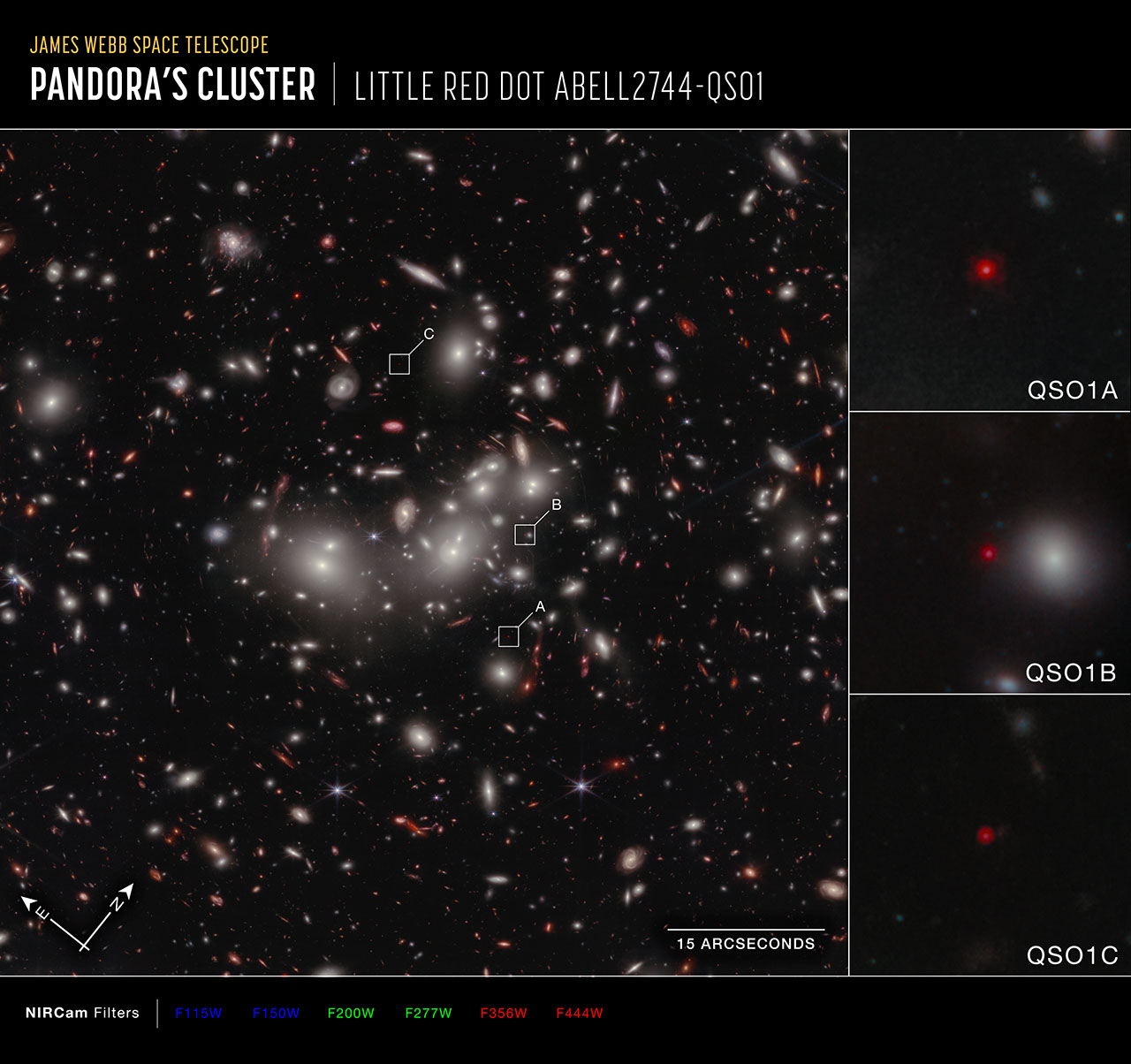
This discovery, centered on a mysterious object known as Abell2744-QSO1—affectionately dubbed “QSO1”—is rewriting the cosmic playbook. Located a staggering 13 billion light-years away and observed as it existed just 700 million years after the Big Bang, QSO1 is a “Little Red Dot” that has been magnified and triply imaged by the gravitational lensing of galaxy cluster Abell 2744, also known as Pandora’s Cluster. What makes this object so extraordinary isn’t just its age or distance—it’s the implication that a black hole 40 million times the mass of our Sun was already in place before its galaxy had fully formed.
A Glimpse Into the Cosmic Dawn
The universe’s first billion years were a time of profound transformation. After the Big Bang, space was filled with a hot, dense plasma that gradually cooled, allowing hydrogen and helium atoms to form. Gravity began pulling these atoms together, eventually igniting the first stars and galaxies. But how did supermassive black holes—some weighing billions of solar masses—emerge so quickly in this young universe?
This is where QSO1 enters the story. Observed by JWST’s Near-Infrared Camera (NIRCam), QSO1 appears as a faint red dot, barely visible without the aid of gravitational lensing. But thanks to the immense gravitational field of Pandora’s Cluster, the light from QSO1 is bent and magnified, creating three distinct images of the same object. This natural telescope effect allows astronomers to study QSO1 in unprecedented detail.
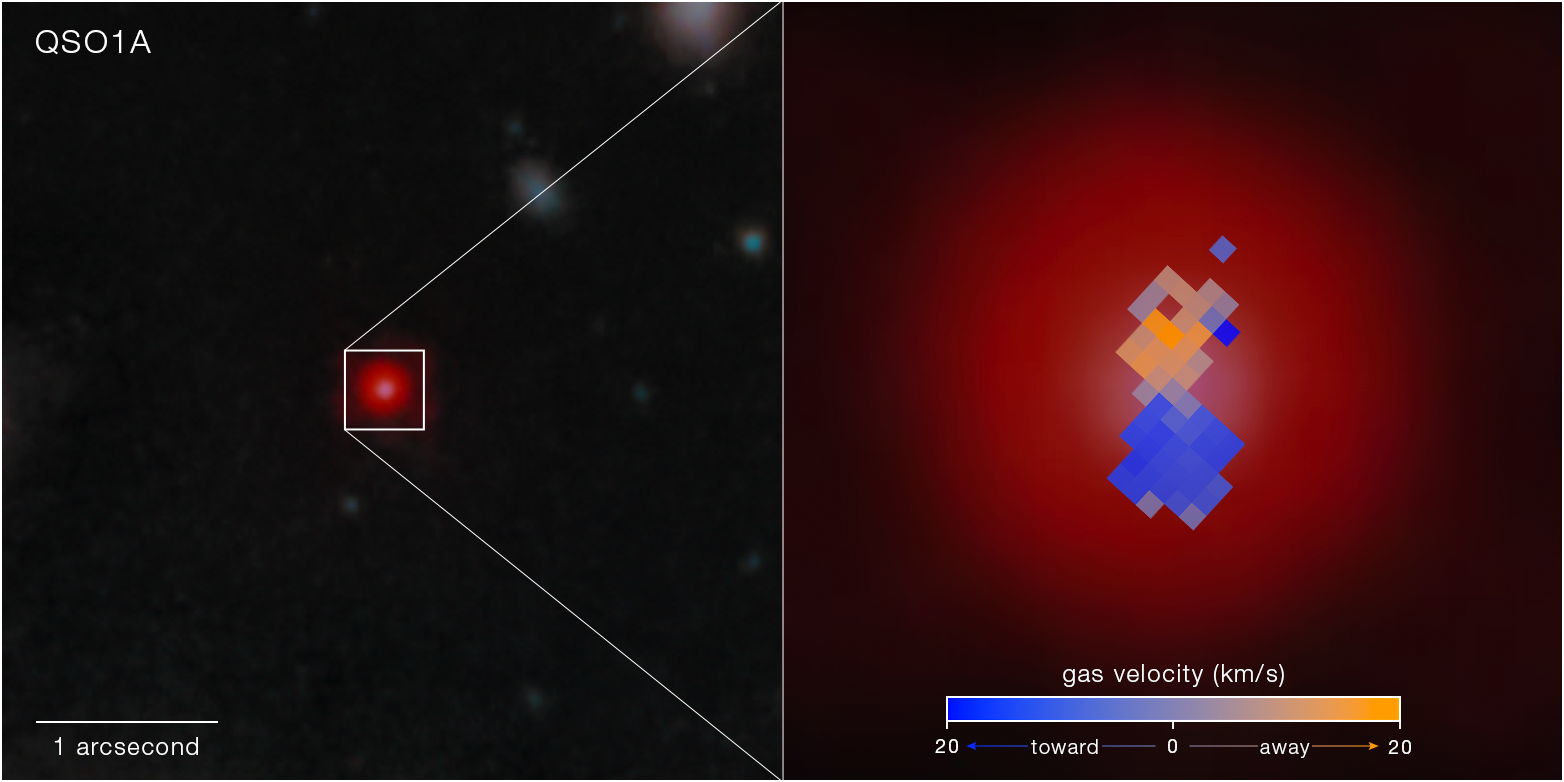
What they found was astonishing: QSO1 is not a fully formed galaxy. Instead, it appears to be a compact, chaotic cloud of gas—mostly hydrogen and helium—swirling around a supermassive black hole that already dominates its environment. The galaxy itself seems to be in its infancy, still assembling stars and structure around this pre-existing gravitational giant.
The Paradox of Early Black Holes
For years, astrophysicists have struggled to explain how black holes could grow so massive so quickly. The standard model suggests that black holes form from the collapse of massive stars, which then accrete matter and merge with others over billions of years. But QSO1 challenges this timeline. A 40-million-solar-mass black hole existing just 700 million years after the Big Bang implies either an impossibly rapid growth rate or a completely different formation mechanism.
“This is a remarkable finding,” said Roberto Maiolino of the University of Cambridge, a co-author of the studies published in Nature and the Monthly Notices of the Royal Astronomical Society. “It’s a paradigm shift, a total revisiting of the classical scenarios of how black holes form and grow.”
One leading hypothesis is that these early black holes may have formed directly from the collapse of massive gas clouds—bypassing the star-formation stage entirely. Known as “direct collapse black holes,” these objects could have started with masses of tens of thousands to millions of suns, giving them a head start in the race to supermassivity.
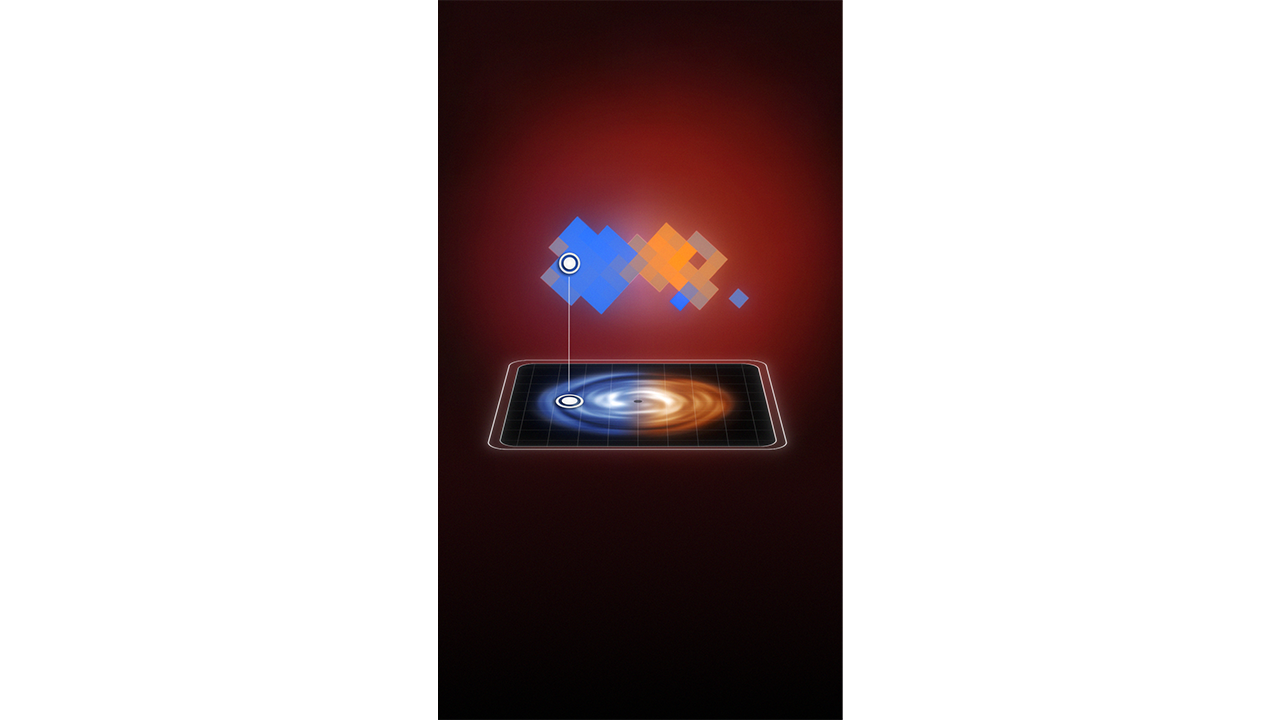
QSO1 is observed as it was 13.1 billion years ago—just 700 million years after the Big Bang.
The black hole at its center weighs about 40 million times the mass of the Sun.
The entire structure is only 1,300 light-years across—tiny compared to the Milky Way’s 100,000-light-year diameter.
JWST’s NIRCam can detect wavelengths from 0.6 to 5 microns, ideal for peering through cosmic dust.
The Little Red Dots: Cosmic Rosetta Stones
QSO1 is not an isolated case. It belongs to a growing class of objects known as “Little Red Dots”—faint, red, point-like sources detected in deep-field images from JWST. These objects are thought to be early-stage galaxies or black hole nurseries, glowing with the light of hot gas and young stars.
What makes QSO1 special is its clarity. Thanks to gravitational lensing, astronomers can resolve its structure in ways that would be impossible for most other Little Red Dots. The triple imaging allows scientists to compare multiple views of the same object, helping them distinguish between light from the black hole’s accretion disk and light from surrounding star formation.
“We’re seeing the black hole’s influence before the galaxy has even settled,” explains Dr. Maiolino. “It’s like watching a skyscraper rise from the ground before the city around it is built.”
This discovery suggests that black holes may not just be byproducts of galaxy formation—they might actually drive it. By emitting powerful radiation and jets of energy, early black holes could have heated surrounding gas, triggered star formation, or even prevented it in some regions. In this view, black holes are not passive passengers but active architects of the cosmos.
How Webb’s Instruments Unlocked the Mystery
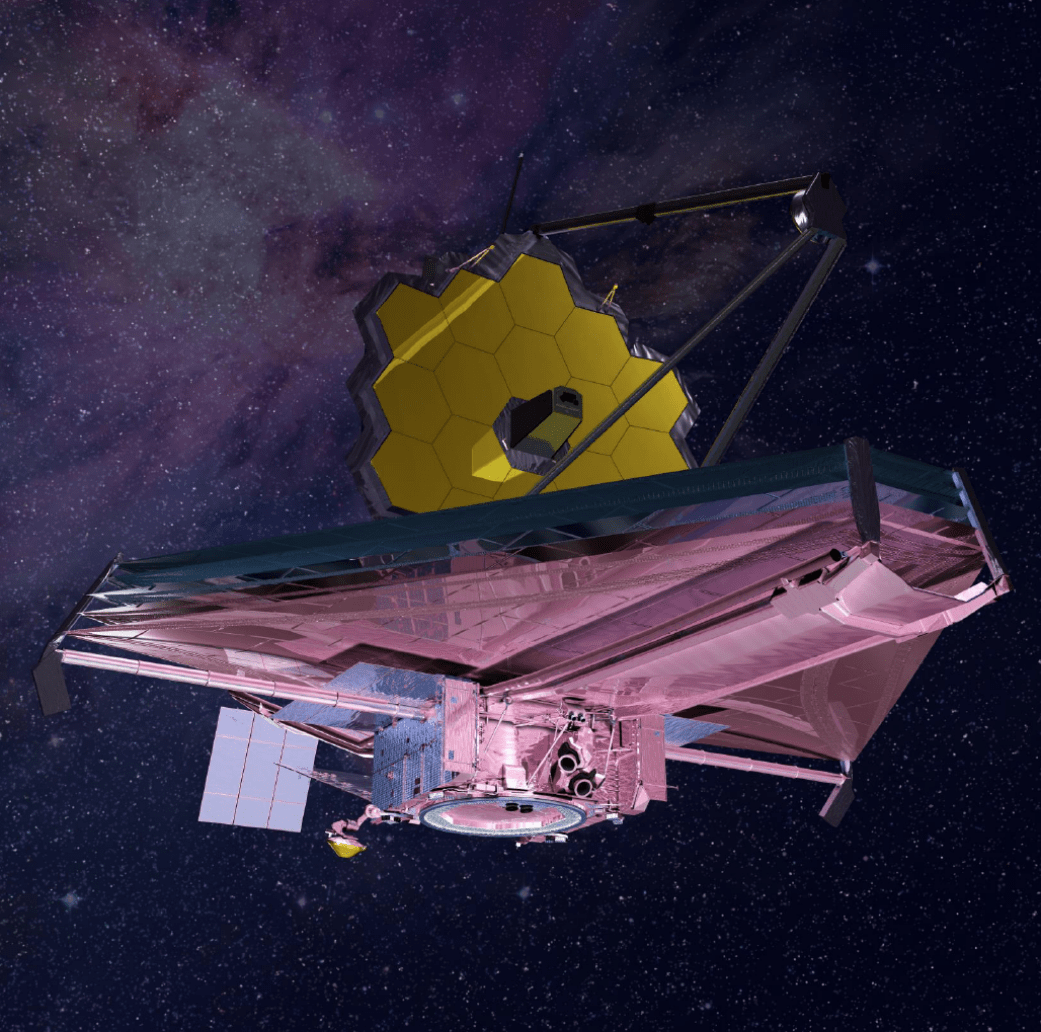
The James Webb Space Telescope’s suite of instruments made this discovery possible. NIRCam, the Near-Infrared Camera, captured the detailed images of QSO1, revealing its triply lensed appearance. Meanwhile, the Near-Infrared Spectrograph (NIRSpec) analyzed the light from the object, identifying the chemical signatures of hydrogen and helium and confirming the presence of a supermassive black hole.
JWST’s ability to observe in the infrared is crucial. As light from the early universe travels across billions of light-years, it becomes redshifted—stretched to longer, redder wavelengths due to the expansion of space. Visible light from QSO1, for example, has shifted into the infrared, where JWST’s instruments are perfectly tuned to detect it.

Rethinking Cosmic Evolution
The implications of QSO1 extend far beyond a single object. If black holes can form before galaxies, it forces a reevaluation of how structure emerges in the universe. Traditional models assume a bottom-up approach: small structures merge to form larger ones. But QSO1 suggests a top-down process, where massive gravitational anchors form first, pulling in gas and stars to build galaxies around them.
This idea echoes earlier theories about “seed” black holes, but with a twist. Instead of growing slowly from stellar remnants, these seeds may have been born massive—perhaps from the collapse of primordial gas clouds in the early universe’s densest regions.
“We’re seeing the universe in a new light,” says Dr. Maiolino. “It’s not just about how galaxies grow—it’s about how gravity, gas, and black holes interact from the very beginning.”
The Future of Cosmic Archaeology
As JWST continues its mission, astronomers expect to find more objects like QSO1. Each discovery will help refine models of black hole and galaxy formation, offering clues about the universe’s infancy. Future observations with MIRI (Mid-Infrared Instrument) and FGS/NIRISS (Fine Guidance Sensor and Near-Infrared Imager and Slitless Spectrograph) will provide even deeper insights into the composition and dynamics of these early systems.
Moreover, the international collaboration behind JWST—led by NASA with contributions from ESA (European Space Agency) and CSA (Canadian Space Agency)—demonstrates the power of global scientific partnership in unraveling the universe’s greatest mysteries.
Conclusion: A New Chapter in Cosmic History
The discovery of a black hole that formed before its galaxy is more than a curiosity—it’s a revolution. It challenges long-held assumptions, opens new avenues for research, and reminds us how much we still have to learn about the universe. With every image from JWST, we’re not just looking at distant objects; we’re peering into the past, witnessing the birth of cosmic giants.
As scientists continue to analyze data from the Little Red Dots and other early universe phenomena, one thing is clear: the story of the cosmos is far more complex—and far more fascinating—than we ever imagined. The chicken-or-egg debate may never be fully settled, but thanks to Webb, we’re getting closer to understanding which came first in the grand cosmic dance.
This article was curated from NASA’s Webb Reveals Black Hole That Formed Before Its Galaxy via NASA Breaking News