Table of Contents
The Universe’s Earliest Monsters: JWST Spots a Lone Supermassive Black Hole Adrift in the Cosmic Dawn
In the vast, silent expanse of the early universe, where time stretched like taffy and galaxies were just beginning to stir, a strange and luminous anomaly has captured the attention of astronomers. Dubbed the “little red dot,” this enigmatic object is not a newborn star cluster, nor a distant nebula, but something far more extraordinary: a naked supermassive black hole, adrift in the cosmic dark ages with no galaxy to call its own. Discovered by the James Webb Space Telescope (JWST), this object—formally known as Abell 2744−QSO1—offers a rare and startling glimpse into the violent, mysterious infancy of black holes that now anchor nearly every galaxy in the cosmos.
The discovery challenges long-standing assumptions about how supermassive black holes form and evolve. For decades, astronomers believed these gravitational giants grew in tandem with their host galaxies, feeding on gas and dust within galactic cores. But this “little red dot” suggests a different origin story—one where black holes may have formed first, blazing into existence before the galaxies that would eventually surround them. It’s as if a city’s central power plant began operating long before the streets, buildings, or even the first residents arrived.
The Dawn of Light and the Birth of Monsters
To understand the significance of Abell 2744−QSO1, we must first travel back to a time when the universe was still in its infancy. Just 700 million years after the Big Bang, the cosmos was a much darker, denser place. The first stars had only recently ignited, their fierce ultraviolet radiation beginning to carve out bubbles of ionized hydrogen in the otherwise neutral gas that filled space. This era, known as the Epoch of Reionization, marks a pivotal moment in cosmic history—the transition from a dark, opaque universe to one illuminated by starlight.
It was during this turbulent period that JWST, with its unprecedented infrared sensitivity, began scanning the sky. Designed to peer through cosmic dust and detect the faintest glimmers from the universe’s earliest epochs, the telescope quickly uncovered a population of compact, red, and surprisingly bright objects. These were dubbed “little red dots” due to their small angular size and deep red hue—colors that indicate extreme distance and redshift, meaning we’re seeing them as they were billions of years ago.
At first, astronomers debated whether these dots were dense clusters of ancient stars or something else entirely. But detailed spectroscopic analysis revealed a smoking gun: broad emission lines in their light spectra, a hallmark of gas swirling at tremendous speeds around a supermassive black hole. The red color, it turned out, wasn’t from stars—it was from the hot, accreting material spiraling into the black hole’s event horizon, glowing fiercely in infrared wavelengths.

A Black Hole Without a Galaxy: The Cosmic Orphan
What makes Abell 2744−QSO1 truly remarkable is not just its age, but its isolation. Unlike the supermassive black holes we see today—each nestled at the heart of a bustling galaxy—this one appears to be galaxy-less, a solitary titan floating in the void. This challenges the traditional model of galaxy formation, which assumes that black holes and galaxies grow together, feeding off the same reservoir of gas and influencing each other’s evolution through feedback mechanisms.
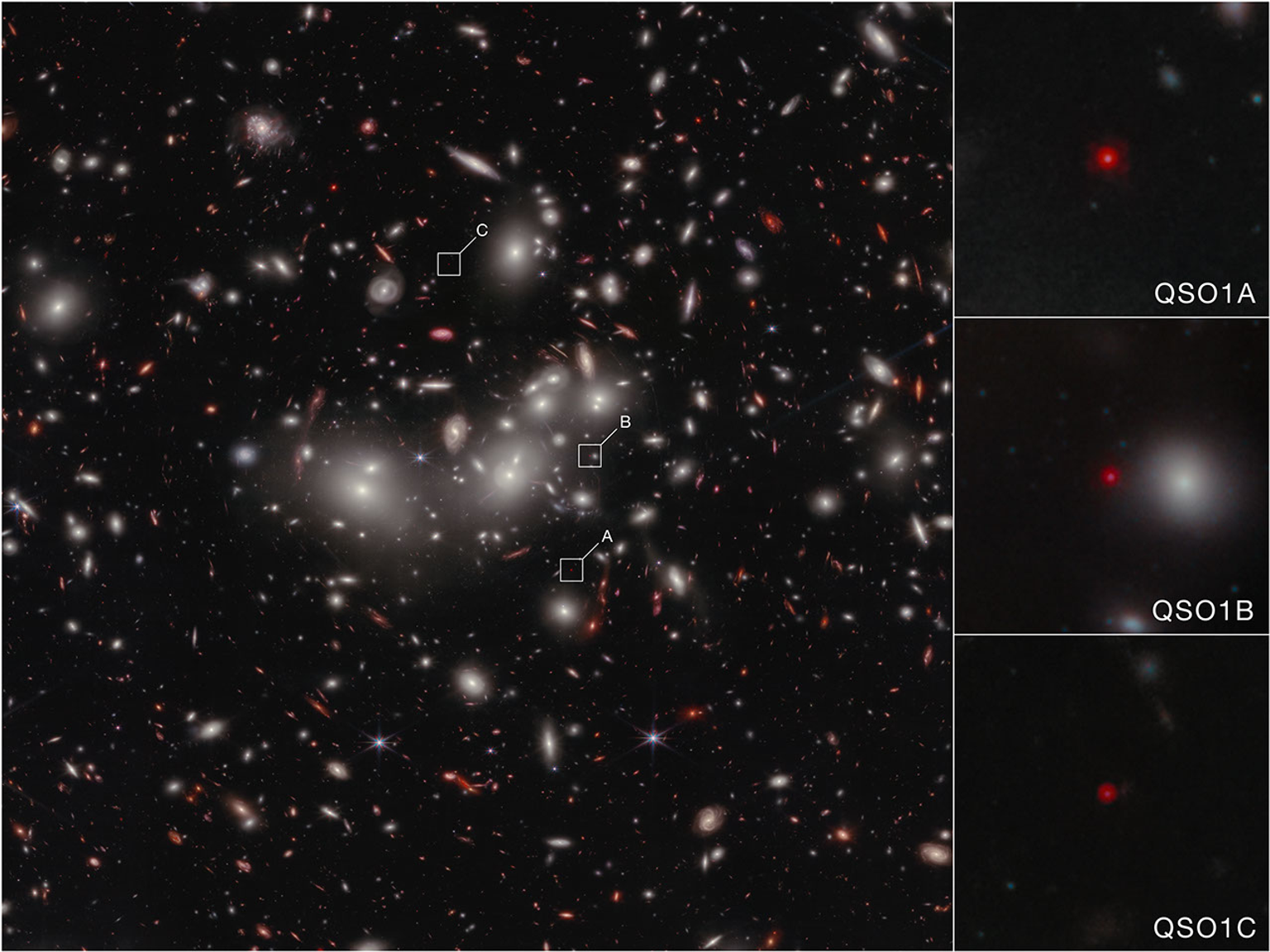
The discovery was made possible by a natural cosmic magnifying glass: gravitational lensing. As light from Abell 2744−QSO1 passed near the massive galaxy cluster Abell 2744, the cluster’s immense gravity bent and distorted the light, acting like a telescope. This effect not only magnified the object’s brightness but also produced three distinct images of the same source, scattered around the cluster. By analyzing these multiple images, astronomers could confirm the object’s intrinsic brightness and rule out the possibility that it was merely a foreground object or a lensed star cluster.
The data revealed that the black hole is actively accreting matter at a prodigious rate, shining with the luminosity of billions of suns—yet there’s no detectable stellar population around it. No signs of a host galaxy, no surrounding star clusters, no disk of gas and dust typical of galactic nuclei. It’s as if the black hole was born fully formed, a gravitational seed that never got the chance—or the material—to build a galaxy around itself.

How Could a Black Hole Form So Early—and Alone?
The existence of a supermassive black hole just 700 million years after the Big Bang raises profound questions about the origins of these cosmic giants. According to current theories, black holes form from the collapse of massive stars, but even the most massive stars would take hundreds of millions of years to evolve, die, and potentially merge into larger black holes. To reach 100 million solar masses in such a short time, the black hole must have formed through a much faster mechanism.
One leading hypothesis is the direct collapse model, in which massive clouds of primordial gas—devoid of metals and cooled only by molecular hydrogen—collapsed directly into black holes weighing 10,000 to 100,000 solar masses. These “seed” black holes could then grow rapidly by accreting surrounding gas, bypassing the slow process of stellar evolution. In this scenario, Abell 2744−QSO1 could be one of these primordial seeds, caught in the act of rapid growth before it had time to gather a galaxy.
Another possibility is that the black hole once had a galaxy, but it was torn apart by gravitational interactions or stripped of its stars and gas by the harsh environment of the early universe. Alternatively, the galaxy may simply be too faint or too distant for current instruments to detect. JWST’s sensitivity is extraordinary, but even it has limits—especially when searching for dim, diffuse structures around extremely bright point sources.

The Role of Gravitational Lensing in Unveiling Cosmic Secrets
Gravitational lensing, predicted by Einstein’s theory of general relativity, has become one of astronomy’s most powerful tools. When a massive object—like a galaxy cluster—sits between Earth and a distant source, its gravity bends the path of light, creating magnified, distorted, or even multiple images of the background object. This natural telescope effect allows astronomers to study objects that would otherwise be too faint or too small to resolve.
In the case of Abell 2744−QSO1, lensing didn’t just magnify the object—it provided crucial geometric information. The three images appeared at different positions and brightness levels, allowing researchers to reconstruct the original source and confirm its nature. Without lensing, the object might have remained hidden or misidentified. This technique has already revealed dozens of early galaxies and black holes, but Abell 2744−QSO1 stands out as one of the most extreme examples.
Future observations with JWST and next-generation telescopes like the Nancy Grace Roman Space Telescope will search for more such “naked” black holes, potentially uncovering a whole population of early-universe monsters that formed before their galaxies. These discoveries could rewrite our understanding of cosmic structure formation, suggesting that black holes may have played a more dominant role in shaping the universe than previously thought.
It shines with the light of over 100 billion suns, yet has no detectable host galaxy.
Gravitational lensing magnified its brightness by a factor of 10–20, making it visible to JWST.
The black hole is accreting matter at nearly the theoretical maximum rate, known as the Eddington limit.
Its discovery supports the idea that supermassive black holes can form before their host galaxies.
What This Means for the Future of Cosmology
The discovery of a naked supermassive black hole in the early universe is more than just a curiosity—it’s a paradigm shift. It suggests that the seeds of today’s galactic giants may have been sown in the first few hundred million years after the Big Bang, long before the galaxies we see today had even begun to take shape. This “bottom-up” model of cosmic evolution—where black holes form first and galaxies later coalesce around them—challenges the traditional “top-down” view.
Moreover, these early black holes may have played a crucial role in reionizing the universe. Their intense radiation could have helped strip electrons from hydrogen atoms, contributing to the clearing of the cosmic fog that shrouded the early cosmos. In this way, black holes weren’t just passive observers of cosmic history—they were active participants, shaping the universe’s evolution from the very beginning.
As JWST continues its mission, astronomers expect to find more such objects, each offering a new piece of the puzzle. The “little red dots” may turn out to be a common feature of the early universe, a hidden population of black holes that have remained invisible until now. And with each discovery, we come closer to answering one of the most profound questions in science: How did the universe’s largest structures form, and what role did black holes play in their creation?
In the end, Abell 2744−QSO1 is more than just a distant point of light—it’s a time capsule, a messenger from the dawn of time, whispering secrets about the universe’s violent, luminous, and mysterious beginnings. And as we peer deeper into the cosmic past, we may find that the monsters of the early universe were not just real—they were the architects of everything we see today.
This article was curated from "Little red dot" in early Universe is a naked supermassive black hole via Ars Technica – Science