Table of Contents
- The Bizarre Physics of Oobleck: When Liquids Turn Solid on Command
- What Makes Oobleck So Unusual?
- The Science Behind the Splat: What Happens When Oobleck Hits a Surface?
- Oobleck in the Real World: From Playgrounds to Protective Gear
- The History and Cultural Impact of Oobleck
- Why Oobleck Still Surprises Scientists
- The Future of Oobleck: From Classroom to Cutting-Edge Tech
The Bizarre Physics of Oobleck: When Liquids Turn Solid on Command
Imagine a substance that behaves like water when you gently swirl it in a bowl, but transforms into something as hard as concrete the moment you punch it. It sounds like science fiction, but this strange material exists—and it’s made from nothing more than cornstarch and water. Known affectionately as oobleck, this non-Newtonian fluid continues to baffle physicists and delight children in equal measure. Despite its simple recipe, oobleck still holds surprising secrets, recently uncovered through high-speed imaging and precision force measurements published in Physical Review Letters.
Named after a gooey, otherworldly substance in Dr. Seuss’s 1949 book Bartholomew and the Oobleck, this kitchen-science marvel has become a staple of science demonstrations and sensory play. But beneath its playful exterior lies a complex interplay of physics that challenges our everyday understanding of how materials behave under stress. Oobleck isn’t just a curiosity—it’s a window into the strange world of non-Newtonian fluids, where the rules of classical fluid dynamics bend and break.
What Makes Oobleck So Unusual?
At its core, oobleck is a suspension of tiny cornstarch particles in water. When left undisturbed, the particles settle and the mixture flows like a thick liquid. But the moment you apply sudden force—say, by stomping on it or slapping its surface—the behavior shifts dramatically. The particles lock together, creating temporary solid structures that resist deformation. This phenomenon, known as shear thickening, is the hallmark of certain non-Newtonian fluids.
Unlike water, which maintains a constant viscosity whether you stir it slowly or whip it violently, oobleck’s viscosity is highly dependent on the rate of shear stress. The faster you move, the more resistant it becomes. This is why you can walk slowly across a pool of oobleck—it yields under your feet—but if you try to run, your feet will sink. The sudden impact causes the particles to jam together, forming a solid-like network that can support weight.
This behavior isn’t just theoretical. Engineers have studied oobleck-like materials for use in body armor and protective gear. Imagine a vest that remains flexible during normal movement but instantly stiffens upon impact from a bullet or shrapnel. Such “smart fluids” are already being tested in military and industrial applications, leveraging the same physics that make oobleck so mesmerizing.
The Science Behind the Splat: What Happens When Oobleck Hits a Surface?
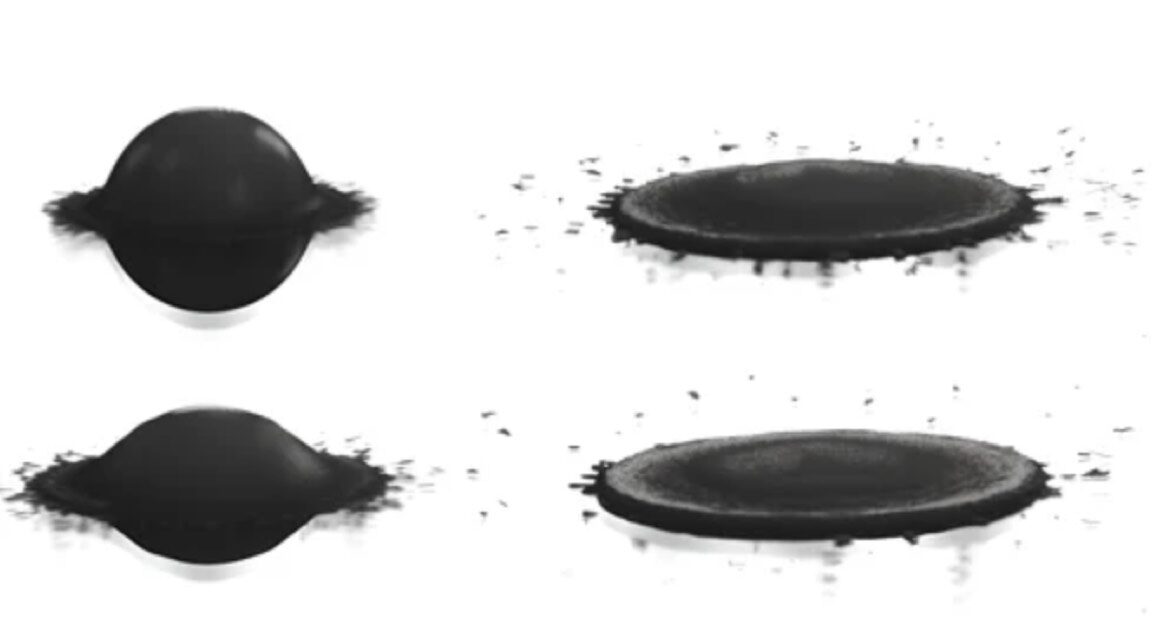
Recent research has shed new light on what happens when a droplet of oobleck strikes a flat surface. Using high-speed cameras and force sensors, scientists observed that the impact doesn’t produce a typical splash. Instead, the droplet flattens and spreads, but then—unexpectedly—forms a rigid “skin” at its edges while the center remains liquid. This creates a unique pattern: a solid ring surrounding a liquid core, a phenomenon not seen in ordinary fluids like water or oil.
This behavior arises from the rapid increase in viscosity at the point of impact. As the droplet hits the surface, the outer edges experience the highest shear rates, causing the cornstarch particles to lock into place almost instantly. The center, experiencing less shear, remains fluid. The result is a hybrid structure—part solid, part liquid—that defies conventional fluid dynamics.
This discovery has implications beyond the lab. Understanding how non-Newtonian fluids behave under impact could improve industrial processes like spray coating, inkjet printing, and even food manufacturing. For example, controlling the spread and solidification of liquid suspensions could lead to more precise 3D printing techniques or better-textured food products.
Oobleck in the Real World: From Playgrounds to Protective Gear
While oobleck is often associated with classroom experiments and sensory bins, its real-world applications are surprisingly diverse. One of the most promising uses is in body armor and impact-resistant materials. Companies like Armor Holdings and research teams at institutions such as the University of Delaware have developed fabrics infused with shear-thickening fluids (STFs) that behave like oobleck.
These STF-enhanced materials remain flexible and lightweight during normal use, allowing soldiers or athletes to move freely. But when struck by a high-velocity object, the fluid inside the fabric instantly thickens, absorbing and dispersing the energy of the impact. This dual behavior—soft until stressed—makes it ideal for protective gear that doesn’t compromise mobility.
Beyond defense, oobleck-like materials are being explored in robotics and soft engineering. Researchers are developing “jamming grippers” that use granular materials suspended in fluid to pick up delicate objects. When the gripper surrounds an item and applies suction, the fluid evacuates, causing the particles to jam together and form a rigid grasp. This technology could revolutionize manufacturing, allowing robots to handle everything from eggs to circuit boards with the same tool.
The History and Cultural Impact of Oobleck
Though oobleck seems like a modern scientific curiosity, its roots stretch back much further. The concept of non-Newtonian fluids has been known since the 19th century, but it wasn’t until the mid-20th century that materials like oobleck gained public attention. The name “oobleck” itself comes from Dr. Seuss’s whimsical tale, where a magical green goo falls from the sky and wreaks havoc on the kingdom of Didd. The book, published in 1949, was a commentary on environmental responsibility and the unintended consequences of human actions—themes that resonate even today.
Since then, oobleck has become a cultural icon in science education. It’s a favorite in STEM classrooms because it’s safe, easy to make, and visually dramatic. Teachers use it to demonstrate states of matter, viscosity, and the scientific method. Children love it because it feels like magic—walking on water, punching a liquid that turns solid, watching it ooze through fingers like quicksand.
But oobleck’s appeal isn’t limited to kids. Artists and performers have used it in installations and live demonstrations. In 2015, a group of artists created a giant oobleck pool in a public square, inviting people to walk, jump, and dance on its surface. The event drew thousands, blending science, art, and play in a way few other materials can.
Why Oobleck Still Surprises Scientists
Despite decades of study, oobleck continues to reveal new secrets. The recent discovery of its unique impact behavior—forming a solid ring around a liquid core—shows that even simple mixtures can exhibit complex physics. Scientists are still unraveling the microscopic mechanisms behind shear thickening. Why do the particles lock up so suddenly? How do forces propagate through the suspension? These questions remain active areas of research.
One leading theory involves hydroclusters—temporary aggregates of particles that form under shear stress. When force is applied, water is squeezed out from between the cornstarch grains, causing them to clump together. These clusters increase resistance to flow, effectively turning the fluid into a solid. But the exact conditions under which hydroclusters form and dissolve are still being mapped.
Understanding these mechanisms could lead to breakthroughs in material science. Imagine designing fluids that can switch between liquid and solid states on demand—used in everything from self-healing coatings to adaptive shock absorbers. Oobleck may be made of corn and water, but its potential is anything but ordinary.
It’s made from cornstarch and water in a 2:1 ratio.
The name comes from a Dr. Seuss book published in 1949.
It’s used in research for body armor and smart materials.
High-speed imaging revealed it forms a solid ring when droplets hit a surface.
The phenomenon is due to particle jamming under shear stress.
Oobleck has inspired art installations and public science events.
Scientists still don’t fully understand the microscopic mechanics behind its behavior.
The Future of Oobleck: From Classroom to Cutting-Edge Tech
As research continues, oobleck is poised to play a bigger role in emerging technologies. One exciting frontier is soft robotics, where materials that can change stiffness on demand are essential. Imagine a robotic arm that can gently pick up a flower or firmly grip a tool, all by adjusting the fluid inside its structure. Oobleck-like materials could make this possible.
Another area is energy absorption. In automotive and aerospace engineering, materials that can dissipate impact energy are crucial for safety. Shear-thickening fluids could be integrated into car bumpers or aircraft hulls to absorb crash forces more effectively than traditional materials.
Even in everyday life, oobleck-inspired innovations could emerge. Think of self-sealing tires that harden when punctured, or sports shoes that adapt their cushioning based on the intensity of movement. The line between liquid and solid is blurring, and oobleck is leading the way.
Oobleck reminds us that the most ordinary ingredients can yield extraordinary behaviors. What began as a children’s book character has evolved into a scientific marvel with real-world impact. From playgrounds to battlefields, from art galleries to laboratories, oobleck continues to surprise, inspire, and challenge our understanding of matter. And as scientists peer deeper into its mysterious flow, one thing is clear: this humble mixture of corn and water still has plenty of tricks up its sleeve.
This article was curated from "Oobleck" still holds some surprises via Ars Technica – Science