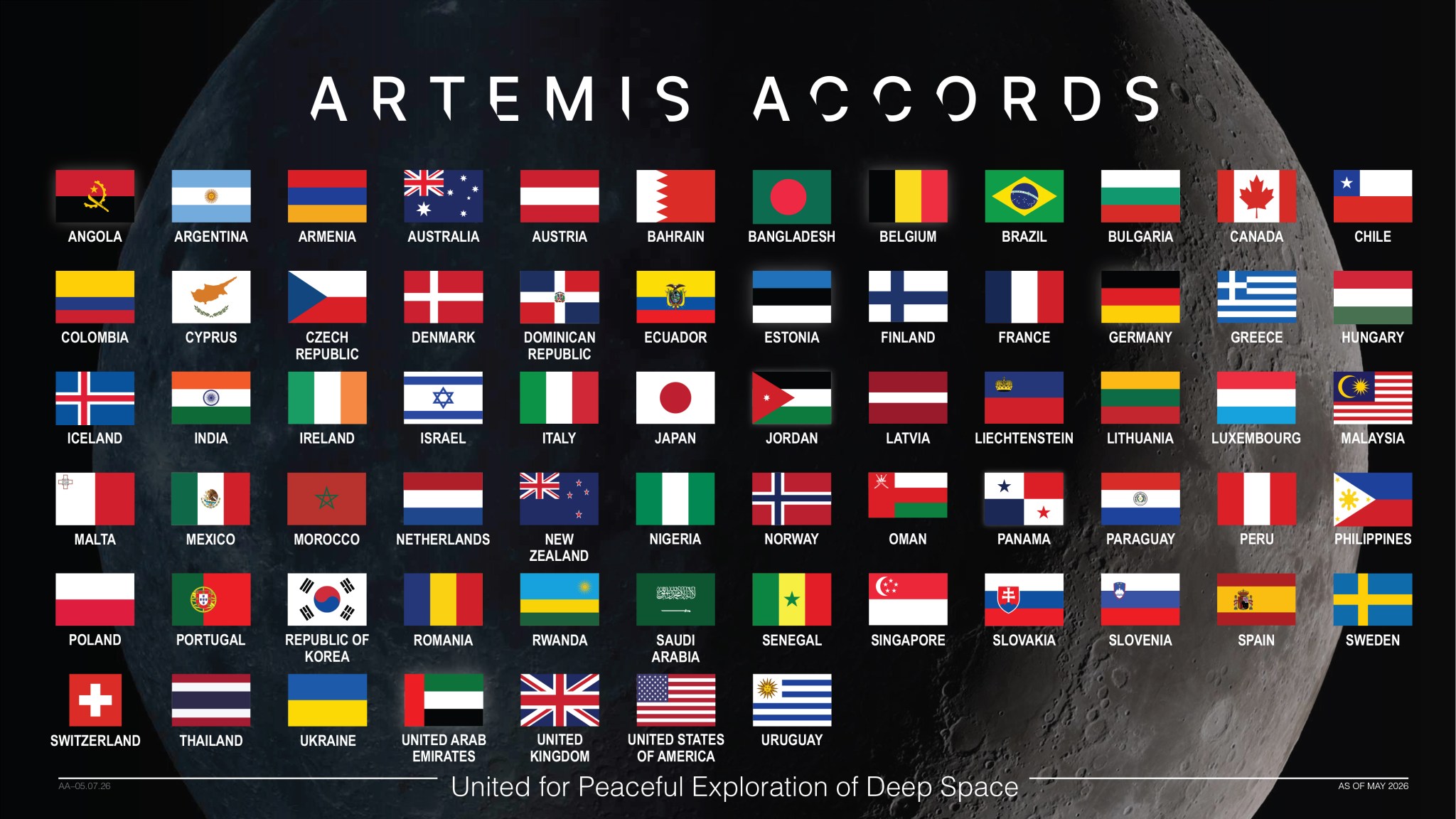
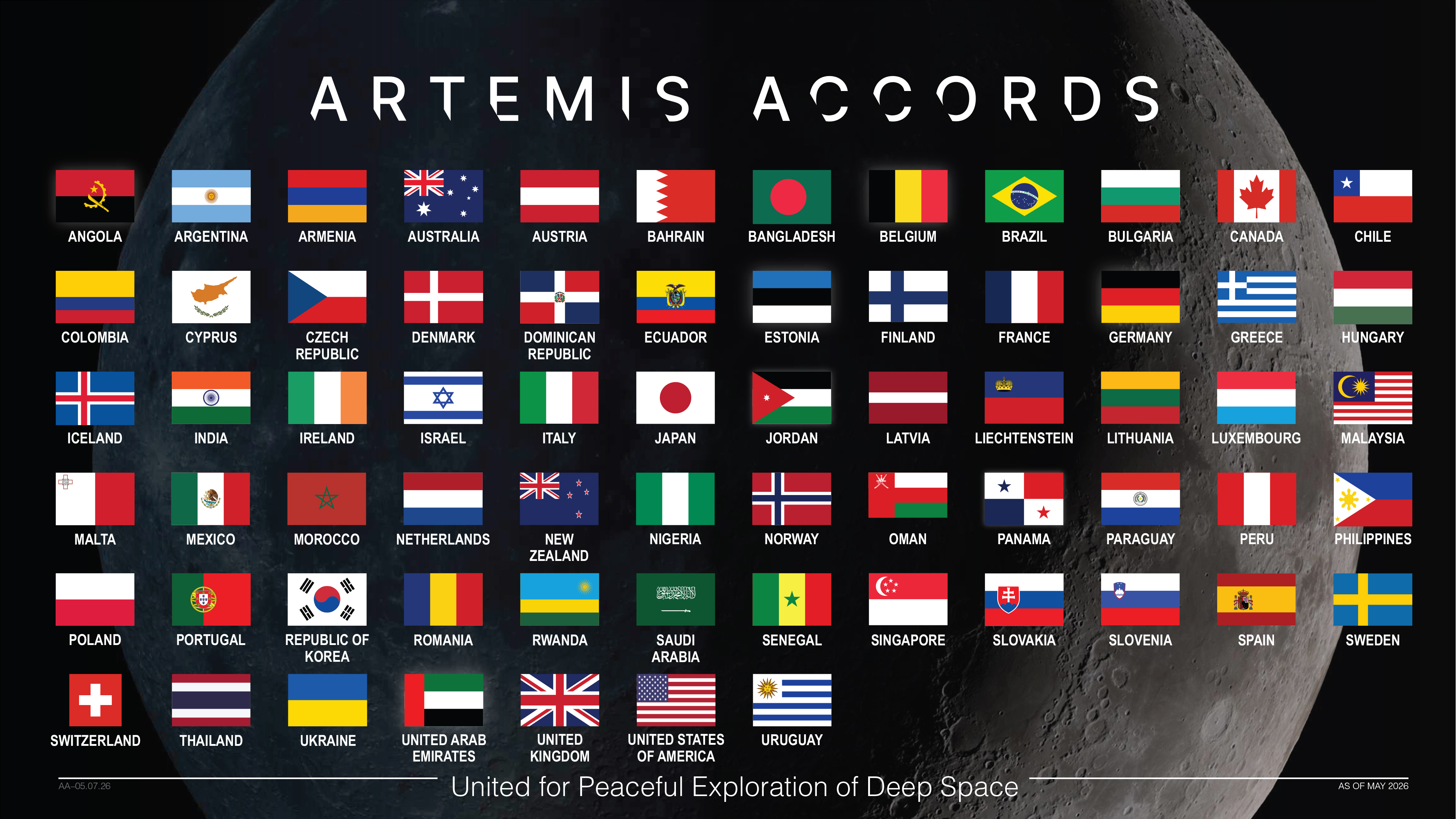
Paraguay has officially joined the global space race, marking a historic milestone in international cooperation beyond Earth’s atmosphere. On a pivotal day in Asunción, the South American nation became the 67th signatory of the Artemis Accords, a landmark agreement that sets the foundation for peaceful, transparent, and responsible exploration of the Moon, Mars, and deeper space. This signing not only elevates Paraguay’s role in the global space community but also signals a growing movement among nations—both large and small—to participate in humanity’s next great leap.
The ceremony, held with diplomatic gravity and scientific optimism, saw Osvaldo Almirón Riveros, Minister President of the Paraguayan Space Agency (AEP), sign the accords on behalf of his nation. Representing the United States, Aaron Pratt, Chargé d’Affaires ad interim at the U.S. Embassy in Asunción, delivered remarks from NASA Administrator Jared Isaacman, who hailed the moment as a triumph of international collaboration. “Today, I am proud to welcome Paraguay as the 67th signatory to the Artemis Accords,” Isaacman stated. “They join an ever-growing coalition of like-minded nations committed to the peaceful, transparent, and responsible exploration of space.”
This moment is more than symbolic. It reflects a fundamental shift in how space exploration is being approached in the 21st century—no longer the exclusive domain of superpowers, but a shared endeavor open to nations of all sizes and capabilities. With Paraguay’s inclusion, the Artemis Accords now represent a truly global vision, spanning six continents and encompassing a diverse array of cultural, economic, and scientific perspectives.
Paraguay’s journey to this moment has been years in the making. The Paraguayan Space Agency (AEP) was founded in 2014, a bold move for a nation with limited prior experience in space technology. Yet, from its inception, AEP focused on building practical capabilities in satellite development and Earth observation—areas critical for agriculture, disaster management, and environmental monitoring in a country where over 30% of the economy is tied to agriculture.
In 2021, Paraguay achieved a major milestone with the launch of GuaraníSat-1, its first domestically developed satellite. Deployed from the International Space Station, the CubeSat was a testament to the nation’s growing technical prowess and international partnerships. Now, the country is preparing for an even more ambitious step: the launch of GuaraníSat-2 in October aboard a SpaceX Falcon 9 rocket from Vandenberg Space Force Base in California.
What makes GuaraníSat-2 particularly notable is its collaborative development. The mission was built in partnership with NASA’s Jet Propulsion Laboratory (JPL) and other international entities, showcasing how smaller space agencies can contribute to—and benefit from—cutting-edge space science. The satellite will carry advanced Earth observation instruments designed to monitor deforestation, water resources, and agricultural productivity across Paraguay and the broader region.

The Artemis Accords were established in 2020 with 8 founding members.
Paraguay launched its first satellite, GuaraníSat-1, in 2021.
GuaraníSat-2 is scheduled for launch in October 2024.
Over 40% of Paraguay’s land is used for agriculture, making Earth observation satellites vital.
NASA’s Artemis program aims to return humans to the Moon by 2026.
The first Artemis mission with astronauts is planned for 2025 (Artemis II).
The long-term goal includes establishing a sustainable lunar base by the 2030s.
Paraguay’s signing of the Artemis Accords is not just a diplomatic formality—it’s a strategic commitment to the principles that will govern humanity’s future in space. These principles include peaceful exploration, transparency in operations, interoperability between space systems, emergency assistance, the public release of scientific data, and the protection of space heritage sites.
One of the most significant aspects of the accords is the emphasis on peaceful use of space. In an era where geopolitical tensions can spill beyond Earth, the Artemis Accords serve as a diplomatic framework to prevent conflict in orbit and on celestial bodies. By signing, Paraguay affirms its dedication to using space for the benefit of all humankind, not for military dominance or territorial claims.
Transparency is another cornerstone. Signatory nations agree to publicly disclose their space policies, scientific discoveries, and mission plans. This openness fosters trust and enables better coordination—critical when multiple spacecraft are operating in the same region of space, such as near the Moon.
Paraguay’s inclusion in this coalition also opens new doors for scientific collaboration. As part of the Artemis network, Paraguayan scientists and engineers will have opportunities to contribute to lunar research, participate in joint missions, and access data from NASA’s upcoming Artemis expeditions. This could include analyzing lunar soil samples, studying the Moon’s geology, or even contributing instruments to future lunar landers.
Moreover, the Artemis Accords encourage the development of sustainable space practices. This includes minimizing orbital debris, avoiding harmful contamination of celestial bodies (planetary protection), and preserving historically significant sites—such as the Apollo landing zones—as “space heritage.” Paraguay’s commitment to these principles reflects a mature understanding of space as a shared commons, not a frontier for exploitation.
The Artemis program itself is named after the Greek goddess of the Moon and twin sister of Apollo, symbolizing a new era of exploration that builds on the legacy of the Apollo missions while aiming for permanence and inclusivity. Unlike the Apollo era, which was largely a U.S.-Soviet competition, Artemis is designed as a global partnership.

NASA’s vision includes establishing a lunar base—potentially near the Moon’s south pole, where water ice is believed to exist in permanently shadowed craters. This base would serve as a proving ground for technologies needed for Mars and beyond. Signatory nations like Paraguay could play roles in supplying scientific expertise, developing communication systems, or even contributing modules to the lunar habitat.
Paraguay’s space ambitions are not limited to satellites and accords. The country is investing in STEM education and workforce development to build a sustainable pipeline of space professionals. Universities in Asunción and Ciudad del Este are expanding aerospace engineering programs, and AEP has launched outreach initiatives to inspire the next generation of scientists and engineers.
This long-term investment is crucial. Space exploration is not just about launching rockets—it’s about building ecosystems of innovation, education, and international cooperation. Paraguay’s approach mirrors that of other emerging space nations like Costa Rica, Rwanda, and the Philippines, which are leveraging space technology for national development while contributing to global knowledge.
The geopolitical significance of Paraguay’s signing should not be overlooked. In a region where space activity has traditionally been dominated by Brazil and Argentina, Paraguay’s entry diversifies the Latin American space landscape. It also strengthens U.S.-Paraguay relations, particularly in science and technology diplomacy—a growing area of strategic importance.
As the Artemis Accords continue to expand, they are shaping a new model of international space governance. Unlike formal treaties, which require lengthy ratification processes, the accords are non-binding agreements based on consensus and shared values. This flexibility allows for rapid inclusion of new partners and adaptation to evolving challenges.
Looking ahead, Paraguay’s role in the Artemis coalition could evolve in exciting ways. The nation may contribute to lunar resource mapping, help develop sustainable life-support systems, or even participate in international astronaut training programs. With continued investment and collaboration, Paraguay could become a model for how smaller nations can meaningfully engage in space exploration.
In conclusion, Paraguay’s signing of the Artemis Accords is a powerful symbol of a changing world—one where space is no longer reserved for the few, but a shared domain for the many. It reflects a commitment to peace, science, and cooperation at a time when such values are more important than ever. As humanity prepares to return to the Moon and reach for Mars, nations like Paraguay remind us that the future of space is not just about technology—it’s about unity, vision, and the collective pursuit of knowledge.
This article was curated from NASA Welcomes Paraguay as 67th Artemis Accords Signatory via NASA Breaking News