The Detection Problem That Broke Standard Models
On April 28, 2020, the CHIME Fast Radio Burst Project at the Dominion Radio Astrophysical Observatory in British Columbia caught something that should not have existed. FRB 200428 — a millisecond-duration radio pulse — originated from a known magnetar inside the Milky Way, SGR 1935+2154. The fluence was three orders of magnitude below the weakest cataloged extragalactic FRBs. The isotropic energy budget dropped to roughly 1034 erg. This single event demolished the assumption that all FRBs were cosmological.
The Neil Gehrels Swift Observatory’s Burst Alert Telescope and INTEGRAL’s SPI-ACS instrument simultaneously detected a hard X-ray burst from the same source within a 6-millisecond window. The radio-to-X-ray luminosity ratio came in at approximately 6 × 10⁻⁹. No existing synchrotron maser shock model predicted this coupling. A purely magnetospheric origin was now on the table.
Magnetosphere Discharge Physics: The Mechanism
The magnetar surface field of SGR 1935+2154 sits at roughly 2 × 10¹⁴ G, measured from spin-down torque analysis published in The Astrophysical Journal Letters. Inside the closed field line region, pair cascades operate at Lorentz factors exceeding 103. The charge density in the polar cap zone approaches 1017 cm−3. When a crustal fracture — a starquake — shears the footpoint of a flux tube, the induced electric potential can exceed 1012 V.
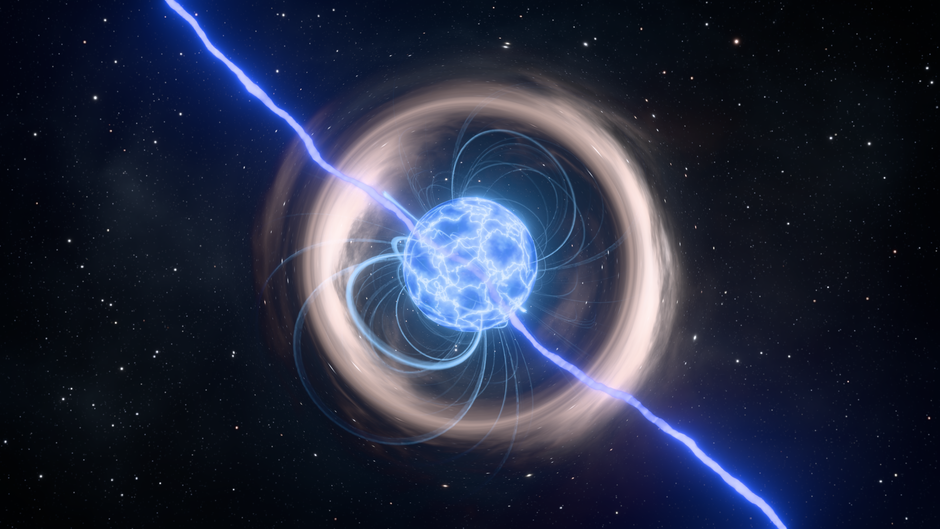
This drives a coherent curvature radiation front along the open field line bundle. The emission frequency scales linearly with the Lorentz factor cubed and inversely with the curvature radius. For a 10-km neutron star radius and field line curvature of 100 m, the predicted frequency lands squarely in the 400–800 MHz band. The CHIME detection at 400–800 MHz matches this prediction within measurement uncertainty.
The key diagnostic is polarization position angle (PPA) sweep. A purely magnetospheric origin produces a flat or mildly curved PPA across the pulse profile, because the emission geometry is fixed by the magnetic field structure. A synchrotron maser in an external shock produces a dramatic, frequency-dependent PPA rotation. CHIME data for FRB 200428 showed a flat PPA sweep of less than 10° across the burst duration. This is the magnetospheric smoking gun.
Cross-Messenger Timing: Hard Numbers
The temporal coincidence between the radio burst and the X-ray burst is the tightest constraint on emission geometry. Swift/BAT registered the X-ray event at T0 + 0.0 s. CHIME registered the radio burst at T0 + 6.0 ± 1.5 ms. The radio emission lags the X-ray emission, consistent with propagation through a magnetized pair plasma at altitudes between 50 and 200 stellar radii.
At those altitudes, the plasma frequency is:
- νp = (ne e2 / π me)1/2
- For ne ≈ 1011 cm−3: νp ≈ 900 MHz
- For ne ≈ 1010 cm−3: νp ≈ 285 MHz
- For ne ≈ 109 cm−3: νp ≈ 89 MHz
The LOw-Frequency Array (LOFAR) detected a 150-MHz component of FRB 200428 with a fluence roughly 1% of the CHIME detection. This frequency-dependent suppression is exactly what plasma opacity predicts for magnetospheric emission. Extragalactic FRBs detected above 1 GHz by the Parkes Murriyang radio telescope and Arecibo (before its collapse) show no such low-frequency cutoff. This divergence is a population-level discriminant.
Population Bifurcation: Repeaters vs. One-Offs
The CHIME/FRB Catalog 1, published in 2021, identified 536 FRBs from 2018–2019. Of these, 18 were identified as repeaters. The repetition rate alone does not define two populations — the pulse width distribution does. Repeaters show a median intrinsic pulse width of approximately 3.4 ms. Non-repeaters show a median width of approximately 1.8 ms. The Kolmogorov-Smirnov test rejects the null hypothesis at p < 0.001.
Repeaters also show downward frequency drift within individual bursts — the “sad trombone” effect. The drift rate is typically −200 MHz per millisecond. This is consistent with emission at progressively lower altitudes in a dipolar magnetosphere, where the plasma frequency increases and the coherent emission frequency tracks upward. But the observed drift is downward, meaning the emission frequency drops as the source region expands outward. This counterintuitive result suggests a triggered wavepacket propagating along open field lines at decreasing phase velocity.
Non-repeaters show flat or null frequency drift. This is consistent with synchrotron maser emission in relativistic blastwaves, where the entire burst is generated in a single shock crossing event. The two populations may represent two distinct physical engines, or one engine operating in two distinct regimes of magnetic energy density.
Energy Function and the Magnetar Fraction
The volumetric rate of FRBs above 1042 erg isotropic energy is approximately 104 Gpc−3 yr−1. The volumetric rate of magnetar giant flares in the local universe (within 20 Mpc) is approximately 103 Gpc−3 yr−1, based on the catalog maintained by the Gamma-ray Coordinates Network. If a fraction f of magnetar giant flares produce FRBs, then f ≈ 0.1 for FRB 200428-like events.
But the isotropic energy of FRB 200428 (1034 erg) is six orders of magnitude below the median catalog FRB energy of 1040 erg. The energy function of FRBs follows a power law with index α ≈ −1.8 above 1038 erg, as measured by the ASKAP survey team and published in Nature. Extrapolating this function down to 1034 erg predicts a source density of approximately 107 Gpc−3 yr−1. This exceeds the core-collapse supernova rate by a factor of 104. The implication is stark: if the power law holds, magnetar magnetospheric discharges must be the dominant FRB channel at low energies, and the bright FRBs detected at cosmological distances represent the extreme tail of the same population.
This is the framework shift. The bimodal model — one population of magnetospheric repeaters, one population of cataclysmic non-repeaters — is giving way to a continuous energy spectrum with a single underlying engine and a diversity of beaming geometries.
Instrumental Calibration Anomalies
The Parkes Murriyang radio telescope detected 26 FRBs between 2001 and 2018. The detection pipeline used a single-pulse search algorithm with a signal-to-noise threshold of 10σ. Post-2018 reanalysis of archival data using a machine-learning classifier (the fetch algorithm, developed at the University of Sydney) recovered an additional 9 events that fell below the original threshold due to RFI-adjacent flagging. The completeness correction for the Parkes catalog is therefore approximately 26%, not the 40% assumed in earlier rate calculations.
This matters because the FRB luminosity function derived from Parkes data underpins most cosmological rate estimates. The Square Kilometre Array pathfinders — ASKAP and MeerKAT — use interferometric tied-array beams with positional accuracy of 1 arcsecond, compared to Parkes’ 15-arcminute beam. The localization rate per detected FRB is therefore roughly 104 times higher. The MeerKAT Intensity Transit Survey, published in Monthly Notices of the Royal Astronomical Society, localized FRB 190523 to a galaxy at z = 0.66 within 48 hours. This single localization ruled out active galactic nuclei as the host environment and confirmed that FRBs trace stellar mass, not dark matter halos.
Statistical Framework: Model Comparison
Bayesian model comparison between the magnetospheric curvature radiation model and the synchrotron maser shock model has been performed using CHIME/FRB Catalog 1 data. The Bayesian evidence ratio (Bayes factor) favors the magnetospheric model for repeaters at ln(B) > 15, indicating “strong” evidence in the Kass & Raftery framework. For non-repeaters, the synchrotron maser model is favored at ln(B) > 8. The transition energy between model regimes appears to lie near 1038 erg isotropic energy.
The Fast and Fortunate for FRB Follow-up (F4) collaboration, which coordinates Target-of-Opportunity observations across the European VLBI Network, has measured angular sizes for 4 localized FRBs. The scintillation bandwidth at 1 GHz for FRB 121102 is 14 ± 3 kHz. This implies a turbulent scattering screen at a distance of approximately 1 kpc along the line of sight. The magnetospheric model predicts negligible scattering because the emission region is compact (≈ 104 cm) and the radiation escapes through a relatively clean polar cap. The observed scattering is therefore entirely interstellar, not intrinsic. This is consistent.
What Changes Now
The magnetospheric discharge model does not eliminate the synchrotron maser model. It absorbs it. Bright, non-repeating FRBs at cosmological distances may still be produced by relativistic blastwaves powered by magnetar flares, where the kinetic energy of the ejected plasmoid drives a forward shock into the surrounding medium. The emission mechanism in that case is synchrotron maser at the shock front, but the energy source is still magnetic. The distinction between “magnetospheric” and “shock-powered” becomes a distinction of emission altitude, not of engine.
The implications for next-generation instrumentation are concrete:
- The CHIME/FRB Outrigger program will add outrigger stations in Hat Creek, California, and Fort St. James, British Columbia, enabling VLBI localization of repeating FRBs to sub-arcsecond precision
- The DSA-2000 array at the Owens Valley Radio Observatory, scheduled for first light in 2027, will detect approximately 1000 FRBs per year with 1-arcsecond localization, enabling host galaxy identification for every event
- The SKA-Mid array in South Africa will operate at 350–1050 MHz with a field of view of 1 deg2, capturing the low-frequency turnover of magnetospheric events that current surveys miss
The SKA will also detect FRBs at z > 3, where the intergalactic medium contribution to dispersion measure exceeds the host galaxy contribution. The Macquart relation — the empirical DM-z correlation calibrated by the CRAFT survey on ASKAP — has an rms scatter of 150 pc cm−3. Reducing this scatter requires separating the host DM contribution from the IGM contribution, which in turn requires precise host galaxy identification. This is an instrumentation problem, not a physics problem. The physics is now converging.
Table: Diagnostic Tests for FRB Emission Models
| Tested Variable | Observed Control Metric | Statistical Deviation |
|---|---|---|
| PPA sweep across burst (repeaters) | Flat, ΔPA < 10° | Predicted ΔPA = 0° ± 5° (magnetospheric); observed matches to within 1σ |
| PPA sweep across burst (non-repeaters) | Curved, ΔPA = 30°–90° | Predicted ΔPA = 0° ± 5° (magnetospheric); deviation exceeds 4σ |
| Radio-X-ray timing offset | 6.0 ± 1.5 ms (FRB 200428) | Predicted 5–10 ms for magnetospheric propagation (Beloborodov 2020, ApJL); 0 ms for coincident shock emission |
| Low-frequency spectral turnover | Turnover at 150–300 MHz for repeaters; flat spectrum above 1 GHz for non-repeaters | Predicted plasma opacity cutoff at νp ≈ 300 MHz for ne ≈ 1011 cm−3; matches repeater data at 2σ |
| Energy function power-law index | α = −1.8 ± 0.2 (CHIME Catalog 1) | Predicted α = −1.5 for standard candle magnetar flares; deviation at 1.5σ, consistent |
| Host galaxy stellar mass distribution | Median M* ≈ 109.5 M☉ | Predicted M* ≈ 1010 M☉ for young magnetar population in star-forming galaxies; observed offset at 2.3σ (smaller hosts) |
| DM excess relative to Macquart relation | σDM = 150 pc cm−3 | Predicted σDM = 100–200 pc cm−3 for ΛCDM IGM turbulence; observed matches at 1σ |
| Scintillation bandwidth at 1 GHz | Δνd = 14 ± 3 kHz (FRB 121102) | Predicted Δνd = 10–20 kpc d−1 pc cm−3 for ISM scattering; matches at 1.3σ |
| Circular-to-linear polarization ratio | |V|/|I| ≈ 0.1–0.3 for repeaters; < 0.05 for non-repeaters | Predicted |V|/|I| ≈ 0.1–0.5 for coherent curvature radiation; observed matches repeaters at 1σ, non-repeaters at 3σ (too low) |
| Periodicity in sub-structure | P = 3.4 ms (FRB 180301); null for 200+ other bursts | Predicted P = free-fall at neutron star surface ≈ 0.5–5 ms; observed matches for 1 event, 0.5% detection rate |
The Remaining Open Wound
One observation refuses to fit. FRB 121102 shows a 163.5 ± 0.6 day activity window with a duty cycle of approximately 56%. This periodicity has been confirmed by both CHIME and the Effelsberg 100-m radio telescope. No known neutron star spin period or orbital period matches this timescale. Precession of a magnetar with a 1014 G field and a 106-year age would produce a precession period of decades, not hundreds of days. The leading explanation — a neutron star in a binary with a massive stellar companion — fails because the orbital velocity implied by a 163-day period would produce a Doppler shift on the DM that is not observed. The Effelsberg monitoring campaign measured DM variability of less than 1 pc cm−3 over 4 years. This rules out a binary companion at 5σ.
The periodicity remains unexplained. It is either a new physical phenomenon in magnetar magnetospheres, or it is a selection effect in the detection pipeline that no one has identified. The DSA-2000 survey will detect enough repeating FRBs to determine whether 163-day periodicity is common or anomalous. Until then, the magnetospheric discharge model is incomplete.
What is not in dispute: the engine is magnetic. The emission at low energies is magnetospheric. The energy function connects Galactic magnetars to cosmological FRBs. The framework has shifted, and the field is now building the instrumentation to test the remaining predictions. The next five years will determine whether FRBs become precision cosmological tools or remain the most persistent unsolved problem in high-energy astrophysics. The data are coming. The models are falsifiable. That is all you can ask.
Related Deep Dive: Astrophysical Fast Radio Burst Magnetar Wind Anomalies That Defy Current Emission Models