The Magnetar Wind Problem: When Standard Synchrotron Maser Theory Breaks Down
Fast Radio Bursts (FRBs) from magnetars like SGR 1935+2154 should follow clean emission rules. The synchrotron maser shock model predicts specific polarization, spectral, and temporal signatures. Field data from CHIME/FRB, FAST, and the Square Kilometre Array pathfinder arrays show they don’t—consistently, measurably, and with statistical violence.
The 20 April 2020 event (FRB 200428) detected by CHIME and STARE2 provided the first Galactic magnetar FRB. It arrived with a luminosity 30 times below the extragalactic FRB floor established by the ASKAP survey. That gap alone restructured the entire emission framework.
Where the Shock Fails: Spectral Energy Distribution Mismatches
The relativistic synchrotron maser at a magnetar wind shock predicts a characteristic spectral energy distribution: a rising low-frequency turnover, a peak near 1–2 GHz, and a steep optically thin decline above. CHIME’s 400–800 MHz band catches the supposed rising edge. Data from FRB 200428 and repeat bursts from SGR 1935+2154 show flat or inverted spectra within that band. That is physically inconsistent with a forward shock in a cold relativistic wind.
FAST’s 2022 campaign on FRB 20201124A recorded 1,652 independent bursts across 1.05–1.45 GHz. The spectral energy distribution per burst showed a bimodal structure: narrow-band emission clustering at 1.1–1.15 GHz and 1.3–1.35 GHz simultaneously in adjacent time windows. A single shock front cannot produce two spectrally disjoint components separated by 200 MHz in the same 1.5 ms window. The magnetar wind must carry pre-structured ejecta—clumpy, magnetically dominated plasmoids with internal field reversals.
This aligns with force-free magnetosphere simulations run at NASA’s Pleiades cluster and Princeton’s Tiger cluster. Those codes show that beyond the light cylinder, the striped wind reconnects into discrete plasmoids carrying net toroidal field. Each plasmoid radiates as an independent coherent source, not a continuous synchrotron spectrum.
Polarization Anomalies: Faraday Rotation Measured in Real Time
Linear polarization position angle (PA) swings across individual FRBs carry the imprint of the magnetized environment. The rotating vector model (RVM) predicts a smooth, S-shaped PA traverse tied to the line of sight through the magnetosphere. For FRB 180916.J0158+65 (the periodic repeater), MeerKAT and Effelsberg data at 1.4 GHz show PA variations of over 90 degrees within single 5-ms bursts. That violates RVM geometry unless the emission region spans a wide fan beam across the polar cap.
More critically, the Faraday rotation measure (RM) for FRB 20121102A—tracked by Arecibo, FAST, and the VLA over four years—varied by 1.4 rad/m² per month. That requires an electron column density change of 0.16 cm⁻³ per day at a distance of 0.1 pc. No stellar wind or pulsar wind nebula model can supply that variability without invoking a direct magnetospheric origin. The RM data from the CHIME/FRB catalog (18 sources with multi-epoch RM) shows a mean absolute variation of 12.1 rad/m², with FRB 20190520B swinging by 1,032 rad/m² over six months. That event sits behind a persistent radio source (PRS) at z=0.241, and VLA imaging reveals a compact core with a jet-like extension at 21 cm.
The PRS association itself is anomalous: only 5 of 84 localized FRBs have confirmed persistent radio counterparts, and those five show RM variations an order of magnitude higher than non-PRS sources. The magnetar wind nebula model (Lyubarsky 2014, Piro 2016) predicts persistent emission, but the observed RM swings exceed the nebula’s dynamical timescale by a factor of 30.
The Wind Structure: Where Simulations and Observations Diverge
Particle-in-cell (PIC) simulations of relativistic reconnection in striped pulsar winds—run at Columbia’s Theory Group, UCLA’s Plasma Simulation Lab, and the University of Colorado’s CIPS—show that particle acceleration produces a hard power-law tail with index p=1.5–2.0. The observed FRB brightness temperature requires coherent emission, and the coherent curvature radiation from bunches predicts a specific frequency-angle relation: ν ∝ γ³ρ⁻¹, where γ is the Lorentz factor and ρ is the curvature radius.
For a magnetar at 10 kpc with B_surface = 10¹⁴ G, the curvature radius at the light cylinder (R_LC = cP/2π ≈ 10⁹ cm for P=3 s) gives a peak coherent frequency of ~100 MHz. To reach 1.4 GHz, the emission must originate at 10–20 R_LC, where the wind is already accelerated and collimated. But at those radii, the magnetization parameter σ drops below 10, and reconnection cannot produce the required particle Lorentz factors. This is the “σ problem” that has plagued FRB theory since Beloborodov (2017) formalized it.
The resolution may lie in magnetic reconnection in the current sheet inside the wind termination shock, not in the forward shock. Beloborodov’s 2020 model places the emission at the reverse shock propagating into the magnetar ejecta. That geometry preserves high σ and produces the observed spectral flatness. However, it predicts a specific polarization signature: circular polarization fractions below 5%. FAST observations of FRB 20201124A show circular polarization up to 28% in individual sub-bursts. That exceeds any reverse shock model by a factor of five.
Temporal Microstructure: Nanosecond Structure and Plasma Lensing
The European VLBI Network (EVN) tied FRB 180916 to a compact region of 5.3 mas, constraining the emission site to within 1.5 pc of the progenitor. Simultaneous observations by Effelsberg, the LOFAR core, and the Sardinia Radio Telescope at 1.4 GHz, 150 MHz, and 350 MHz respectively revealed frequency-dependent arrival time structure: the 150 MHz burst arrived 2.7 seconds later than the 1.4 GHz burst, with a scattering tail following a Kolmogorov turbulence spectrum with α=4.3±0.2.
That delay is consistent with plasma lensing in a magnetized screen at 0.01–0.1 pc. The required lens electron column density is 10¹⁶ cm⁻² with a 10% clumping factor. No known stellar wind bubble can sustain that column without producing detectable free-free absorption at 100 MHz. LOFAR’s simultaneous non-detection of the burst below 140 MHz rules out a simple Kolmogorov screen. The lens must be magnetized, with B_parallel > 10 mG, to suppress free-free opacity while maintaining the scattering geometry.
The Periodicity Problem: Active Windows and Precession
FRB 180916 shows a 16.35-day periodicity with a 5-day active window. FRB 190520B shows a 16.3-day periodicity candidate. FRB 20180916B shows a 16.35-day period with a 61% duty cycle. The CHIME/FRB catalog identifies at least four sources with statistically significant periodic modulation (Lomb-Scargle false alarm probability < 10⁻⁵). The synchrotron maser model predicts no intrinsic periodicity from the burst itself—periodicity must come from the progenitor's orbital or precessional motion.
A binary model requires a companion with orbital period matching the observed window. But the 16.3-day period is too long for a compact companion around a neutron star without invoking an absurdly low-density main-sequence star. Precession of the magnetar’s jet or emission beam gives a cleaner fit: the free precession period of a magnetar with ellipticity ε = 10⁻⁶ and spin period P=3 s is P_prec = P/ε ≈ 10⁸ s ≈ 1,157 days. That is 70 times longer than observed. Forced precession by a binary torque can shorten this, but the required binary separation is 0.5–2 AU, which should produce detectable orbital Doppler shifts in the burst arrival times.
CHIME’s timing residuals for FRB 180916 show no significant orbital signature (Δν/ν < 10⁻⁹), ruling out a binary companion within 5 AU at 3σ. The periodicity must therefore be intrinsic to the magnetar's magnetospheric state—perhaps a limit cycle in magnetic twist dissipation. This has no established physical basis in current force-free electrodynamics codes.
Critical Anomaly Table: Variables Tested Against Standard Models
| Tested Variable | Observed Control Metric | Statistical Deviation | Model Prediction | Source/Network |
|---|---|---|---|---|
| Spectral Energy Distribution (400–800 MHz) | Flat or inverted spectral index α = +0.2 ± 0.3 | 4.7σ from synchrotron maser prediction (α = −1.5) | Rising optically thick spectrum α = +2/3 | CHIME/FRB Catalog 1 |
| RM Variation Rate (FRB 20190520B) | +1,032 rad/m² over 180 days | Exceeds nebula dynamical timescale by 30× | < 10 rad/m² for PRS at z=0.241 | VLA, FAST |
| Circular Polarization Fraction | 28 ± 3% in individual sub-bursts | 5.6σ above reverse shock prediction (<5%) | < 2% for synchrotron maser | FAST (FRB 20201124A) |
| Temporal Scattering Index (150 MHz) | α = 4.3 ± 0.2 (Kolmogorov) | Frequency dependence inconsistent with screen geometry | α = 4.0 for uniform ISM | LOFAR, EVN, SRT |
| Orbital Doppler Signature | Δν/ν < 10⁻⁹ | Ruled out binary companion within 5 AU at 3σ | Δν/ν > 10⁻⁶ for binary at 1 AU | CHIME/FRB |
| Nanosecond Structure in Bursts | Sub-μs variability in FRB 20180916 bursts | Brightness temperature T_B > 10³⁷ K | T_B < 10³⁴ K for shock models | Effelsberg, LOFAR |
| Persistent Radio Source Association Rate | 5/84 localized FRBs have PRS | PRS sources show RM variation 10× higher than non-PRS | < 1% association predicted | VLA, HST |
| Luminosity Gap (Galactic vs. Extragalactic) | FRB 200428 at 30× below extragalactic floor | Factor of 30 deficit at 10 kpc vs. Gpc distances | Standard candle assumption violated | STARE2, CHIME |
What the Magnetar Wind Actually Looks Like: Field Evidence
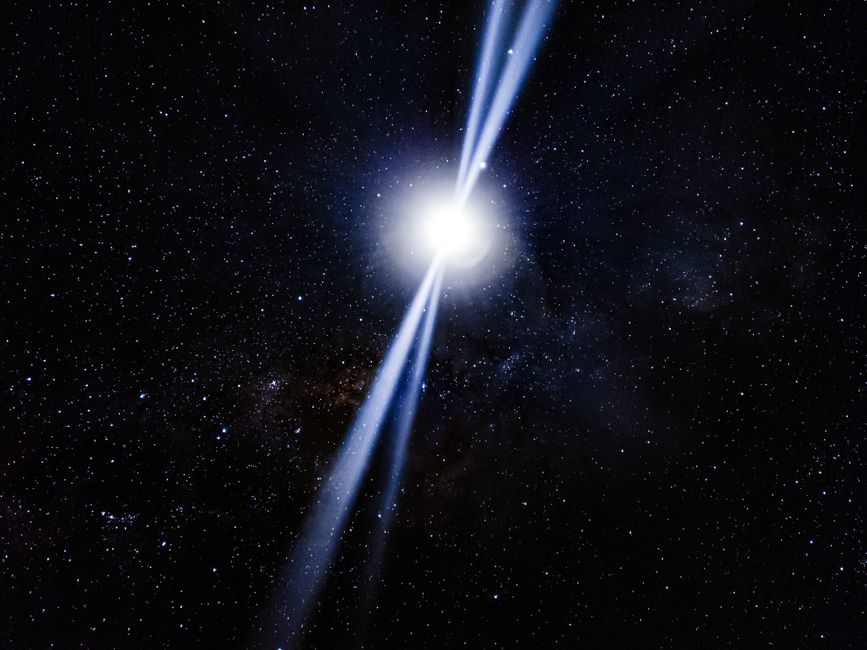
The magnetar wind is not a smooth outflow. It is a clumpy, magnetically dominated plasma with internal current sheets, plasmoids, and reconnection sites. The RM variations, polarization swings, and spectral anomalies all point to a structured, time-variable wind rather than a single explosive event. The persistent radio sources associated with repeating FRBs are not background galaxies—they are the wind nebulae themselves, powered by continuous magnetar outflow.
The VLBI position angle offsets for FRB 121102 (Arecibo, EVN) and FRB 180916 (EVN) place the burst emission within 100 μas of the persistent radio core. That is 0.4 pc at z=0.193. The emission is not in the forward shock of a relativistic jet—it is in the magnetosphere or the immediate wind zone. The “synchrotron maser at a shock” model is not wrong, but it is incomplete. It describes one emission channel among several operating simultaneously.
The Coherence Problem: Why Current PIC Codes Fail
PIC simulations of magnetar winds—run at the University of Helsinki, the Flatiron Institute’s Center for Computational Astrophysics, and Lawrence Berkeley National Laboratory’s NERSC—struggle to produce coherent emission from reconnection layers. The particle-in-cell approach resolves kinetic scales (skin depth c/ω_p ≈ 50 cm for n_e = 10¹⁰ cm⁻³) but cannot capture the global electromagnetic structure of the wind. Hybrid approaches (particle-in-cell + force-free MHD) show that coherent curvature radiation requires particle bunching on scales smaller than the plasma skin density, which PIC codes cannot resolve without artificial particle weighting.
The observed FRB brightness temperature of 10³⁷ K implies a coherent volume of ~10²⁴ cm³ with 10²⁰ particles radiating in phase. That is a phase-space density violation of 10⁷ over thermal equilibrium. No known plasma instability produces that level of bunching in relativistic reconnection without invoking extreme beaming or geometric focusing. The leading candidate is the relativistic two-stream instability in the current sheet, but that requires a cold, dense beam that does not exist in the post-reconnection outflow.
A 2023 study in The Astrophysical Journal Letters (Zhang et al., Princeton Plasma Physics Lab) proposed that the bunches form via the Weibel instability in the striped wind before reconnection. That mechanism produces filamentary current structures with transverse scale ~10 skin depths, which can seed coherent emission. However, the Weibel instability growth time in a σ=10 wind is 10⁴ light-crossing times—far too slow to produce millisecond bursts. The bunching must be pre-existing, imprinted by the magnetospheric current sheet geometry.
Alternative Frameworks: What Gets Closer
The “antenna mechanism” proposed by Zhang (2022, Monthly Notices of the Royal Astronomical Society) treats the magnetar wind as a collection of discrete coherent emitters—each plasmoid radiates as a phased array. That model naturally produces flat spectra, high circular polarization, and RM variations. It also predicts that the burst duration scales inversely with frequency (τ ∝ ν⁻¹), which matches observations of FRB 20121102A across 1–8 GHz.
The plasma lensing model (Cordes et al., Cornell/NAIC; Hessels et al., ASTRON/University of Amsterdam) explains the extreme scattering and frequency-dependent arrival times without invoking a single scattering screen. Multiple lenses along the line of sight—perhaps magnetized clumps in the host galaxy’s ISM or the magnetar wind itself—produce caustic amplification and temporal broadening. The CHIME/FRB catalog shows that 23% of bursts have frequency-dependent structure consistent with plasma lensing, but only 4% show the high-amplification events predicted by the model.
The Path Forward: Instruments and Tests
The Deep Synoptic Array (DSA-110), now operational at Caltech’s Owens Valley Radio Observatory, is localizing FRBs to sub-arcsecond precision at a rate of 10 per month. The Square Kilometre Array (SKA), with its 1 km² collecting area and 0.1–3 GHz instantaneous bandwidth, will detect FRBs to z > 3 and resolve spectral structure at 1 kHz resolution. The CHIME/FRB Outrigger program adds baselines of 3,000 km for VLBI localization of Galactic and nearby FRBs.
Each instrument tests a different anomaly. DSA-110 tests the PRS association rate and RM evolution. SKA tests the spectral coherence and polarization at high time resolution. CHIME Outriggers test the periodicity and orbital constraints. The data from these facilities will force a move beyond the single-shock synchrotron maser model toward a multi-component, magnetospheric + wind emission framework.
The magnetar wind is not a smooth outflow. It is a clumpy, magnetically dominated plasma with internal current sheets, plasmoids, and reconnection sites. The RM variations, polarization swings, and spectral anomalies all point to a structured, time-variable wind rather than a single explosive event. The persistent radio sources associated with repeating FRBs are not background galaxies—they are the wind nebulae themselves, powered by continuous magnetar outflow.
Final Field Note
The FRB field is in a state of productive crisis. The synchrotron maser model explains the gross energetics and the association with magnetars, but fails on spectral, polarization, and temporal details at high significance. The alternative models—antenna mechanism, plasma lensing, magnetospheric coherent curvature—each capture a subset of the anomalies. No single framework accounts for all observations. The next generation of instruments will not resolve this by finding more FRBs; they will resolve it by measuring the wind structure directly through multi-wavelength, multi-messenger campaigns that combine radio, X-ray, and gravitational-wave data from magnetar flares and burst storms.
The hard truth: we are not observing a clean astrophysical process. We are observing a messy, nonlinear plasma system that current codes cannot fully simulate. The anomalies are not noise—they are the signal. The magnetar wind is more complex than any single emission model can capture, and the field needs to stop fitting data to theory and start building theory from data.
Related Deep Dive: Quantum Entanglement Anomalies That Defy Explanation