Table of Contents
Jordan Joins the Artemis Accords: A New Chapter in Global Space Diplomacy
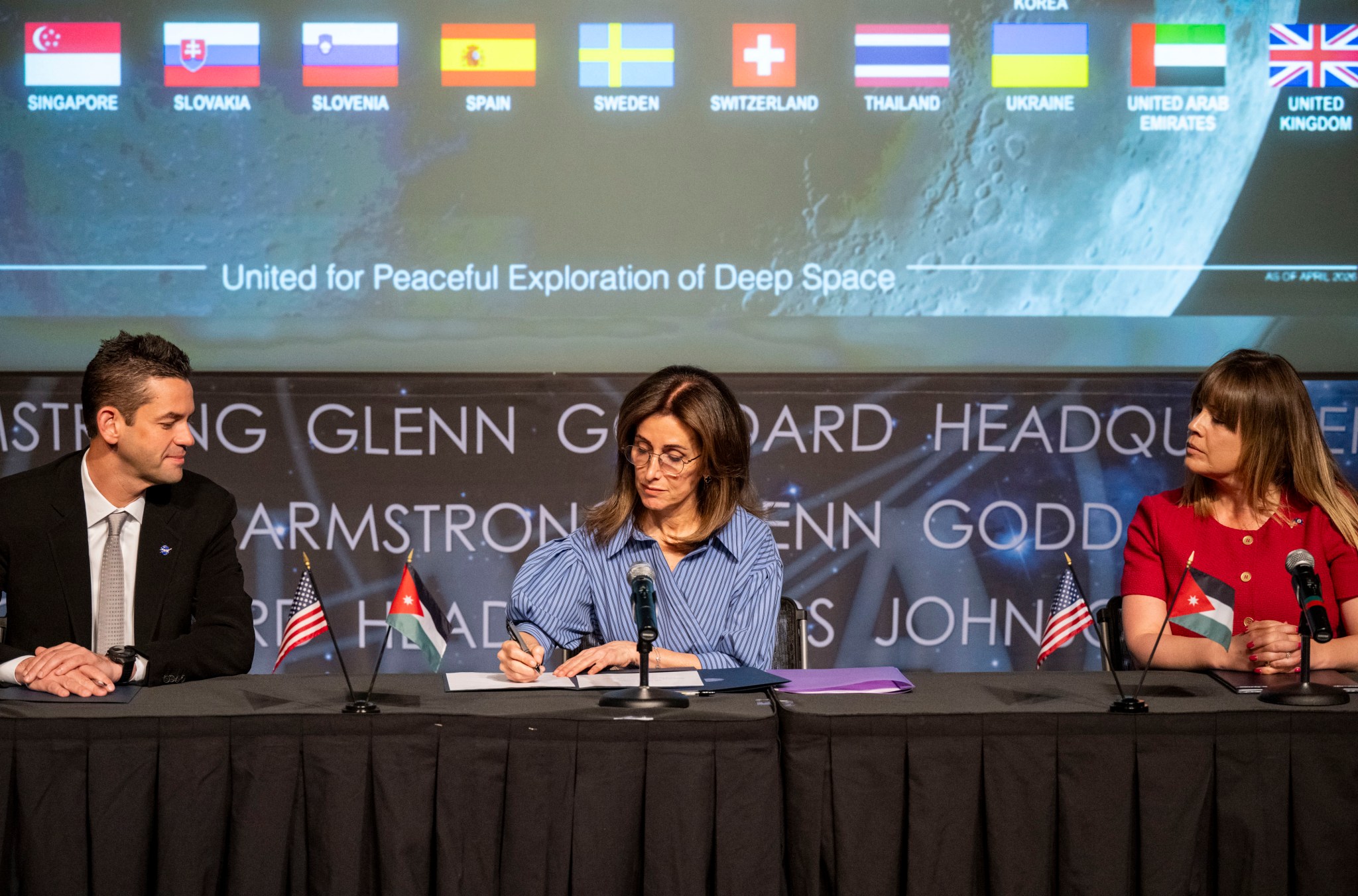
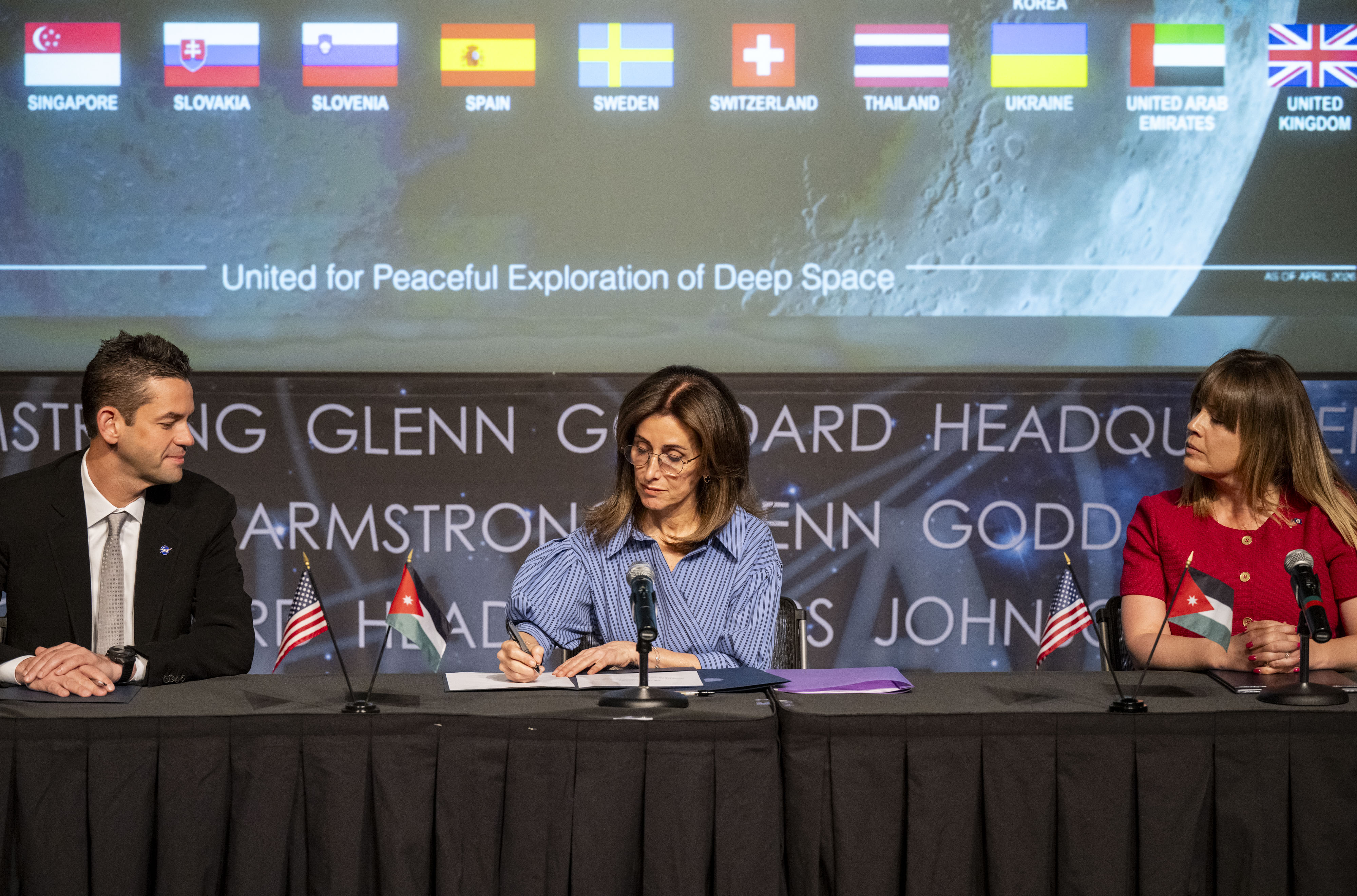
In a landmark moment for international space collaboration, the Hashemite Kingdom of Jordan became the 63rd nation to sign the Artemis Accords on April 23, 2026, marking a pivotal expansion of global commitment to peaceful, sustainable, and transparent exploration of outer space. The signing ceremony, held at NASA’s Mary W. Jackson Headquarters in Washington, D.C., brought together key figures from Jordan, the United States, and the broader international space community. Jordan’s accession signals not only a strategic leap for the Middle Eastern nation but also a broader shift in how emerging spacefaring nations are shaping the future of lunar and deep-space exploration.
The event featured a symbolic handshake between Jordan’s Ambassador to the United States, Dina Kawar, and NASA Administrator Jared Isaacman, with U.S. Department of State official Ruth Perry also in attendance. As Kawar affixed her signature to the document, it represented more than a diplomatic formality—it was a declaration of intent. Jordan, a nation with no traditional space agency or rocket launch capability, is now formally aligned with the principles guiding humanity’s next great leap into the cosmos.
Jordan’s inclusion in this elite group is particularly notable given its relatively modest footprint in the global space sector. Unlike traditional spacefaring powers such as the United States, Russia, or China, Jordan has never launched a satellite independently or operated a space station. Yet, its decision to sign the Artemis Accords underscores a new era in space diplomacy—one where technological ambition, innovation ecosystems, and international cooperation matter more than sheer launch capacity.
A Strategic Leap for Jordan’s Technological Future
Jordan’s move to join the Artemis Accords is deeply intertwined with its national strategy to become a regional leader in science, technology, engineering, and mathematics (STEM). As Ambassador Kawar highlighted during the ceremony, Jordan boasts one of the highest ratios of engineers per capita in the world—a statistic that speaks volumes about the country’s investment in human capital. This engineering talent pool, nurtured through robust university programs and government-backed initiatives, is now being channeled into cutting-edge fields such as artificial intelligence, advanced manufacturing, and digital infrastructure.
Central to this transformation is the National Council for Future Technologies, an initiative spearheaded by Crown Prince Al Hussein bin Abdullah II. The council serves as a strategic hub for coordinating Jordan’s technological ambitions, ensuring that the country’s intellectual resources are aligned with global trends and opportunities. By signing the Artemis Accords, Jordan is effectively opening a new frontier for its engineers and scientists—one that extends beyond Earth’s atmosphere.

“We are not just signing a piece of paper,” Kawar emphasized. “We are inviting our American and international partners to co-create the future with us.” This sentiment reflects a broader vision: to position Jordan not as a passive participant in space exploration, but as an active contributor to the technologies and policies that will define the next era of human spaceflight.
This focus on human capital is not new. Over the past two decades, Jordan has invested heavily in education and innovation, establishing technology parks, startup incubators, and partnerships with global tech firms. The country’s Silicon Wadi initiative, modeled after Israel’s Silicon Valley, has already attracted major investments from companies like Google and Cisco. Now, with the Artemis Accords, Jordan is extending this innovation ecosystem into the space domain.
The Artemis Accords: A Framework for Peaceful Exploration
To understand the significance of Jordan’s accession, it’s essential to grasp the foundational principles of the Artemis Accords. Launched in 2020 under the Trump Administration, the Accords were designed as a practical, non-binding framework to guide responsible behavior in space. Unlike traditional treaties such as the 1967 Outer Space Treaty, which established broad principles like the prohibition of national appropriation of celestial bodies, the Artemis Accords provide actionable guidelines for modern space activities.

At their core, the Accords emphasize transparency, interoperability, emergency assistance, registration of space objects, scientific data sharing, and the preservation of heritage sites such as Apollo landing zones. They also affirm the right of nations to extract and utilize space resources—a provision that has sparked debate but is grounded in the principle of sustainable development.
For Jordan, signing the Accords means committing to these principles in all its future space endeavors. While the country may not yet have a lunar rover or a satellite constellation, its participation signals a long-term vision. By aligning with the Accords now, Jordan ensures that when it does develop space capabilities—whether through partnerships, joint missions, or indigenous programs—it will do so within a globally accepted ethical and operational framework.
NASA Administrator Jared Isaacman underscored the importance of this moment, noting that Jordan joins the Accords at a “pivotal moment” in human space exploration. With the Artemis program aiming to return humans to the Moon by the late 2020s—and eventually establish a sustainable lunar base—the need for international coordination has never been greater. The Moon is no longer a distant frontier; it’s becoming a shared workplace, a laboratory, and potentially, a launchpad for missions to Mars.

Jordan’s Role in the Global Space Ecosystem
While Jordan may not be launching rockets anytime soon, its contributions to the global space ecosystem are already taking shape. The country has been actively involved in satellite technology through partnerships with international agencies. In 2023, Jordan launched its first domestically designed nanosatellite, the JY1-Sat, in honor of the late King Hussein. Developed by students and engineers at the Royal Jordanian Airlines and the Jordan University of Science and Technology, the satellite was deployed from the International Space Station and has since been used for Earth observation and educational outreach.
This project exemplifies Jordan’s “small but smart” approach to space. Rather than competing in the expensive arena of heavy-lift launch vehicles, Jordan is focusing on niche areas where it can excel: satellite design, data analytics, AI-driven Earth observation, and space policy. These are precisely the kinds of contributions that the Artemis Accords encourage—collaborative, specialized, and sustainable.
Moreover, Jordan’s geopolitical position in the Middle East adds a layer of strategic value to its space ambitions. As a stable, pro-Western nation in a volatile region, Jordan can serve as a bridge between spacefaring powers and emerging space nations in Africa, Asia, and the Middle East. Its participation in the Artemis Accords could inspire neighboring countries to pursue peaceful space cooperation, reducing the risk of militarization or conflict in orbit.
The Broader Implications of Expanding Space Partnerships
Jordan’s signing of the Artemis Accords is more than a bilateral achievement between Amman and Washington—it’s a reflection of a broader trend toward inclusive space governance. As space becomes increasingly accessible, thanks to falling launch costs and miniaturized technology, more nations are seeking a seat at the table. The Artemis Accords, with their emphasis on transparency and cooperation, offer a pathway for these countries to participate meaningfully in space exploration.
This inclusivity is crucial for the long-term sustainability of space activities. With over 90 countries now operating satellites and dozens more planning lunar or orbital missions, the risk of congestion, interference, and conflict is growing. The Artemis Accords provide a common language and set of expectations that can help prevent misunderstandings and promote peaceful coexistence in space.
Furthermore, the Accords foster innovation by encouraging data sharing and joint missions. For example, NASA’s Artemis program includes contributions from the European Space Agency (ESA), the Canadian Space Agency (CSA), and the Japan Aerospace Exploration Agency (JAXA). These partnerships have led to shared technologies, such as the Orion spacecraft’s service module and the Lunar Gateway space station. Jordan, with its strong engineering base, could one day contribute software, AI algorithms, or even lunar habitat designs to such projects.
Jordan is the 12th Middle Eastern or North African country to sign the Accords, following the UAE, Israel, and Saudi Arabia.
Over 200 private companies have expressed interest in collaborating with Artemis signatory nations on lunar missions.
The first Artemis crewed lunar landing is scheduled for 2026, with a permanent Moon base planned by 2030.
NASA estimates that international partnerships will reduce the total cost of the Artemis program by up to 30%.
Looking Ahead: A New Golden Age of Exploration
As the world stands on the brink of a new era in space exploration, Jordan’s accession to the Artemis Accords symbolizes the democratization of the cosmos. No longer the exclusive domain of superpowers, space is becoming a shared human endeavor—one that values diversity, innovation, and cooperation.
For Jordan, this moment is about more than prestige. It’s about securing a place in the future of technology, science, and global leadership. By aligning with the principles of the Artemis Accords, Jordan is not just joining a club—it’s helping to shape the rules of the road for humanity’s journey to the Moon, Mars, and beyond.
As Administrator Isaacman aptly put it, we are living in a “Golden Age of exploration.” And with each new signatory, that age becomes richer, more inclusive, and more promising. Jordan’s signature on April 23, 2026, may have been written in Washington, but its impact will be felt across the solar system.
This article was curated from NASA Welcomes Jordan as 63rd Artemis Accords Signatory via NASA Breaking News