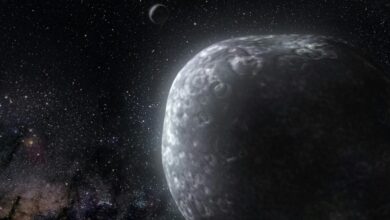
In the vast silence of intergalactic space, some structures remain hidden not because of their distance, but because they emit no light at all. They are not stars, and they are not galaxies in the traditional sense. They are cosmic phantoms. One such object, recently confirmed by NASA’s Hubble Space Telescope, has stunned astronomers: a starless, dark matter-dominated cloud that may never have birthed a single star.
The First Of Its Kind: A Starless Relic From The Early Universe
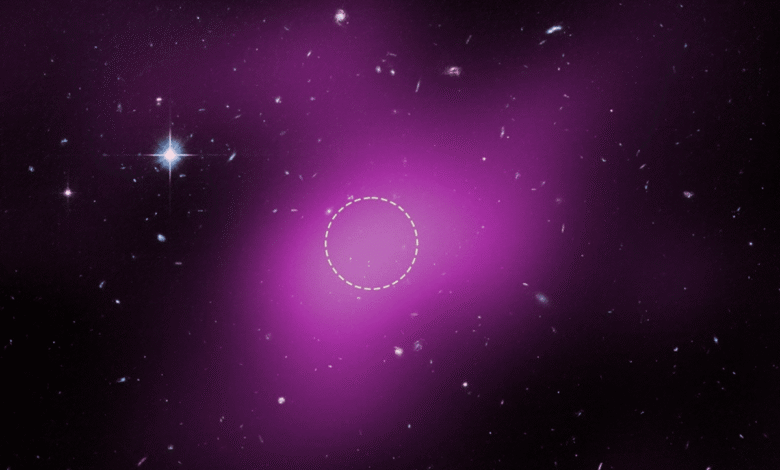
The object, named Cloud-9, is what astronomers classify as a Reionization-Limited H I Cloud (RELHIC), a compact, spherical cloud composed primarily of neutral hydrogen, entirely devoid of stars. Located approximately 14 million light-years from Earth near the spiral galaxy Messier 94 (M94), this dark, gas-rich structure represents a rare and elusive example of a “failed galaxy.” Unlike traditional galaxies that glow with starlight, Cloud-9 is shrouded in darkness, making it nearly impossible to detect with conventional ground-based telescopes.
The Hubble observations were definitive. Using its Advanced Camera for Surveys, researchers found no evidence of stars within the radio-defined boundaries of the cloud.
“This is a tale of a failed galaxy,” said Alejandro Benitez-Llambay, principal investigator of the program from Milano-Bicocca University in Milan. “In science, we usually learn more from the failures than from the successes. In this case, seeing no stars is what proves the theory right. It tells us that we have found in the local universe a primordial building block of a galaxy that hasn’t formed.”
The absence of stellar light is not just a void. It’s a signal that confirms this object may be one of the building blocks of galaxies that never fully assembled.

Science: NASA, ESA, VLA, Gagandeep Anand (STScI), Alejandro Benitez-Llambay (University of Milano-Bicocca); Image Processing: Joseph DePasquale (STScI)
Shedding Light On Dark Matter With Cloud-9
The discovery of Cloud-9 is significant not only for what it lacks, stars, but for what it contains in abundance: dark matter. Researchers estimate the cloud’s dark matter mass at approximately five billion solar masses, based on the pressure balance of the hydrogen gas. This is consistent with theoretical models that predict the existence of starless halos, collections of dark matter and gas that failed to ignite star formation.
“This cloud is a window into the dark universe,” said Andrew Fox of AURA/STScI for the European Space Agency. “We know from theory that most of the mass in the universe is expected to be dark matter, but it’s difficult to detect this dark material because it doesn’t emit light. Cloud-9 gives us a rare look at a dark-matter-dominated cloud.”
The study, featured in The Astrophysical Journal Letters, not only confirms the presence of such a cloud but also marks the first time astronomers have positively identified a RELHIC in the observable universe.
This insight supports long-standing cosmological theories suggesting that many small dark matter halos formed in the early universe, but only some managed to gather enough gas and mass to form stars and become full-fledged galaxies. Cloud-9 stands as proof that not all of these primordial structures followed that path.
A New Frontier For Galaxy Formation Research
The implications of this discovery reach far beyond a single object. The characteristics of Cloud-9, its isolation, spherical shape, and compact size, set it apart from typical hydrogen clouds previously observed near the Milky Way, which tend to be larger and more irregular. Researchers believe this could mean there are many other Cloud-9-like objects scattered throughout the universe, undetected by existing surveys.
“Among our galactic neighbors, there might be a few abandoned houses out there,” said Rachael Beaton of STScI, evoking the poetic image of primordial structures left behind during galaxy formation. These “abandoned” clouds could hold vital clues to how galaxies evolve and what factors determine whether a cloud becomes a galaxy or remains in a dark limbo.
The team notes that detecting such faint objects is inherently challenging. Observations with ground-based telescopes are often hindered by limited sensitivity and interference from brighter background galaxies. Only Hubble’s precision allowed researchers to confirm the absence of stars within Cloud-9 and cement its classification as a failed galaxy.
NASA Just Found A Ghost Galaxy That Was Never Meant To Exist
Discover more from GTFyi.com
Subscribe to get the latest posts sent to your email.