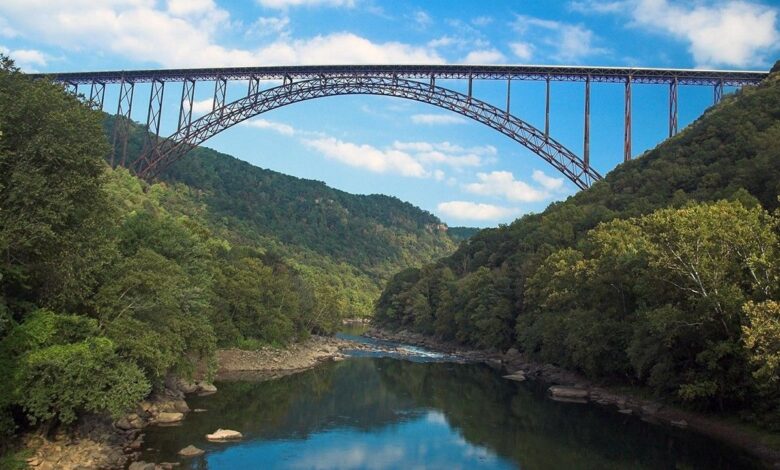
Researchers are turning to satellite data to monitor the world’s longest bridges. Due to high costs and logistical challenges, fewer than 1 in 5 bridges extending 492 feet (150 meters) or more have systems installed to track structural changes that might be harbingers of damage or danger. Satellites could more than triple the portion of bridges globally that are actively being monitored for safety and structural health, researchers say.
In a study in Nature Communications, researchers evaluated the feasibility of using a pair of European Space Agency satellites that make up the Sentinel-1 constellation to gather high-resolution radar data from bridges. They found that a data analysis technique known as Multi-Temporal Interferometric Synthetic Aperture Radar (MT-InSAR) can reveal structural displacements as small as a few millimeters. Though tiny, comparable to the thickness of a dime, these small shifts can be evidence of structural weakness.
The researchers hope to soon begin using data from the recently-launched NISAR (NASA-ISRO Synthetic Aperture Radar) satellite, jointly operated by NASA and the Indian Space Research Organisation. NISAR will collect higher resolution data than the Sentinel satellites, which researchers expect will provide more meaningful information for civil engineers keeping an eye on long-span bridges.
On-site inspections and sensors installed on bridges remain crucial for monitoring structural health. But including spaceborne SAR monitoring could expand regular oversight from less than 20% of the 744 long-span bridges worldwide to more than 60%, the researchers say. Satellite data will be particularly useful in remote regions where installing traditional sensors and conducting on-site inspections can be prohibitively expensive.
NISAR will systematically gather imagery of nearly every bridge in the world twice every 12 days. This comprehensive radar time series will make it possible to identify and track subtle changes not only to bridges but also other infrastructure, such as dams, railways, buildings, and levees. NASA’s free and open data policy means that anyone can use NISAR data to evaluate infrastructure.
~James Riordon

NASA Satellite Data Could Soon Lead to Safer Bridges Worldwide
Discover more from GTFyi.com
Subscribe to get the latest posts sent to your email.


