Venus superior conjunction on January 6
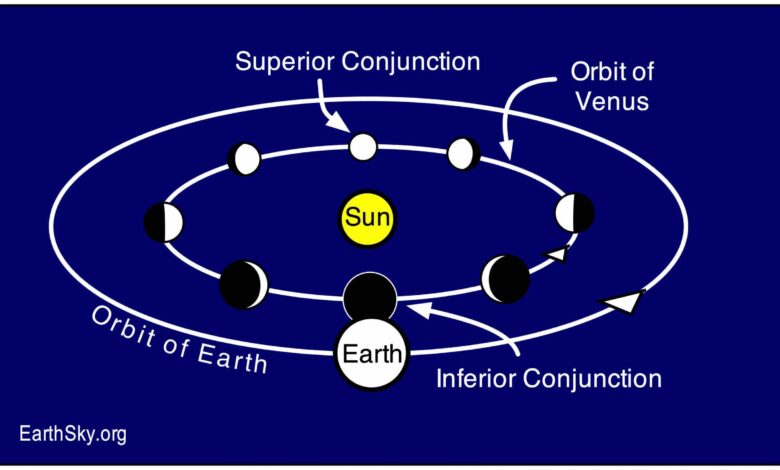
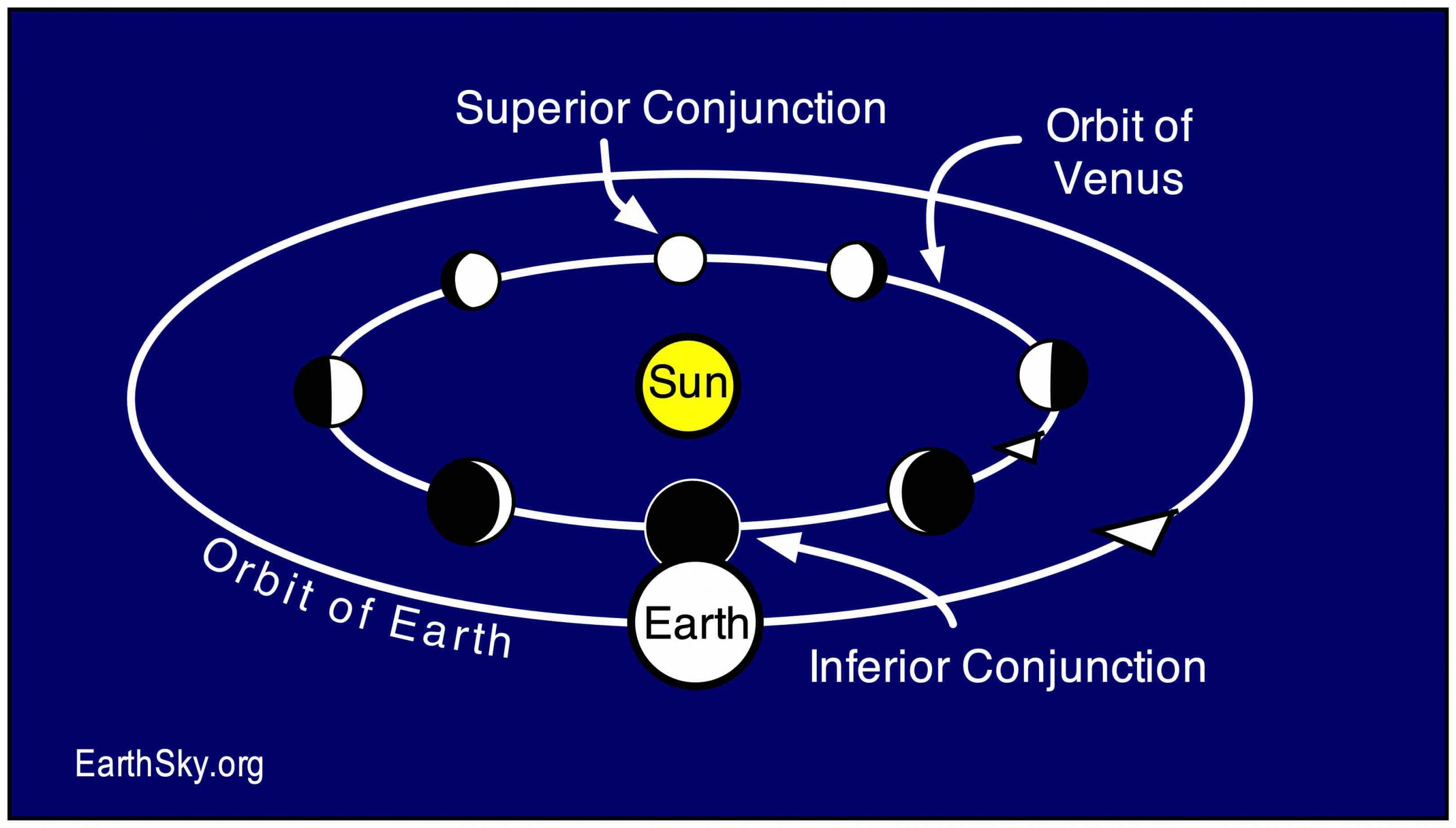
Venus is the brightest planet we see. It orbits the sun one step closer than Earth. So it stays near the sun in our sky and is often called the morning “star” or the evening “star.” When it’s up, you can spot Venus easily. And it’ll catch your eye if it’s near a crescent moon. But where is Venus now? On January 6 the Earth, sun and Venus are aligned in space and Venus is on the opposite side of the sun as viewed from Earth.
Before early January 2026, Venus spent over eight months as a dazzling morning “star.” It reached greatest elongation – its greatest apparent distance from the sun in our sky – on June 1, 2025. It hung low in the east before sunrise for many months, before slipping away in the morning sunlight in late November 2025. Since then, it’s been too close to the sun to see. Venus will reach its superior conjunction – achieving the same east-west coordinate as the sun in our sky – at 17 UTC (1 p.m. CST) on January 6, 2026.
That is, at this 2026 superior conjunction, the sun is between us and Venus and Venus is passing almost directly behind the sun as seen from Earth! See the image above.
When does a Venus superior conjunction happen?
Venus comes to a superior conjunction every 584 days. Usually, it passes above or below the sun in our sky. At every superior conjunction, Venus moves from our morning sky to our evening sky. We can’t see Venus now. But it’ll emerge into our evening sky in February around mid-month. At this time, it’ll appear as a bright light in the western evening twilight: the glittering evening “star.” And it’ll be joined briefly by the planet Mercury around February 18.
When will you see Venus in the evening? Possibly as early as mid-February, and certainly (assuming you have a clear western horizon) by early March. It’ll be easier to spot from Earth’s Southern Hemisphere than for us in the north. For all of us, Venus will ascend gradually in the evening twilight for several months. Overall, at this evening apparition, it’ll spend about eight months as a brilliant light in the evening sky. It’ll disappear again, passing back into the sun’s glare (between Earth and the sun this time) in October 2026.
Venus will pass close to the sun
During this superior conjunction of Venus, the planet will pass very close the sun in our sky. It won’t go behind the sun as seen from Earth. Even though the sun will not occult or pass in front of Venus, it’ll still be too close to the sun to see.
When will you next see Venus?
Venus will emerge in the western evening twilight in mid- to late February 2026. But, as seen from Earth’s Northern Hemisphere, it’ll be setting soon after the sun. Luckily, Venus is the brightest planet, so you might be able to spot it low on the horizon. Then in mid- to late March, look for it about 30 minutes after sunset. It’s so bright, it’ll show even in the bright evening twilight.
In April, Venus will become easier to spot. It’ll be best in 2026 from June through the end of August. Unfortunately for us in the Northern Hemisphere, the autumn months will feature the ecliptic – or path of the sun, moon and planets – making a narrow angle with the western evening horizon. So, around September and October, Venus’ distance from the sun will be mostly sideways with respect to the sun along our western horizon, not up above the sun.
It’ll disappear from view in the evening not long after that, going between the Earth and sun when it reaches inferior conjunction on October 24, 2026.
Photos of Venus

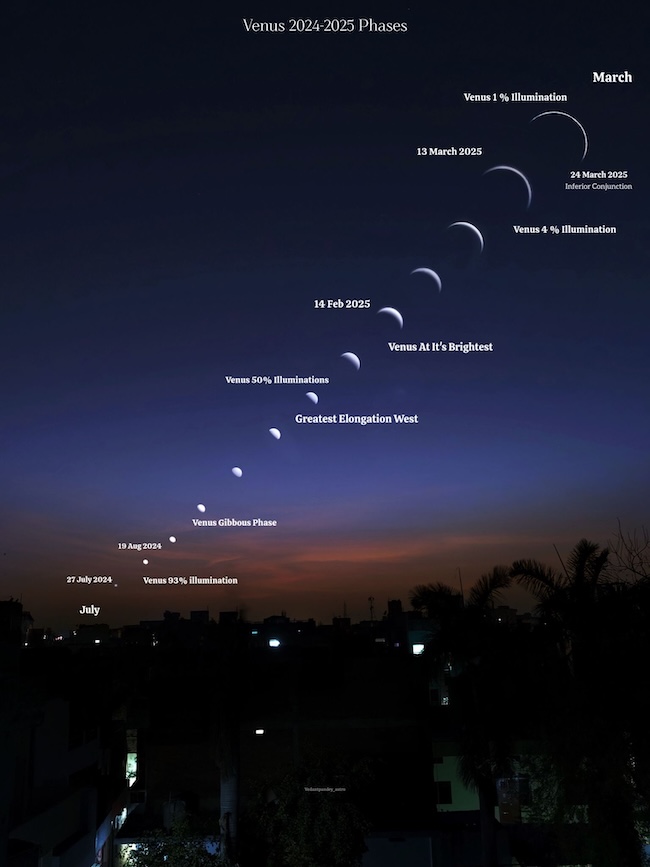
Bottom line: Venus reaches superior conjunction – passing behind almost directly behind the sun as viewed from Earth – at 17 UTC (1 p.m. CST) on January 6, 2026. So the sun lies between Earth and Venus.
Venus superior conjunction: Venus aligns with the sun January 6
Discover more from GTFyi.com
Subscribe to get the latest posts sent to your email.