
ID 69321036 ©
Letloose78 | Dreamstime.com
Lately, Venezuela appears in the news almost every day—usually framed through crisis, conflict, or political tension. But countries are never just headlines. They are layers of history, geography, ambition, contradiction, and loss, stacked unevenly over time.
To understand Venezuela even slightly, it helps to step back from the noise and look at a few facts that don’t argue or persuade. They simply exist. Together, they sketch a country shaped by abundance and absence, by idealism and consequence, by forces both natural and human-made.
1. A country sitting on unmatched oil wealth—yet barely pumping it
Venezuela holds the largest proven oil reserves on Earth—more than any other nation. And yet today, it produces roughly ten times less oil per day than Saudi Arabia, the country with the second-largest reserves.
There was a time when Venezuela’s oil wealth reshaped daily life. During the early 1970s, the country experienced an economic boom so dramatic it earned the nickname Venezuela Saudita. Oil money funded infrastructure, social programs, and a growing middle class that believed prosperity was permanent.
Oil was never the only resource. Beneath its soil lie iron, gold, nickel, timber, diamonds, and rare earth minerals critical for modern electronics. Venezuela’s problem was never scarcity. It was what came after abundance.
2. Social gains under Hugo Chávez—and a darker parallel trend
Under the presidency of Hugo Chávez, Venezuela saw measurable improvements in several social indicators. Extreme poverty fell sharply, unemployment dropped by half, and GDP per capita more than doubled during his early years in power.
At the same time, gun violence increased. The social safety net expanded, but insecurity followed a different trajectory. It was a reminder that economic statistics and lived experience do not always move together—and that progress in one area can coexist with deterioration in another.
3. A revolutionary who gave up everything
Simón Bolívar was born into privilege. He inherited wealth, land, and enslaved labor—then voluntarily gave it up. He freed his own slaves and spent his fortune fighting colonial rule across South America.
Today, Bolívar’s legacy is complex. He is revered by leftist movements, invoked by governments, and immortalized in place names. Bolivia bears his name. Venezuela officially calls itself the Bolivarian Republic. Few historical figures are claimed so often by people who interpret him so differently.
4. The country that lost its last glacier
By 2024, Venezuela’s final glacier had disappeared. At the start of the 20th century, six glaciers existed in the Venezuelan Andes. None remain.
This made Venezuela the first postglacial nation in the Andes—a quiet but profound distinction. The loss didn’t arrive with spectacle. It happened slowly, year by year, until one day there was nothing left to measure.
5. A little-known Cold War drug operation
In 1990, a U.S. intelligence operation quietly moved nearly 3,000 pounds of pure cocaine from Venezuela into the United States. The stated goal was to gain the trust of a Colombian cartel for undercover work.
The DEA objected. The operation went ahead anyway. The CIA worked alongside Venezuela’s anti-narcotics chief to procure the drugs, which were then sold on American streets. Only one person faced legal consequences: a civilian aide to the Venezuelan official, later sentenced to 20 years in a U.S. prison.
6. A lightning storm that refuses to end
Near Lake Maracaibo lies Catatumbo, a place where lightning storms ignite the sky for hours at a time—up to 160 nights a year. The phenomenon can last ten hours in a single evening.
For centuries, sailors used the lightning as a natural beacon. It appears without thunder, returns without warning, and ends only to begin again the next night. Science can explain parts of it. The experience itself feels older than explanation.
7. A waterfall that glows at sunset
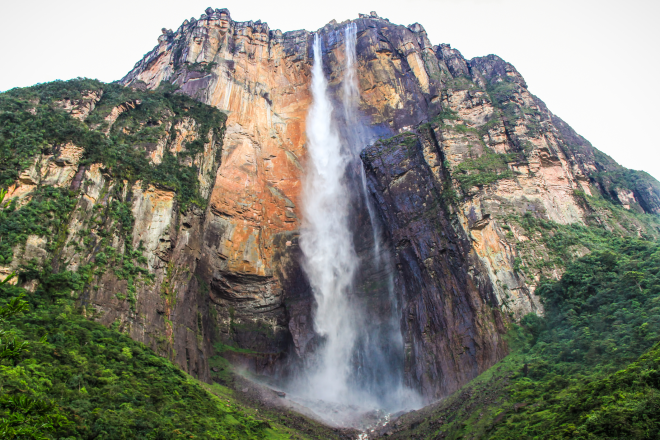
In Canaima National Park, one of Venezuela’s great waterfalls appears to glow like molten rock at sunset. As the sun lowers, mineral-rich water and fine mist scatter red light through the air.
Nothing is actually burning. Nothing is changing temperature. It only looks that way—for a few minutes—before the light fades and the illusion disappears.
Closing reflection
Venezuela is often described in absolutes: richest, poorest, safest, most dangerous, rising, collapsing. Reality sits somewhere quieter in between. It is a country of extremes that rarely align, of beauty and burden existing side by side.
0 views
Related
Discover more from GTFyi.com
Subscribe to get the latest posts sent to your email.


