You might have heard that opposition is the best time of year to observe a planet. But what is opposition? And which planets have oppositions? In astronomy, opposition means a planet is opposite the sun as viewed from Earth. So, for example, the planets with orbits inside Earth’s orbit (Mercury and Venus) can’t be in opposition. But the planets orbiting outside Earth’s orbit (Mars, Jupiter, Saturn, Uranus, Neptune) all can.
Once each year, we pass between them and the sun in our smaller, faster orbit. If the sun is setting in the west, and Jupiter is rising in the east, then Jupiter is at opposition. Earth is passing between the sun and Jupiter, which will, therefore, take all night to cross our sky. At opposition, a planet is easiest to observe because it’s generally closest to Earth and visible throughout the night.
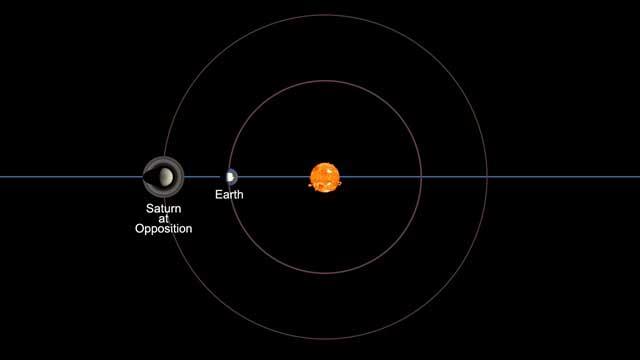
Look at the diagram above. The sun is in the center of the diagram. Earth is a little way out, and Saturn farther still. As seen from above our solar system, the planets are moving counterclockwise around the sun. Now, run this diagram forward in your mind. Because it’s in an inner orbit, Earth travels faster than Saturn. And Jupiter (not shown) travels faster than Saturn. Of course, the planets will be in various configurations as seen from above the solar system. But, in nearly every earthly year, Earth will pass between the outer planets and the sun. This is opposition.
An opposition as seen from Earth
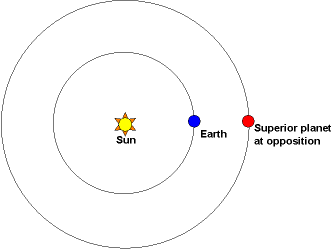
At opposition, Earth is in the middle of a line between an outer planet and the sun, and we see the sun at one end of our sky and the opposition planet in the opposite direction. It’s as if you’re standing directly between two friends as you chat in the supermarket, and you need to turn your head halfway around to see one and then the other. At opposition, the sun is on the opposite side of the sky from the outer planet; when the sun sets in the west, the planet is rising in the east. As the planet drops below the horizon, the sun pops above it again: opposite.
To be technical, opposition for an outer planet happens when the sun and that planet are exactly 180 degrees apart in the sky. The word comes to English from a Latin root, meaning to set against.
Consider that Venus and Mercury can never be at opposition as seen from Earth. Their orbits are closer to the sun than Earth’s, so they can never appear opposite the sun in our sky. You will never see Venus in the east, for example, when the sun is setting in the west. These inner planets always stay near the sun from our point of view, no more than 47 degrees from the sun for Venus, or 28 degrees for Mercury.
Oppositions can only happen for objects that are farther from the sun than Earth is. We see oppositions for Jupiter, Saturn, Uranus, and Neptune about every year. They happen as Earth, in its much-faster orbit, passes between these outer worlds and the sun. We see oppositions of the planet Mars, too, but Martian oppositions happen about every 27 months, because Earth and Mars are so relatively close together in orbit around the sun. Their orbits and speeds in orbit are more similar.
Dates of upcoming oppositions
Since everything in space is always moving, oppositions of planets farther than us from the sun happen again and again. As far as the bright planets go, the next opposition is never too far away:
Note: Dates are based on UTC time.
Jupiter will be in opposition on January 10, 2026.
Neptune will be at in opposition on September 26, 2026.
Saturn will be in opposition on October 4, 2026.
Uranus will be in opposition on November 25, 2026.
Mars will be in opposition on February 19, 2027.
Note that Jupiter’s oppositions come about a month later each year. Saturn’s come about two weeks later each year. Uranus and Neptune opposition dates come only a few days later, year after year.


Why are planets at opposition so interesting to sky-watchers?
As mentioned, because they’re opposite the sun, planets at opposition rise when the sun sets and can be found somewhere in the sky throughout the night.
Secondly, planets at opposition tend to be near their closest point to Earth in orbit. Due to the non-circular shape of planetary orbits, the exact closest point might be different by a day or two, as is the case for Jupiter in 2026. Jupiter’s opposition will be on January 10, 2026, and its exact closest point will be on January 9. Still, for many weeks around opposition – between the time we pass between an outer planet and the sun – the outer planet is generally closest to Earth. At such a time, the planet is brightest, and more detail can be seen through telescopes.
And here’s another interesting aspect of opposition. Since the sun and outer planet are directly opposite each other in Earth’s sky, we see that far-off planet’s fully lit daytime side. Fully lit planets appear brighter to us than ones not completely lit. If you’re saying to yourself that this sounds a lot like the moon, you’re right! After all, what’s a full moon if not the moon at opposition? During the moon’s full phase, it’s directly opposite the sun in the sky, fully illuminated, and at its brightest for that orbit. As it moves through the rest of its orbit, the sun-Earth-moon line bends and gives us what we see from Earth as the moon’s phases.
Oppositions from other planets
Like so much in life, opposition is all about point of view. We’ve been talking about the view from Earth. What if we flip it around?
When an outer planet – let’s say Jupiter – is at opposition for us, Earth is at inferior conjunction as seen from that planet. In other words, at the moment of opposition for us on Earth, observers on Jupiter would see Earth passing between their world and the sun. The Earth and the sun would be in the same side of Jupiter’s sky, Earth hidden in the sun’s glare except to skilled observers using special equipment.
Consider also that the line from the sun to Jupiter passes through the Earth, which means Earth passes directly between the sun and Jupiter. Maybe one day, a visitor to Jupiter will see Earth transit the sun as seen from Jupiter. That is, they’ll see Earth’s darkened nighttime side, and all of humanity, cross the face of the sun from half a billion miles away.
Bottom line: The ideal time to observe a planet is around opposition. During opposition, Earth passes between an outer planet and the sun, placing the planet opposite the sun in our sky. A planet at opposition is closest to Earth in its orbit and bright. It rises when the sun sets, and so is visible all night.
Discover more from GTFyi.com
Subscribe to get the latest posts sent to your email.