Top 10 brightest objects in our solar system
There are at least 10 natural objects in our solar system – our neighborhood of space – that are, in theory, visible to the unaided eye. Most of these objects are easy to see! But a few aren’t.
So what are these objects, the brightest natural objects in our solar system? Note that we’re not counting transient objects, such as very bright meteors. And we’re not counting human-made objects, such as satellites and the International Space Station.
Keep reading to find out which are the top 10 brightest natural solar system objects, in order from brightest to dimmest. You can see the first seven objects on this list easily, using just your eyes, even from cities and suburbs. The last few items are fainter and more challenging … but still among our solar system’s brightest objects.

#1. Brightest object in our solar system: The sun
No surprise here. You mustn’t ever look at the sun without protective filters. Gazing at the sun directly without special filters can cause permanent blindness. Don’t do it!
How bright is the sun? Astronomers speak of an object’s brightness by its magnitude. The brightest objects have negative magnitudes. And the sun shines at magnitude -26.7!
Read about the magnitude scale here.
Read: Top 7 tips for observing the sun safely
Read the sun news: Daily updates
#2. The moon
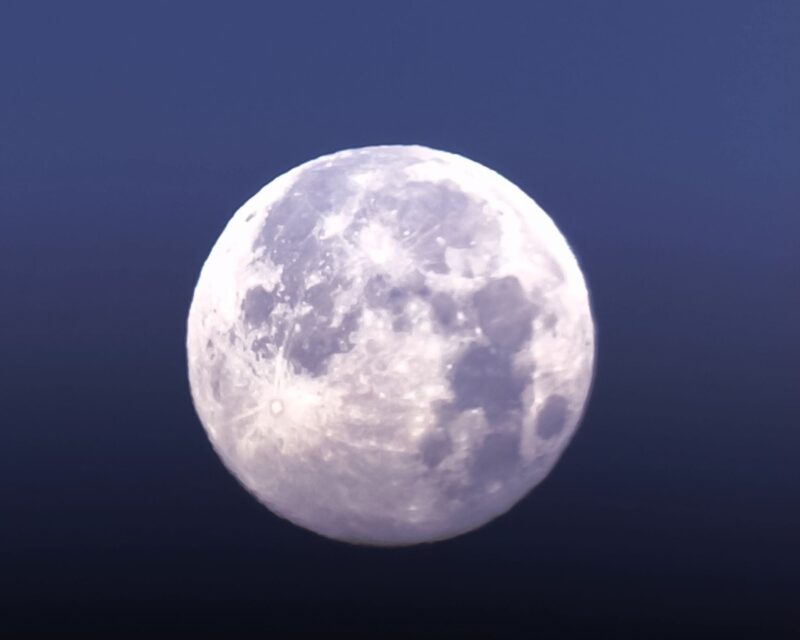
To the eye alone, there’s nothing more beautiful than a bright moon shining in a dark night sky, casting its light and creating moon shadows in the landscape all around you. The moon is our sky’s 2nd-brightest object.
On the other hand, if you’re a deep-sky observer – interested in distant, faint star clusters, nebulae and galaxies – the moon is bright enough to ruin your night vision. If you get a chance to use a telescope, let the moon be your last stop of the night.
So how bright is the moon? Its brightness varies, depending on its phase. At its full phase, when it’s the brightest, it tops out at magnitude -12.7. In a crescent phase, it shines at only about magnitude -6.
Pick up EarthSky’s moon phases calendar for 2026 to keep track of the moon’s nightly show.
#3. Venus
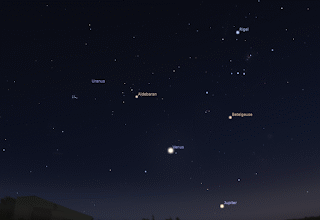
Venus is the closest planet to Earth, one step inward in orbit around the sun. And it’s also our sky’s brightest planet and 3rd-brightest object, after the sun and moon. As with all other solar system objects, Venus varies in brightness depending on where Earth and Venus are in their orbits with respect to each other. Also, as a planet orbiting inward from Earth, Venus shows phases! The planet is brightest when it’s in a slim crescent phase. So the next greatest brilliancy for Venus is coming around September 18, 2026! Wait. What? It’s brighter in our sky when in a slimmer phase? Yup! Read more here!
So how bright is Venus? It can shine as brightly as magnitude -4.7. That’s bright enough to be seen in daylight!
Why is Venus so bright? The answer isn’t just it’s nearness. It’s also its thick, reflective clouds.
Venus is too close to the sun to see in January 2026, but will emerge in the evening sky late February or early March. Find Venus’ current location in EarthSky’s night sky guide.

#4. Mars
The red planet is the 2nd-closest to Earth, after Venus. And, yes, it’s the 4th-brightest object in our night sky … sometimes. Every two years, Earth flies between the sun and Mars. That’s when Mars reaches opposition to the sun, appearing opposite the sun in Earth’s sky. And it’s when Earth and Mars are closest for that two-year period. And that’s when Mars can outshine Jupiter, becoming our sky’s 4th-brightest object.
When is that once-in-two-years opportunity here? The red planet will have an opposition on February 20, 2027.
How bright can Mars get at its brightest? Magnitude -2.9.
By the way, this 2027 opposition won’t see Mars at its absolute brightest. It won’t outshine Jupiter in 2027. But it’ll still be very bright and very red in color. It’ll be close to the brightness of Sirius, our sky’s brightest star.
Between its times of great brightness – in other words, most of the time – Mars is faint. Read about Mars’ changing brightness here.
And find Mars’ location for each month in EarthSky’s night sky guide.

#5. Jupiter
Because Jupiter is the largest planet in our solar system, some mistakenly believe it’s the brightest planet. But not so. It’s the 3rd-brightest planet and 5th-brightest solar system object. Jupiter’s greater distance from us lets Venus and Mars, our neighbors, shine more brightly.
But – unlike Mars – Jupiter is always bright. It’s nearly as bright as Mars’ peak of -2.9, and always brighter than Sirius, the sky’s brightest star.
How bright is Jupiter? At its maximum, it shines at magnitude -2.8. And it’s at its brightest for 2026 in January.
Come to know Jupiter, and you’ll enjoy seeing its bright face in your sky for much of every year. Find Jupiter’s location for each month of the year in EarthSky’s night sky guide.

#6. Mercury
Surprise! The rarely-seen planet Mercury shines more brightly than Saturn at its best. Mercury can also shine more brightly than Sirius. It’s the 6th-brightest natural solar system object in our night sky. So why is Mercury often called elusive?
It’s because Mercury is our solar system’s innermost planet. So it always stays near the sun in our sky. You can see it only shortly before sunrise or shortly after sunset. It never gets very high in the night sky. And so we often see it set against bright twilight and not in a nice dark sky. The twilight dims Mercury’s glory.
Still, Mercury’s brightness will surprise you! It can reach -1.9 magnitude. That’s in contrast to Sirius at magnitude -1.3.
Mercury comes and goes in our sky rapidly and switches back and forth between the morning and evening sky. To see if Mercury is visible now, check EarthSky’s night sky guide.
#7. Saturn
The ringed planet Saturn is stunning in a telescope and it’s also an easy catch without optical aid. With the eye alone, you won’t see its rings. But you will see Saturn’s golden color and steady light. Saturn outshines most stars and is on a par with most of the brightest stars. Plus – because it orbits our sun beyond Earth’s orbit – casual observers can spot it more often than Mercury. Saturn is often around deep into the night, when its brightness contrasts with the depths of a dark night sky.
Saturn shines magnitude +0.7. Notice we just slipped over into positive magnitudes? From here on out, the bigger the number, the dimmer the object.
Read about the magnitude scale here.
#8. Jupiter’s moon Ganymede
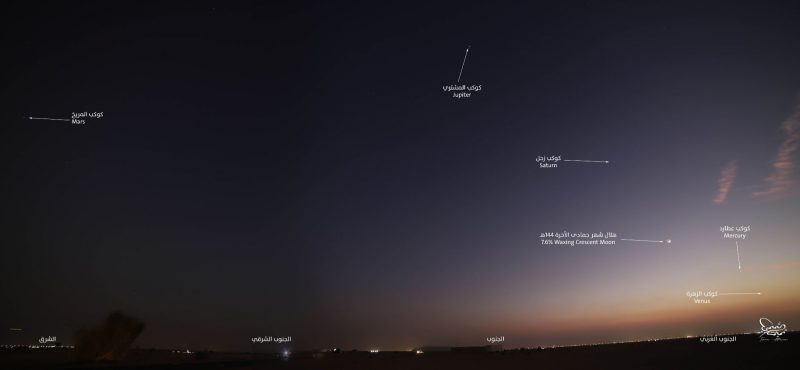
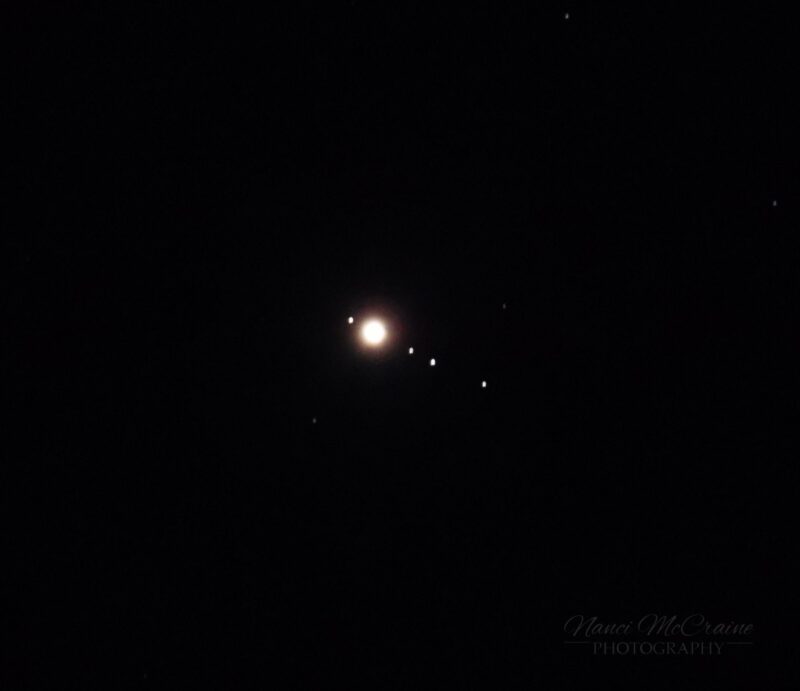
If you ever look up at night, you’ve probably seen all the objects mentioned so far without optical aid, knowingly or not. But only a few have seen Jupiter’s largest moon, Ganymede, without optical aid. Still, Ganymede is relatively bright, in contrast to most moons of the outer planets, or to the million tiny bodies (asteroids and the like) that orbit our sun.
Ganymede shines at approximately +4.6 magnitude. Lots of stars in the night sky have this same brightness. So Ganymede is about as bright of some of the faintest of our night sky’s stars.
Binoculars will – at times – let you spot Ganymede circling Jupiter. This large Jovian moon takes about seven Earth-days to complete an orbit around Jupiter (in contrast to the other Galilean moons, which take varying amounts of time: Io nearly two days, Europa about four days and Callisto 17 days).
There are four of these Galilean moons orbiting Jupiter, with Ganymede the brightest.
Read more: Jupiter’s moons: How to see and enjoy them
Read more: What are the best targets for binoculars?
#9. Asteroid Vesta
Here’s an object that’s not a planet or moon. It’s an asteroid, the 4th asteroid ever discovered and 9th-brightest natural solar system object. It’s the only asteroid to make our list of brightest solar system objects. Vesta is the 2nd-largest asteroid after Ceres. Vesta can reach magnitude 5.1 when at opposition; in other words, when it’s opposite the sun from Earth (when Earth is passing between Vesta and the sun). That’ll happen next around October 13, 2026.
Around the time of Vesta’s opposition, Earth sweeps more or less between Vesta and the sun, bringing the asteroid closest to us for the year. Because Vesta doesn’t have a bright nearby locator, as Ganymede and Io have with Jupiter, you can see this object only by watching over several nights in a row. You can draw Vesta’s star field, and note which dim “star” in the area appears to move slowly in front of the fixed star background. Visit In-The-Sky.org for more.
Read more: While it’s generally seen as an asteroid, some scientists disagree. So what is Vesta?
#10. Planet Uranus
Finally! Many know that planet Uranus is theoretically visible to the unaided eye. The 7th planet from the sun appears at magnitude 5.6 at its best. That’s barely within unaided eye visibility.
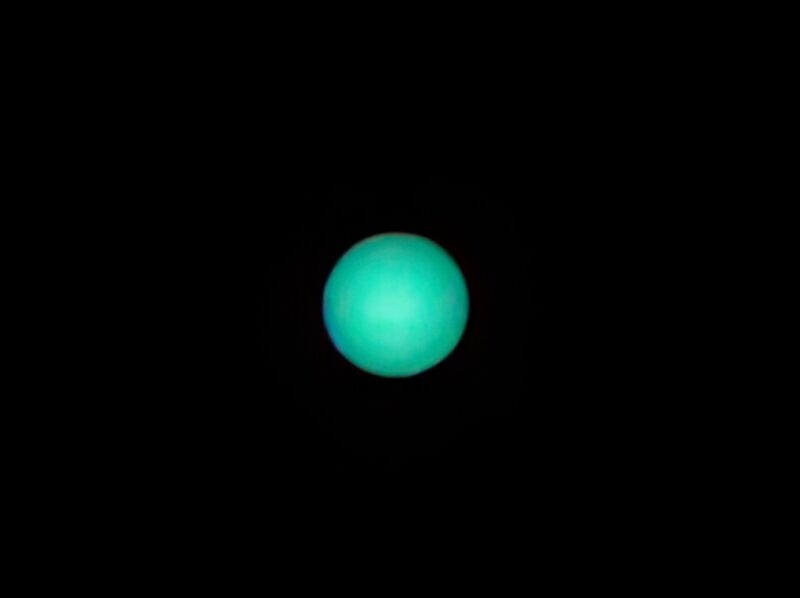
Uranus is most easily picked up with the unaided eye after first pinning down its location with binoculars or a telescope. It has a disk instead of a pinpoint image through an optical device and may even appear faintly bluish green.
It’s particularly easy to find when it pairs up closely with objects easier to locate, such as Mars. And it’s best around its time of opposition, that is, when Earth is passing between Uranus and the sun, bringing Uranus opposite the sun in our sky and closest to Earth for that year. The next opposition of Uranus will be November 25, 2026.
Bottom line: Here are the top 10 brightest natural solar system objects. If you’ve seen every one of these objects, with or without optical aid, congrats!
Discover more from GTFyi.com
Subscribe to get the latest posts sent to your email.