Science & Technology

What’s a green flash and how can I see one?


What’s a green flash? Watch this video to learn more.

The 2026 lunar calendars are here! Best Christmas gifts in the universe! Check ’em out here.

What is a green flash?

A sunset walk on a beach – looking west – is a great time to catch a green flash. What is it? The green flash is an optical phenomenon that you can see shortly after sunset or before sunrise. It happens when the sun is almost entirely below the horizon, with the upper edge still visible. For a second or two, that upper rim of the sun will appear green in color (or sometimes blue). It’s a brief flash of the color green, and quite exciting to see, especially if you’ve been looking for one!

Green flashes do play a role in some legends. In fact, it’s said that once you’ve seen a green flash, you’ll never again go wrong in matters of the heart.
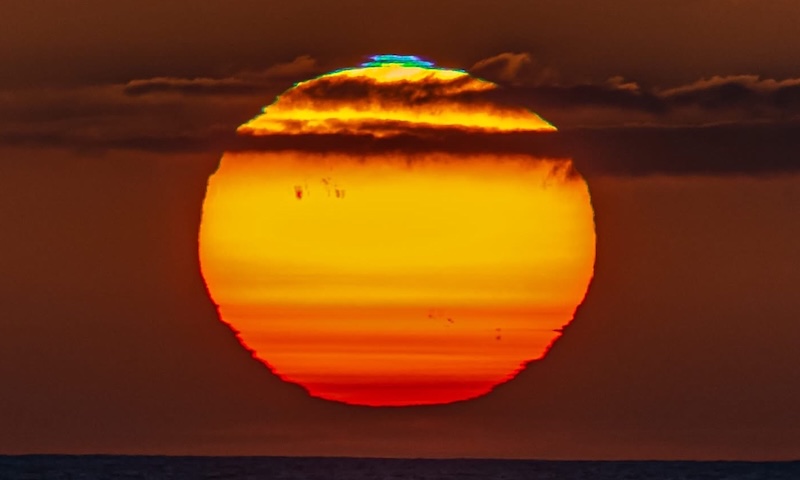
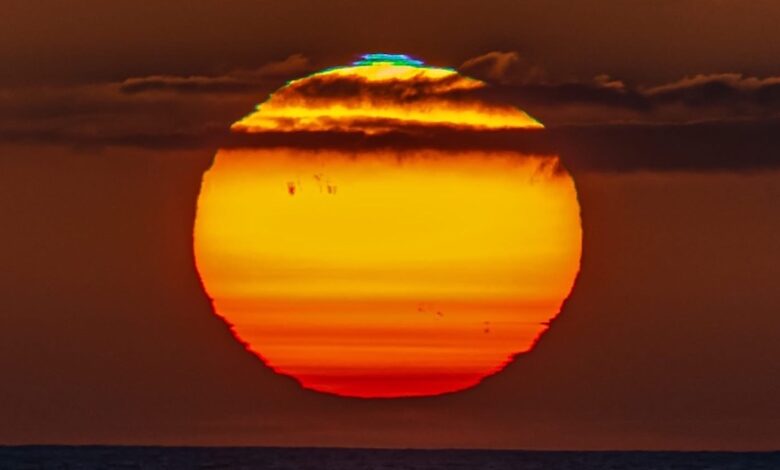
Closeup of the orange sun on the horizon, with clouds in front, sunspots, and a short blue-green line on top.
View at EarthSky Community Photos. | Jim Grant captured a green and blue flash on September 29, 2025, from San Diego, California. Jim wrote: “I saw compressed layers on the horizon an hour before sunset, a good sign for distortion in the sun and possible green flashes. As the sun lowered onto the horizon giant sunspots became visible through my lens. I saw green and blue and purple colors on multiple flashes on the top edge of the sun. Truly a spectacular sight to see. These sunspots, I learned, are 20 times the size of our Earth.” Thank you, Jim!

How can you see one?

You just need two things to see a green flash:

  1. A clear day with no haze or clouds on the horizon.
  2. A distant horizon, and a distinct edge to the horizon. In particular, you can see the green flash from a mountaintop or high building. But usually, people on the beach or in boats see them over the ocean.

Important tip: Don’t look at the sun until it is nearly entirely below the horizon. If you do, you will dazzle (or damage) your eyes and ruin your green flash chances for that day.

Because you need to know exactly where to look along the horizon, and because most of us aren’t up before dawn, green flashes are most often seen after sunset. Diligent observers, however, can see them before dawn, too. And it’s possible to see green flashes over land, too, if your horizon is far enough away.
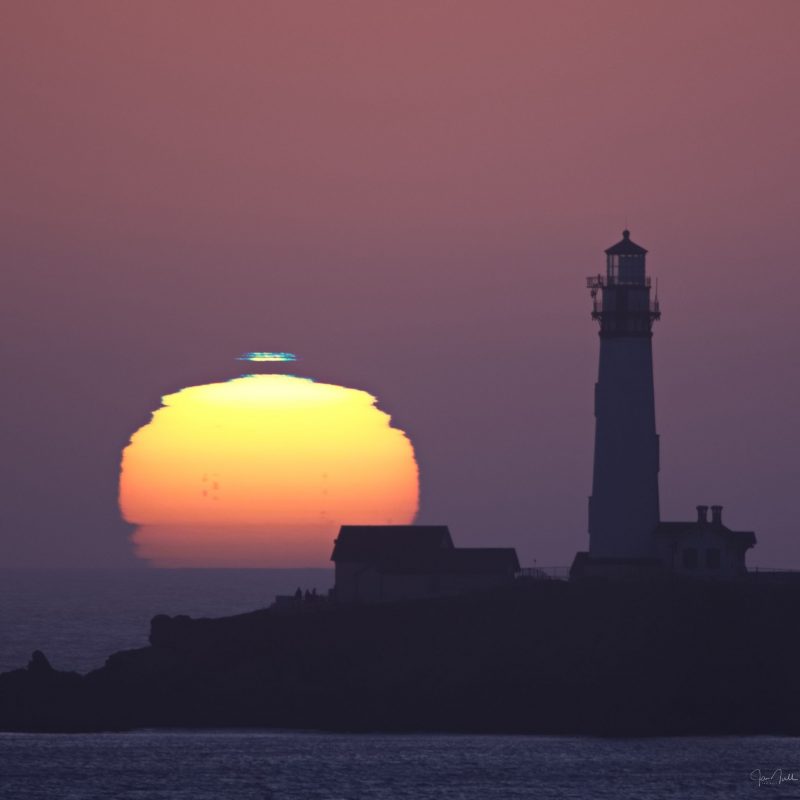
Sun on the horizon with a short blue streak above it and a silhouetted lighthouse on the right.
View at EarthSky Community Photos. | Jan Null took this photo on July 21, 2023, from Pigeon Point, California. Jan wrote: “Photographing Pigeon Point Lighthouse and capturing the green (and occasionally blue) flash are 2 of my favorite subjects on the San Mateo County Coast of California. There was slight inversion on one of the few fog-free days this summer. I drove there hoping to possibly catch one or the other. Fortunately, I was able to get both with probably the most distinct blue color I have seen, with a very strong blue spike on the histogram.” Thank you, Jan!

What makes a green flash?

According to Les Cowley at Atmospheric Optics:

As the sun’s disk diminishes, the green light becomes concentrated and separates from the other colors, creating the brilliant green flash that captivates observers.
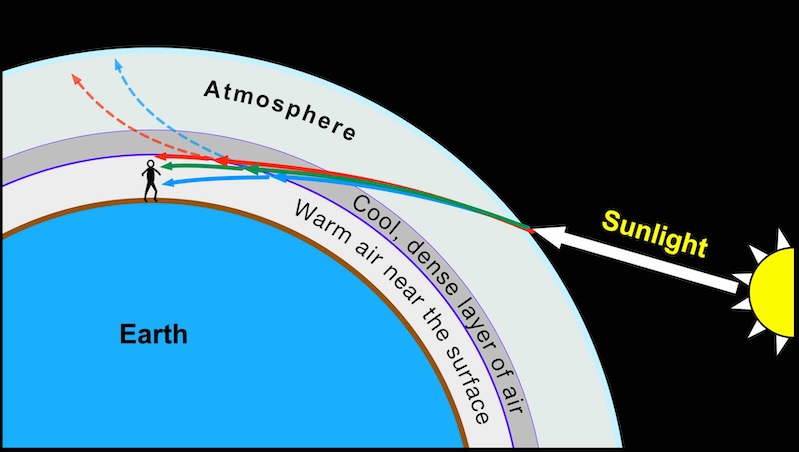
Diagram of light coming through the atmosphere and separating out into colors.
When sunlight enters Earth’s atmosphere at a low angle, its blue portion bends – refracts – most toward the surface, green next, then red. If that refracted light encounters a layer of cool, dense air near the surface, some of that light refracts again, this time at an upward angle. Blue light refracts upward most and red least. The green portion, between blue and red, continues to bend at just the correct angle to enter the observer’s eyes. Chart via EarthSky.

Les explains that the green flash is part of a mirage:

Inferior mirages are produced by warm air at the ocean or earth’s surface and an air temperature gradient changing rapidly with height. Rays from a low sun are refracted back upward as they pass between the cool and warm layers. Refraction always tends to deflect rays toward the denser layer. An observer above the layer sees two solar images or parts of them … (1) an erect image from rays that pass relatively undeflected above the warm layer and (2) a lower inverted image from rays mirrored upward by the warm layer. Each sun image is as ‘real’ as the other. The effect is not dissimilar to the mirage seen above a hot road surface.

As the sunset proceeds, the upper and lower images approach, touch and eventually overlap to form an ‘omega’ shaped sun.

A green flash occurs because at a later stage the deflection by the warm layer/cooler air boundary becomes very sensitive to the angle of incidence of the sun’s rays. Small deviations are vertically magnified including the difference in deflection between red and green rays. This amplification provides the separation between green and red that refraction through a normal atmosphere cannot accomplish.

What is the green ray?

The flash can be like a flame that shoots above the horizon. In that case, it’s called a green ray. I’ve seen lots of green flashes, but never a green ray, although I was once walking on a beach in Mexico and turned away just as my companion saw one.

I did not find any photos of flamelike green rays (if you know of one, let me know), but the photo below suggests the beginnings of a ray.

Enjoying EarthSky? Sign up for our free daily newsletter today!
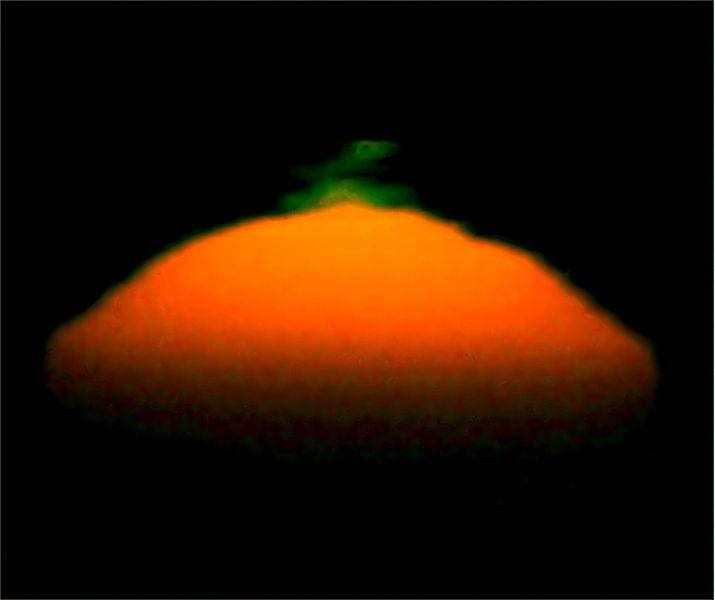
Pyramid-like deep orange setting sun with short, double green streaks at top.
Mock mirage (explained at Atmospheric Optics) and green flash seen from San Francisco. Image via Brocken Inaglory/ Wikimedia Commons (CC BY-SA 4.0).

A green flash on other planets?

Well … Yes! You can also see a green flash on very bright planets – like Venus or Jupiter – from Earth. Check these amazing videos, and don’t miss the comment section below them. People had some very interesting questions to ask, and the authors gave them the answers they were looking for.

Green flash photos from the EarthSky community
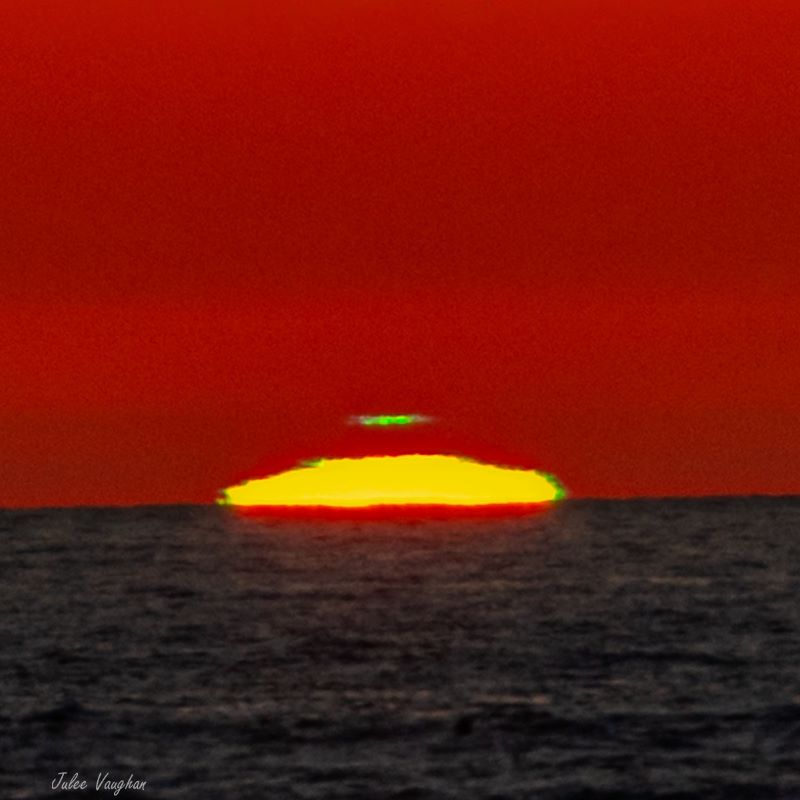
The glowing yellow top of the sun, on ocean horizon, with a short green streak floating above the sun.
View at EarthSky Community Photos. | Julee Vaughan in Ocean Beach, San Diego, California, captured this green flash on November 11, 2023. Julee wrote: “This was one of three green flash shots I got Saturday. Mother Nature put on a show!” Thank you, Julee!
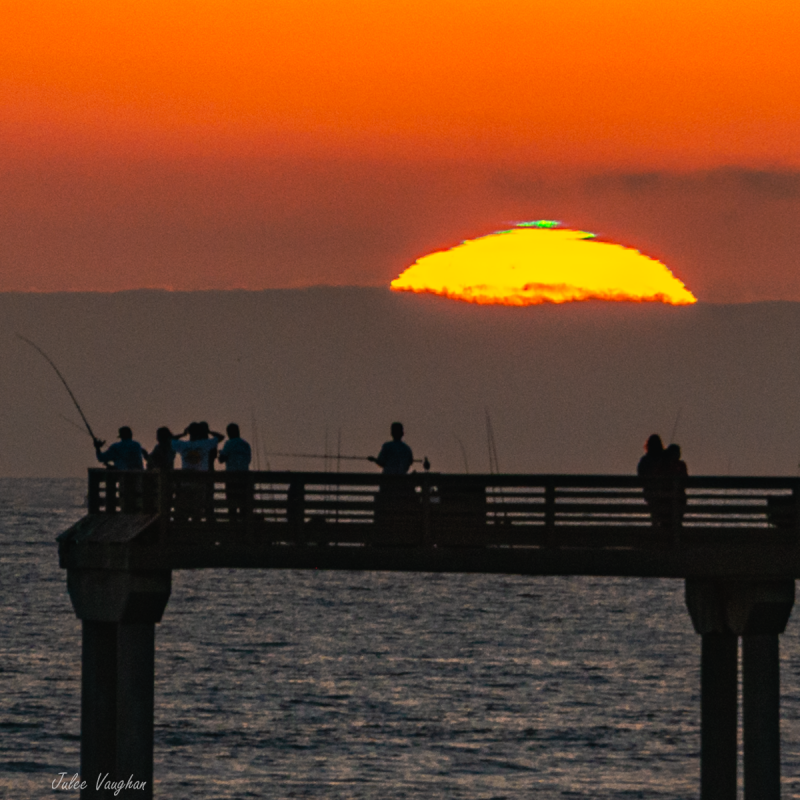
Setting sun, mostly below the ocean horizon, with short green upper rim, and a fishing pier in the foreground.
View at EarthSky Community Photos. | Julia Vaughan caught this green flash at Ocean Beach Fishing Pier, San Diego, California, on July 14, 2023. She commented: “A lot of people think the flash is just a myth, but it isn’t. It’s very real.” So true! Thanks, Julia!
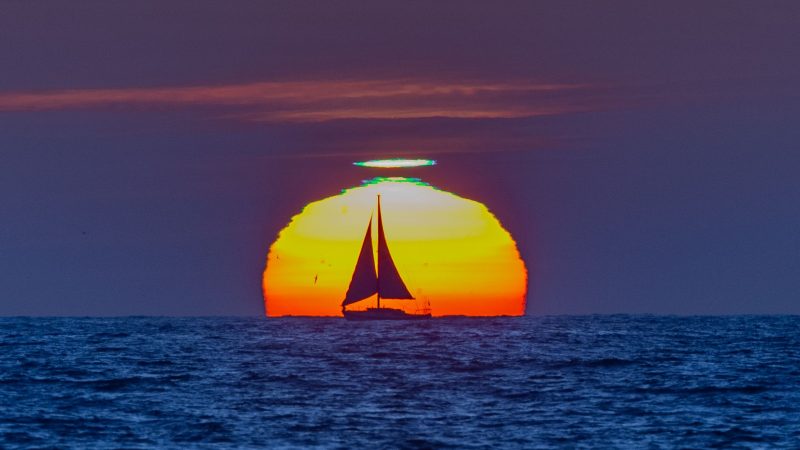
Under a deep blue sky, a sailboat silhouetted against the enormous sun which has a short green streak atop.
View at EarthSky Community Photos. | Jim Grant caught this green flash at the Ocean Beach Pier in San Diego, California, on July 19, 2023. Jim wrote: “This sailboat was drifting close to the Ocean Beach Pier, I knew the sunset was going to be stunning, and I started tracking the boat, hoping to get it centered in the sun. The green rim and green flash above were a bonus.” Thank you, Jim!

A few more green flash photos

Enormous setting sun with green flash over the ocean with birds in front of it. Also it is under a bridge.
View at Earth Sky Community Photos. | Julia Vaughan captured this image on March 15, 2025, and wrote: “Saturday sunset in Ocean Beach, San Diego, California. The green flash is real, this one has a little blue with it.” Thank you, Julia!
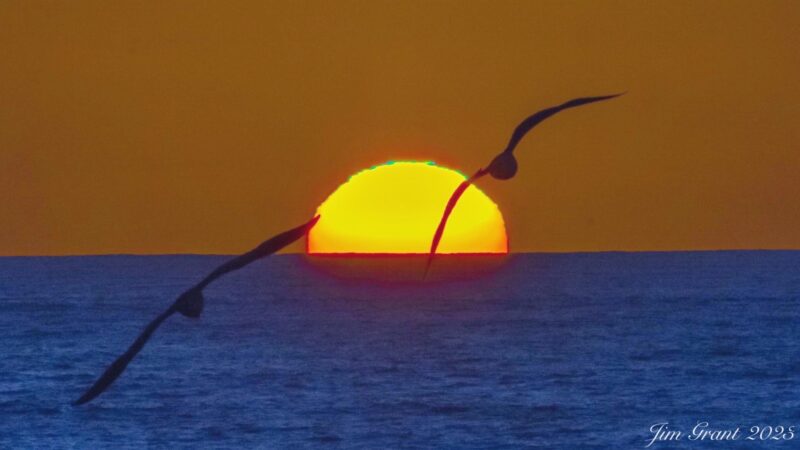
Enormous orange sun half-set over the ocean with the top in green in the background, 2 birds flying in the foreground.
View at EarthSky Community Photos. | Jim Grant at the Ocean Beach Pier, San Diego, California, captured took this image on December 8, 2023, and wrote: “I have been trying to capture the green flash with birds in the image for a few months. Finally all the pieces fell into place.” You nailed it! Thank you, Jim.

More great green flash photos

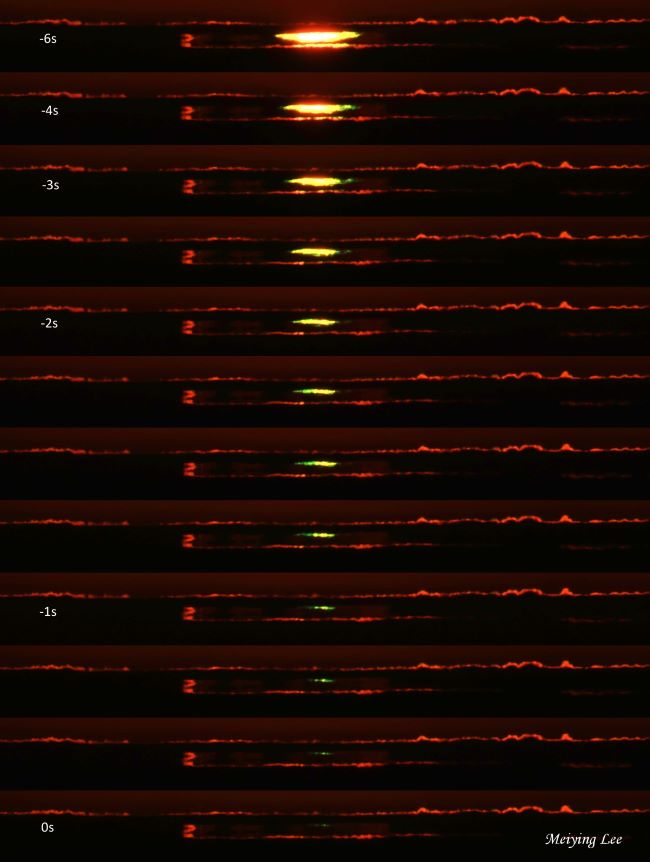
A series of images layered from top to bottom showing decreasing bits of yellow sun with green on the top of each.
View at EarthSky Community Photos. | Meiying Lee in Mount Hehuan, Nantou, Taiwan, captured these images on January 31, 2023. Meiying wrote: “The last 6 seconds of sunset. When the sun has fallen below the horizon, we can continue to see sunlight because of atmospheric refraction. In the last few seconds, when there is only 1 line of sunlight left, because of the different refractive indices of various colors of light, we can see different colors of light … yellow, green and blue are arranged on that line like pearls!” Thank you, Meiying!
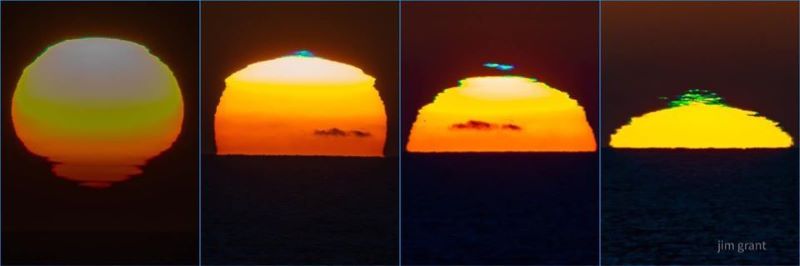
Four images of the sun from just above the horizon to sinking, with a green spot dancing above the last couple.
View at EarthSky Community Photos. | Jim Grant in San Diego, California, captured this series showing the green flash on February 19, 2020. Thank you, Jim!
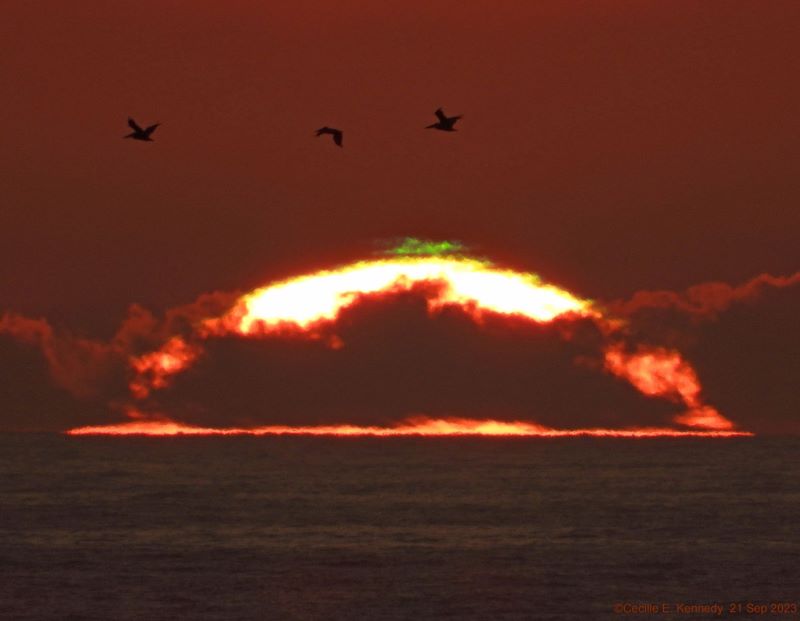
A bright sun half above the ocean with a dark cloud blocking most of it, plus birds above and a small wisp of green atop the sun.
View at EarthSky Community Photos. | Cecille Kennedy on the Oregon Coast captured this image on September 21, 2023. Cecille wrote: “The green flash appeared on top of the fiery red sun as it was setting on the ocean horizon. Over the sun the birds flying south are brown pelicans migrating to South California and Mexico.” Thank you, Cecille!

Bottom line: Learn what a green flash is and how to see one here. Plus, enjoy great photos and watch a video!

What’s a green flash and how can I see one?


Discover more from GTFyi.com

Subscribe to get the latest posts sent to your email.

Alex Hayes

Alex Hayes is the founder and lead editor of GTFyi.com. Believing that knowledge should be accessible to everyone, Alex created this site to serve as a trusted resource for clear and accurate information.

Related Articles

Leave a Reply

Your email address will not be published. Required fields are marked *

Back to top button

Discover more from GTFyi.com

Subscribe now to keep reading and get access to the full archive.

Continue reading