Experience the universe in 2026! Read about the best stargazing of 2026 below, and mark your calendars.
It’s time for the best of 2026 in the night sky! Mark your calendars for these special stargazing events in the upcoming year. From planetary pairings to epic eclipses, and from intriguing evening sky scenes to inspiring morning views, there’s much to see.
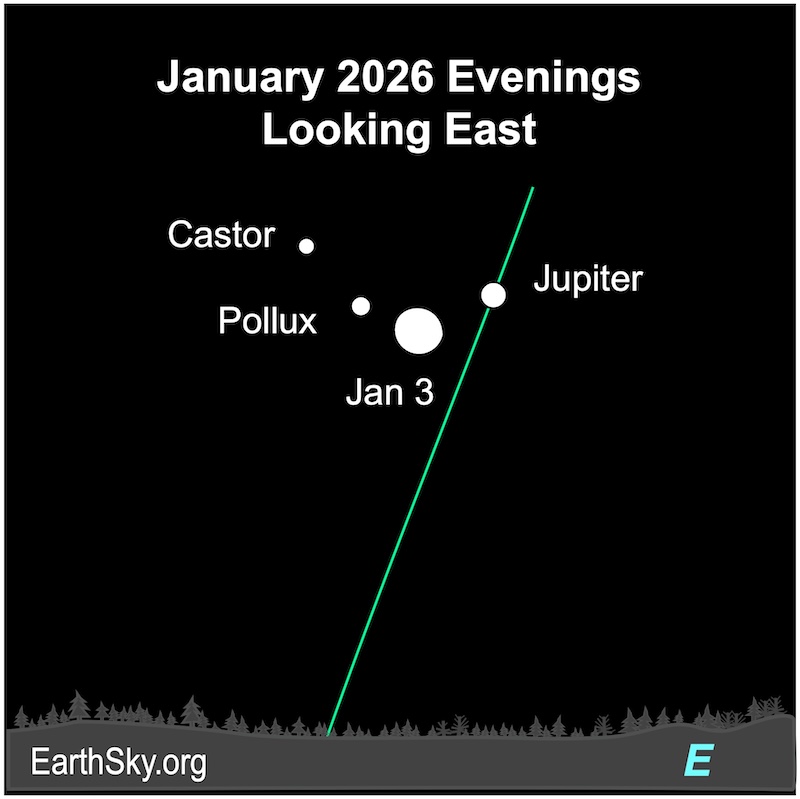
On the night of January 3, 2026, the year’s first supermoon – just hours past its fullest point – will float near Jupiter. Bright moon and brightest starlike object so close in the night sky in January! You can’t miss them. And, as Earth turns beneath the sky, and the moon ascends higher on the night sky dome, Jupiter follows. Earth passes between Jupiter and the sun on January 10. So – like a full moon (which is also opposite the sun) – Jupiter is ascending in the east each evening in January, highest at midnight and descending in the west before dawn. Castor and Pollux – the 2 brightest stars of Gemini the Twins – are also nearby.
#2 Mid-to-late February: A planet parade
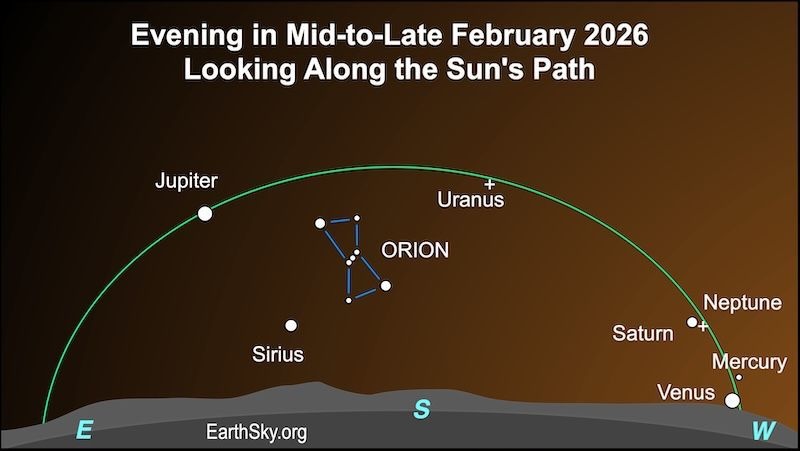
There are 6 planets in the sky after sunset in mid-to-late February. They all lie along the sun’s path, the green line on our chart. You’ll want a clear view to the west, because – as seen from across Earth – 4 of them set soon after the sun. And 2 require optical aid to be seen (the 2 marked with crosses on our chart). Watch for Saturn dropping toward the horizon, while Venus and Mercury climb up from sunset. Neptune is next to Saturn, but you’ll need a telescope to see it. Uranus is higher in the sky; you might see it with binoculars. The easiest planet – the one everyone will be able to see with no problem – is bright Jupiter. Watch for this mighty world arcing across the sky as the night passes. And watch for the moon near Jupiter the evening of February 26!
#3 Total lunar eclipse of the Worm Moon on March 2-3
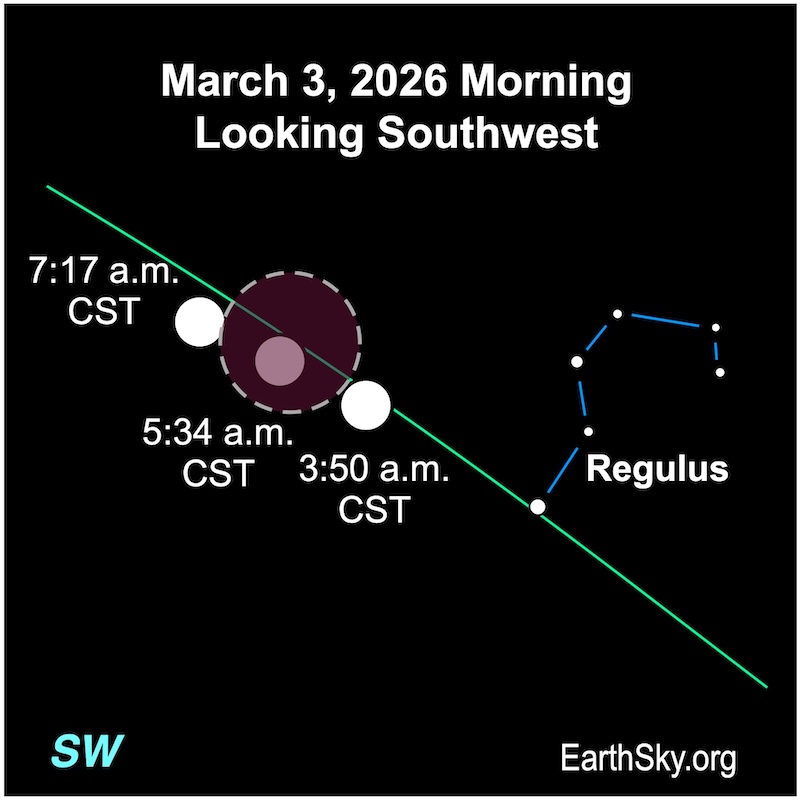
This lunar eclipse will be visible in Asia and Australia during the evening of March 3, and North America in the early morning of March 3. The moon begins to enter Earth’s dark umbral shadow on March 3 at 3:50 a.m. CST, reaching mid-eclipse at 5:34 a.m. CST. The lunar orb moves completely out of Earth’s shadow by 7:17 a.m. CST. However, many in North America will see the moon set before the eclipse is over. During totality, the darkened moon exhibits a shade of deep red. How red? That’s influenced by the atmospheric conditions where you live. Can you spot the star Regulus near the moon?
#4 Captivating crescent, Venus and stars after sunset April 19 and 20
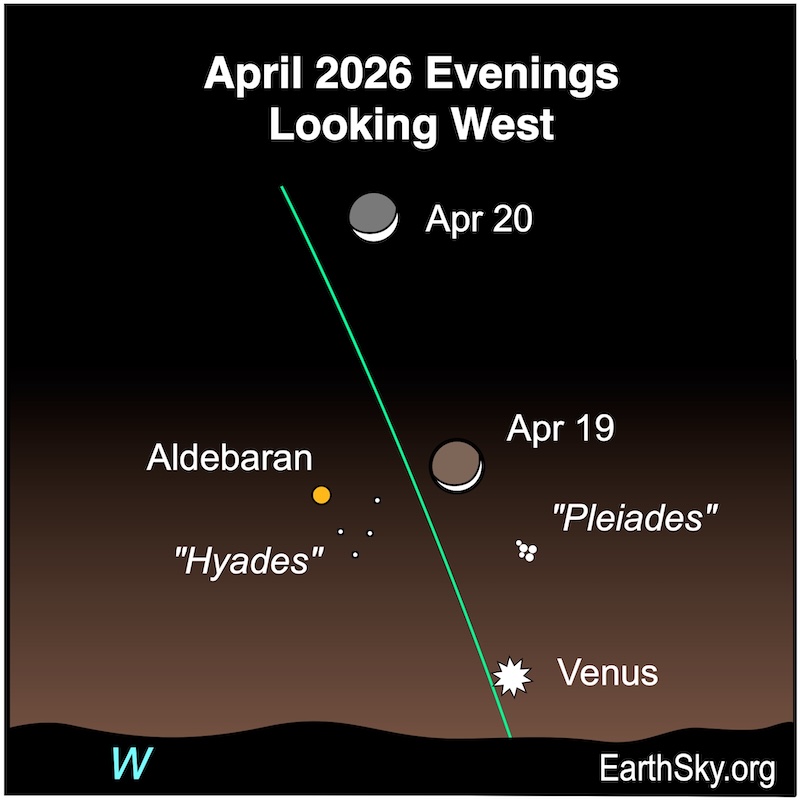
The waxing crescent moon, lit with earthshine, will glow in the west-northwest about an hour after sunset on the evenings of April 19 and 20. The bright point of light closer to the horizon is Venus. Two favorite star clusters are nearby: the dipper-shaped Pleiades and the larger V-shaped Hyades with the red foreground star Aldebaran.
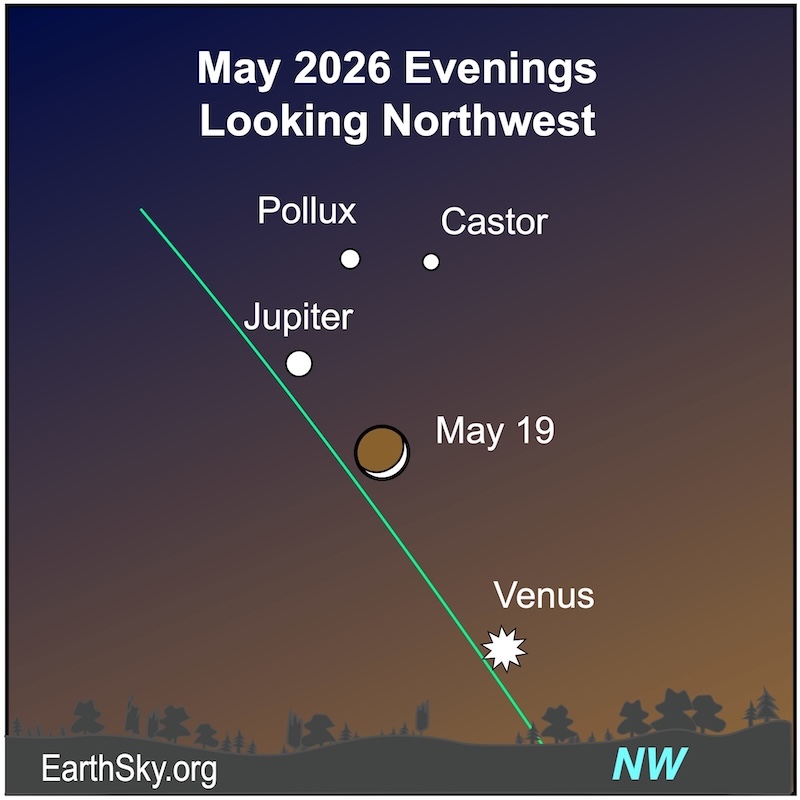
#5 Crescent moon between Venus and Jupiter on May 19
On May 19, look west 30 minutes after sunset to see the waxing crescent moon hanging below bright Jupiter and above brilliant Venus. Above them all stand the twin stars of Gemini: Castor (the dimmer one) and Pollux.
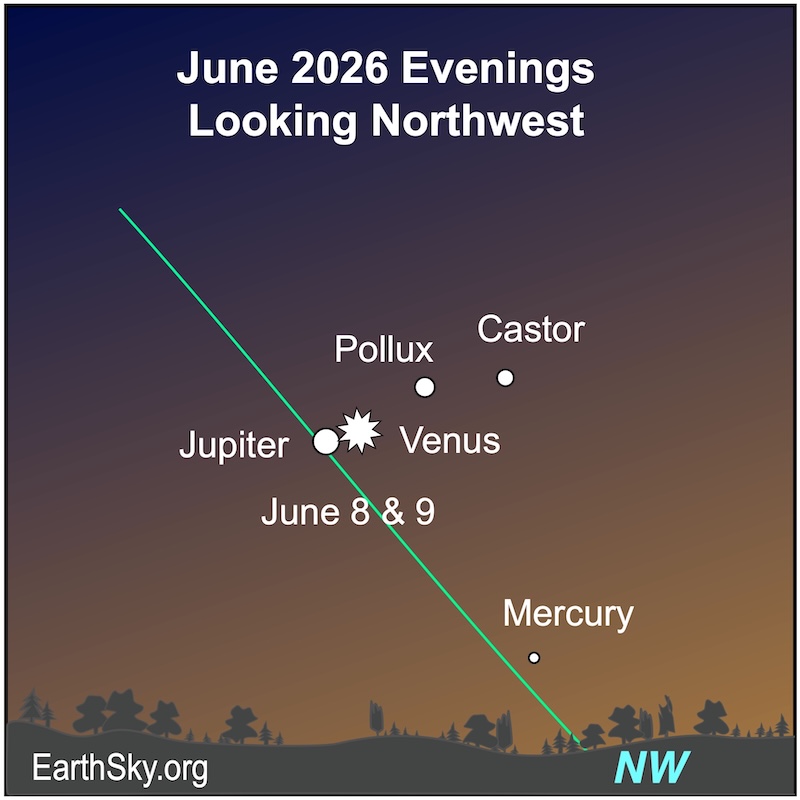
#6 Brilliant Venus-Jupiter conjunction on June 8 and 9
During the first week of June, brilliant Venus approaches bright Jupiter in the northwest around an hour after sunset. On June 7, the two planets are nearly side by side. Then, in the early evening of June 8 and 9, the planets switch places, making for an eye-catching “double planet.” Even though they are next to each other in our sky, they are nowhere near each other in space. Venus lies 111 million miles from our little blue world, while Jupiter is five times farther away.
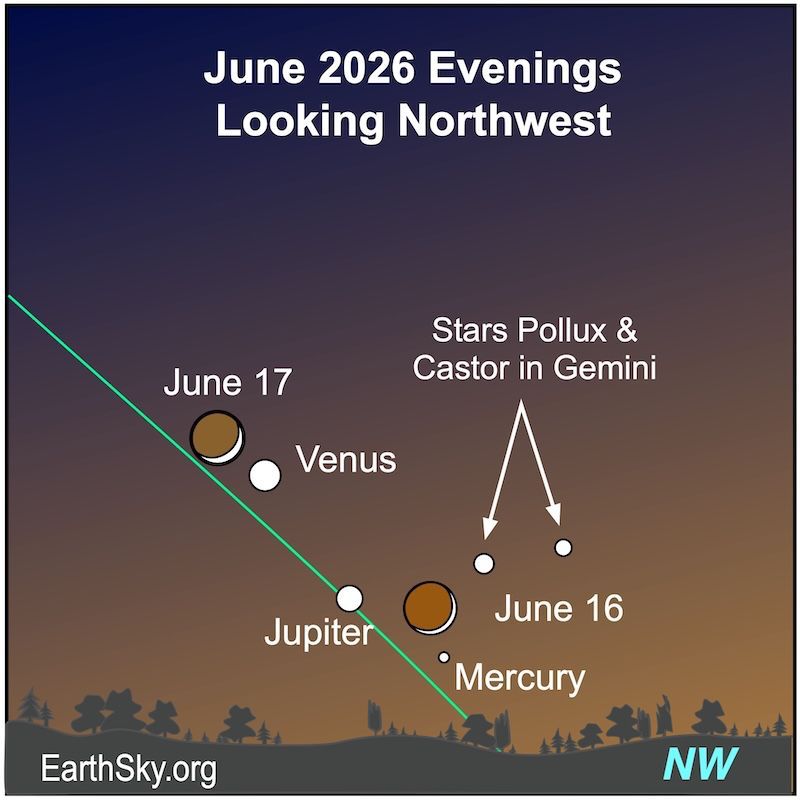
#7 Moon and planet party on June 16 and 17
Shortly after sunset on June 16, the thin waxing crescent moon sits below bright Venus and alongside Jupiter, little Mercury, and the stars Castor and Pollux in the constellation Gemini. On June 17, the crescent moon and Venus sit closer together, with Jupiter, Mercury, Castor and Pollux below.
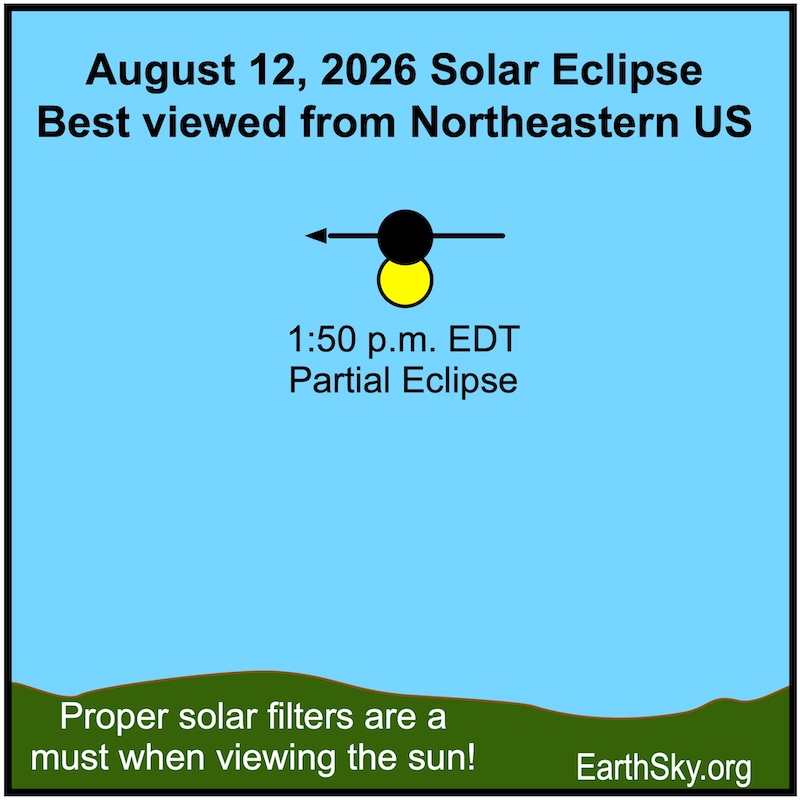
#8 Total solar eclipse on August 12
If you’re lucky enough to be in parts of Greenland, Iceland and Spain on August 12, 2026, you will be treated to a total solar eclipse. Areas outside the path will see a partial solar eclipse, including viewers in the upper Midwest and northeastern United States. Remember that for a partial solar eclipse, you must wear approved, safe solar eclipse glasses. In the northeastern U.S, at maximum eclipse, some people will see up to about 15% of the sun covered by the moon. The exact timing depends largely on your location, but the event runs from about 1:00 p.m. to 2:40 p.m. EDT, with the maximum eclipse occurring about 1:50 p.m.
#9 Perseid meteor shower on mornings of August 11, 12, 13
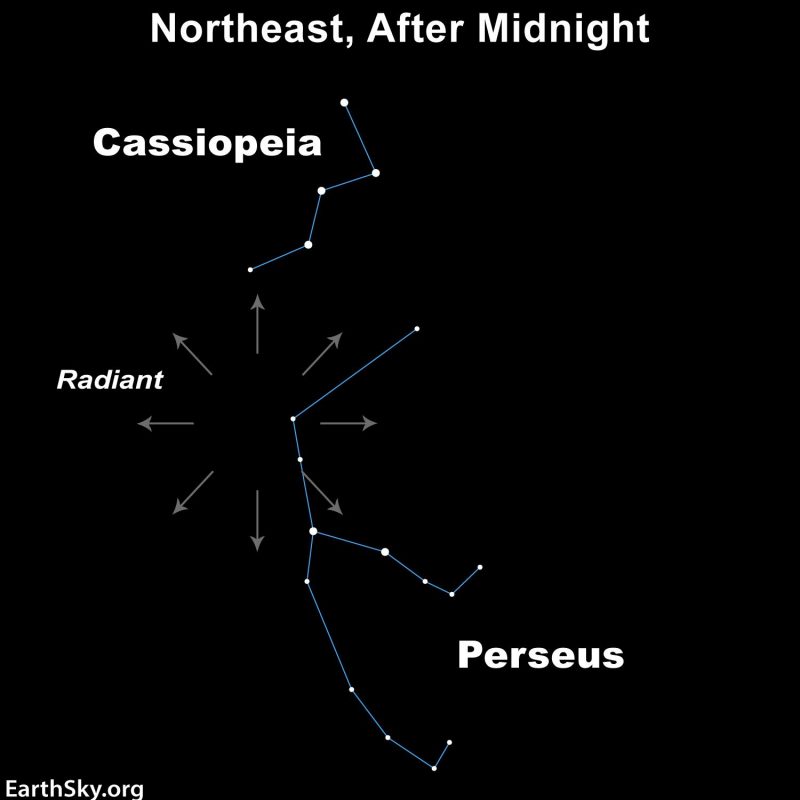
On the mornings of August 11, 12, and 13, skywatchers will be treated to the beloved Perseid meteor shower. These meteors radiate from a point in the constellation Perseus the Hero, which – in August – rises in late evening and is highest at dawn. And in 2026, the peak of the Perseid meteor shower coincides with a new moon, which is ideal for meteor viewing.
#10 Deep partial eclipse of the Sturgeon Moon on August 27
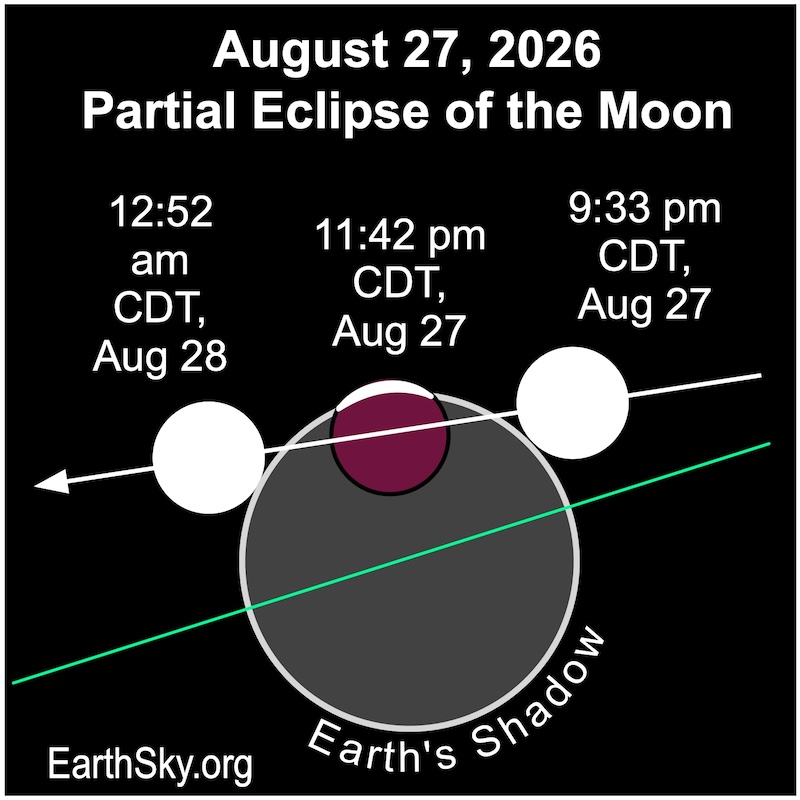
A deep partial eclipse will be visible for much of the globe overnight from August 27 to 28. For those in the U.S., the moon will begin to pass through Earth’s umbral shadow at 9:33 p.m. CDT on August 27. It will reach its maximum (93% coverage) at 11:42 p.m. You should be able to see the reddish moon wearing a glowing white hat! By 12:52 a.m. CDT on August 28, the moon will have completely left Earth’s shadow.
#11 Moon and Mars in the morning September 6 and 7
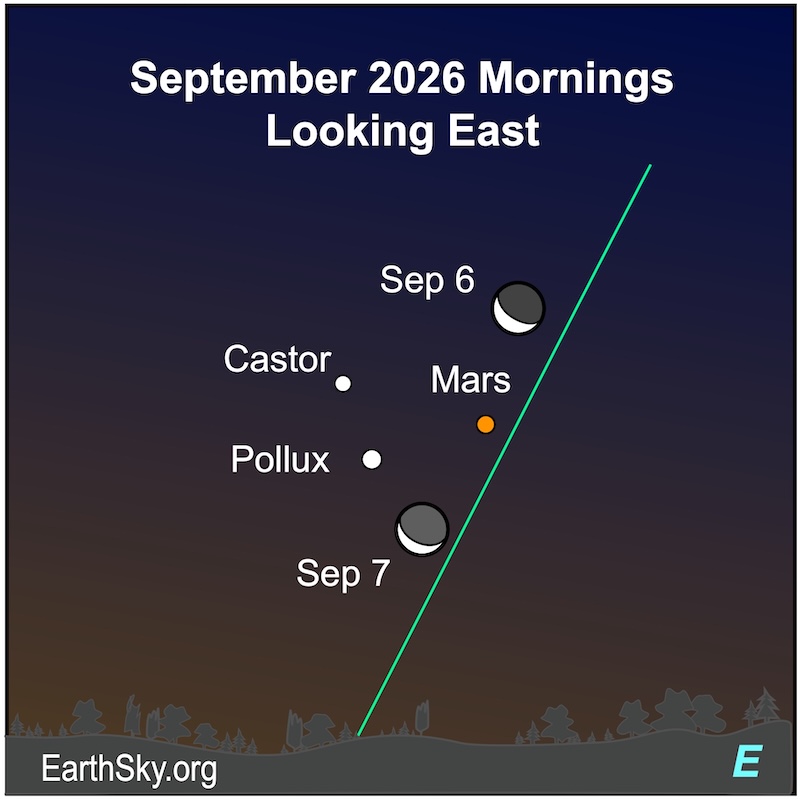
Shortly before sunrise on September 6, the waning crescent moon will hang above Mars and near Castor and Pollux, the twin stars of Gemini. On the following morning, a slightly thinner crescent lies below Mars and forms a straight line with Castor and Pollux.
#12 The temporary triplets of Gemini on September 25
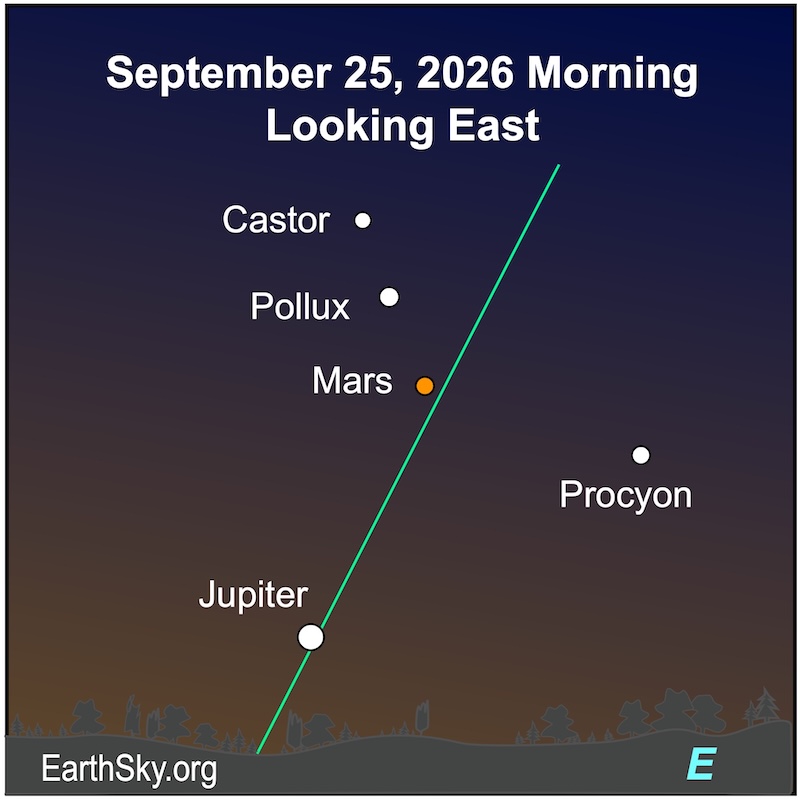
Look east in the early morning hours around September 25. You’ll spot Mars forming a straight line with Castor and Pollux, making the twin stars of Gemini temporary triplets. And below this trio, you’ll see bright Jupiter near the eastern horizon.
#13 The crescent moon hides Jupiter on October 6
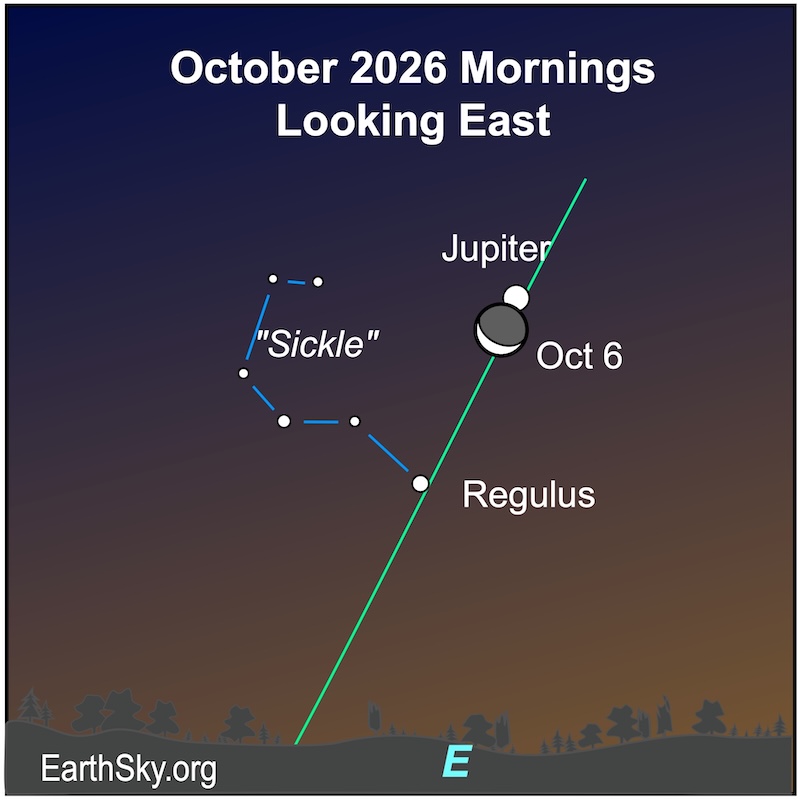
In the pre-dawn hours on October 6, the crescent moon will lie near bright Jupiter. From U.S. locations east of St. Louis, the waning crescent moon will move right in front of Jupiter, temporarily hiding it. Then, about 60 minutes later, the planet will reappear along the moon’s dark rim. Other locations will see Jupiter quite close to or even brushing the limb of the moon. Nearby will be Regulus, the brightest star in Leo the Lion.
#14 Mars meets Jupiter on November 16
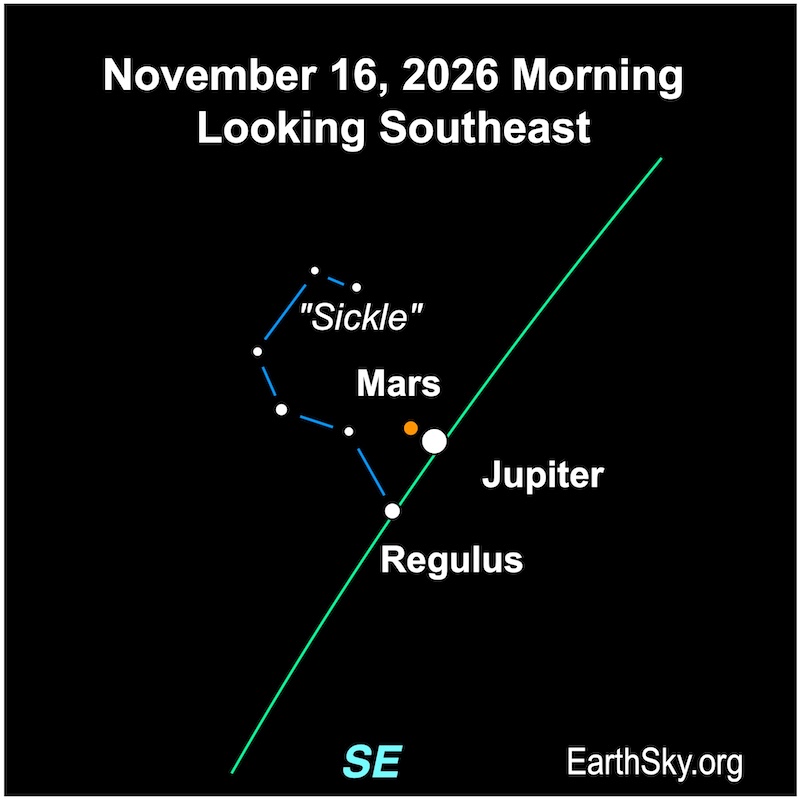
Through early November, bright Jupiter and dimmer, redder Mars will get closer and closer. And on November 16, the duo will be at their closest. They’ll rise just before midnight and be visible through dawn. Nearby you’ll also see the bright star Regulus. This star marks the period at the bottom of a backward-question-mark-shaped star pattern called the Sickle, found in the constellation Leo.
#15 December 4: A double header
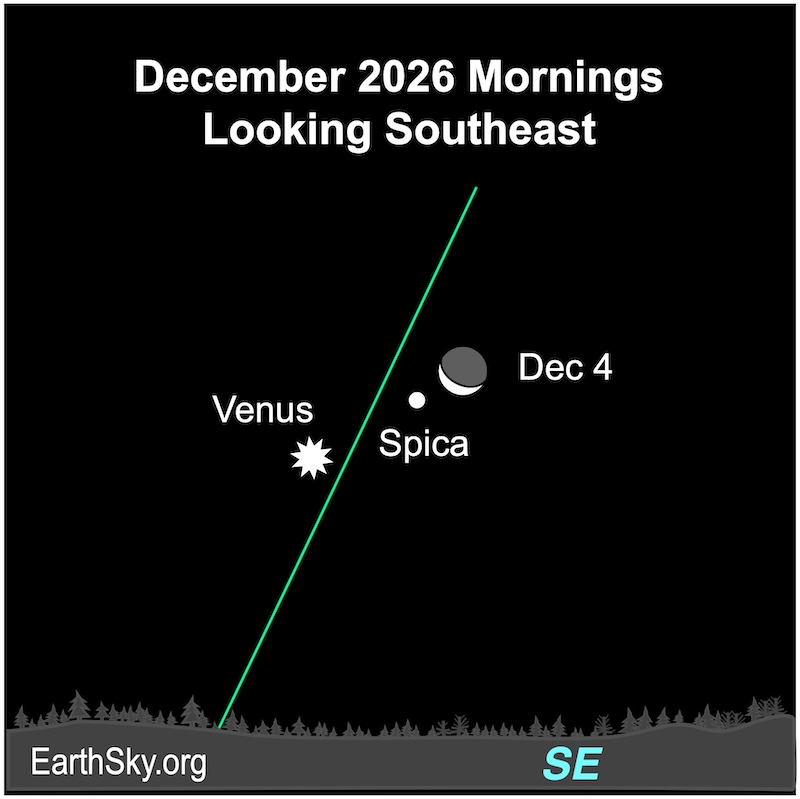
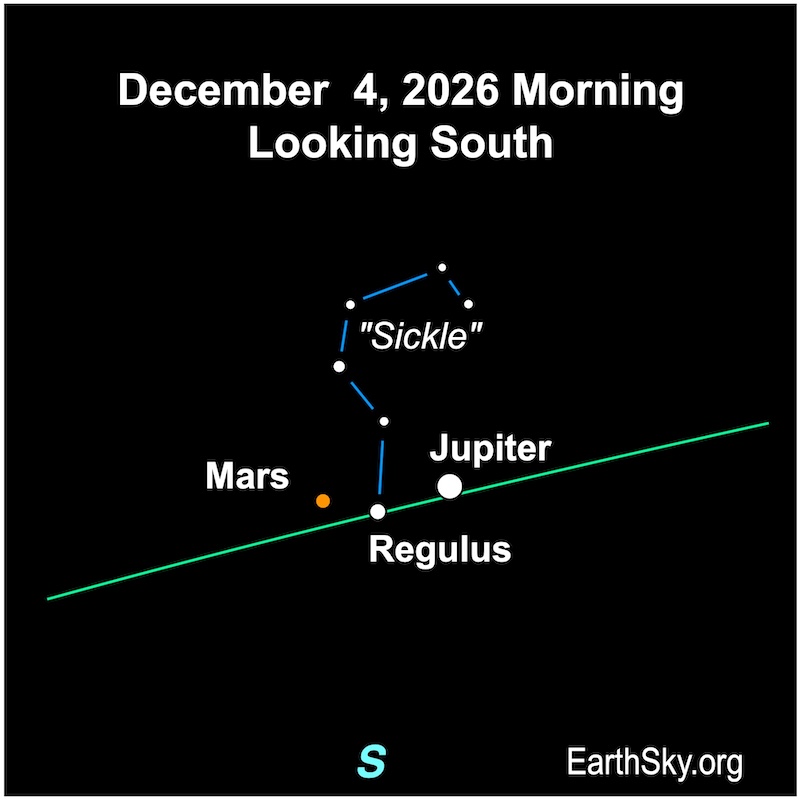
In the hours before sunrise on December 4, two intriguing celestial scenes occur. First, the two brightest objects in the night sky – the moon and Venus – will lie next to each other low above the southeastern horizon. And Spica, the brightest star in Virgo, will be between them.Also before sunrise on December 4, bright Jupiter will lie in the south near red Mars. Between them will be Regulus, the brightest star in Leo.
Bottom line: Here’s the best stargazing of 2026! Read about the top celestial events not to miss in the coming year, and mark them on your calendar.
The EarthSky team has a blast bringing you daily updates on your cosmos and world. We love your photos and welcome your news tips. Earth, Space, Sun, Human, Tonight. Since 1994.
Alex Hayes is the founder and lead editor of GTFyi.com. Believing that knowledge should be accessible to everyone, Alex created this site to serve as a trusted resource for clear and accurate information.