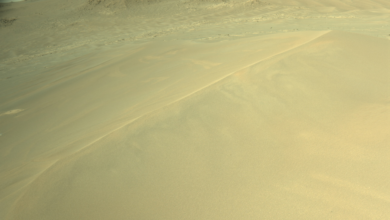
Gorgeous lights o’ the north last night…
— Barbara Exon (@barbaraexonwriter.bsky.social) 2025-12-13T11:55:34.932Z
Sun news for December 12-13, 2025. The last 3 nights have seen auroral displays primarily at higher latitudes. What did it look like? These images from Barbara Exon (@barbaraexonwriter.bsky.social) in Scotland provide a sampling.
Sun news December 13: Auroral displays, 3 nights in a row!
Today’s top story: For the 3rd consecutive night, Earth experienced G1 (minor) geomagnetic storming! Last night’s disturbance lasted through three consecutive 3-hour synoptic periods, beginning around 18 UTC on December 12 and easing by about 3 UTC on December 13. Aurora watchers reported displays from locations such as Trondheim and Kiruna in Scandinavia, as well as Wisconsin and Montana in the United States. Earth’s magnetic field was driven to unsettled-to-active levels by a combination of lingering solar ejecta and special conditions of the solar wind. Additional active periods remain possible tonight and tomorrow as this layered “sandwich” of disturbance-generating solar wind continues to buffet Earth’s magnetosphere, with conditions expected to gradually wane around December 15.
Past 24 hours: The details
(11 UTC December 12 – 11 UTC December 13)
- Flare activity: Flare production increased slightly, with 16 flares over the past day in contrast to 13 flares the day before. Overall solar activity remained at low levels, with only C-class flares recorded over the past day. Despite the low flare levels, striking jets and prominences were observed near sunspot region AR4296 in the southwest and a second region, AR4304, in the northwest.
- Strongest flare: A C3.6 flare from AR4296 at 17:58 UTC on December 12.
- Lead flare producer: AR4296 led flare production during the period, generating six C-class flares.
- Other notable C-class flares: A C2.2 at 13:48 UTC (AR4296), C2.8 at 14:47 UTC (AR4296), C3.3 at 17:57 UTC (AR4298), C2.9 at 18:19 UTC (AR4307), and a C2.5 at 19:04 UTC (AR4296), all on December 12. The remaining flares were weaker events below C2.0.
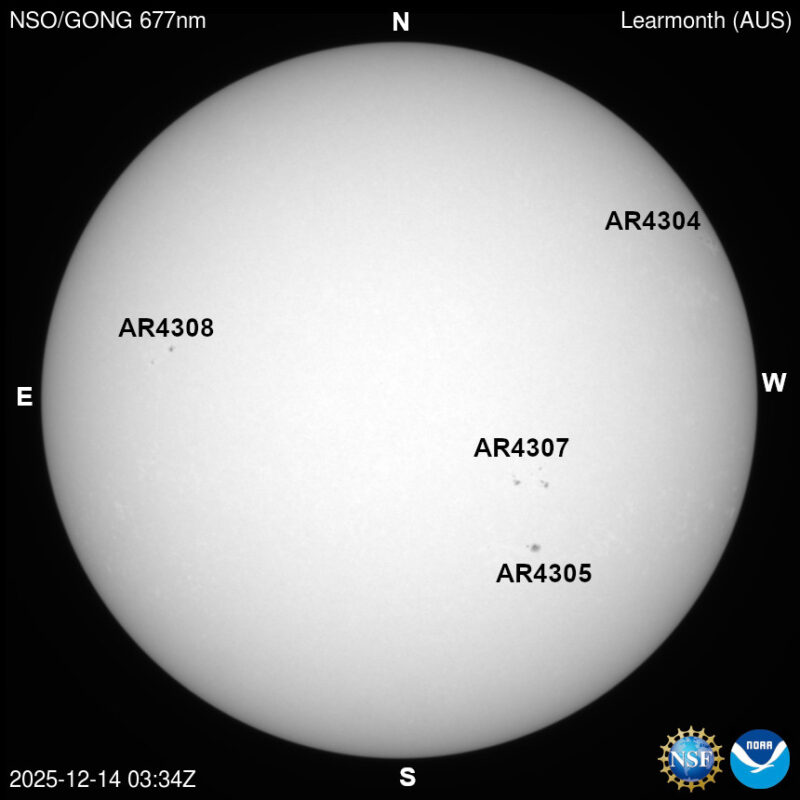
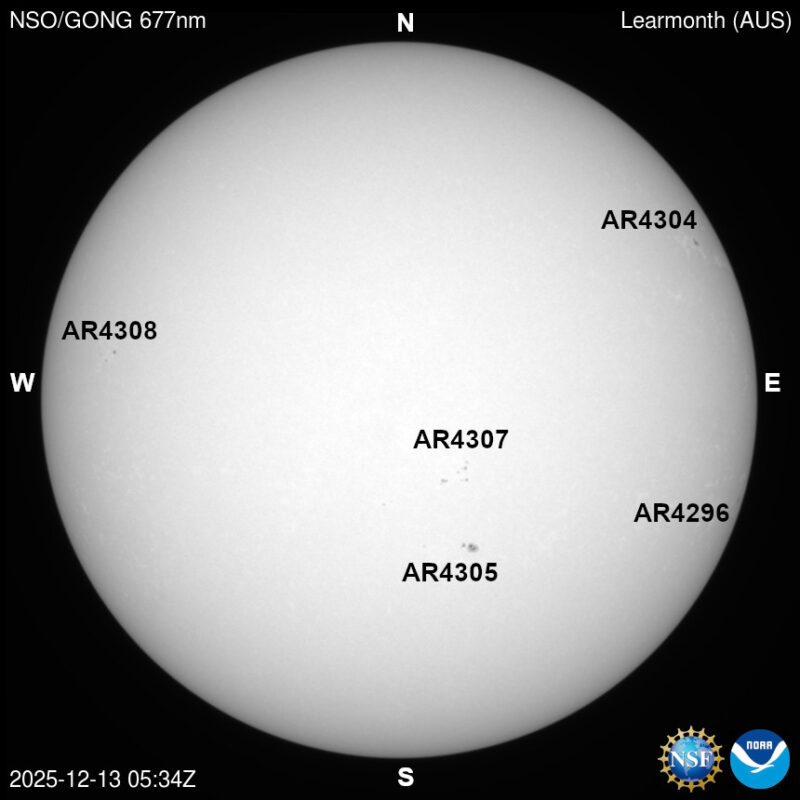
- Sunspot regions: The sun currently shows five numbered active regions on its Earth-facing side, with the most complex groups clustered in the western hemisphere.
- AR4296 (alpha) remains difficult to classify magnetically as it nears the western limb and prepares to rotate out of view. Despite this, it remained the leading flare producer of the period.
- AR4304 (beta) lost its gamma component and stayed stable, producing no flares.
- AR4305 (beta) also lost its gamma complexity and produced a single C-class flare.
- AR4307 (beta) continued to grow near the solar central meridian in the southwest quadrant and produced three C-class flares.
- A new region, AR4308, emerged in the northeast quadrant with a beta magnetic configuration.
- Blasts from the sun? No coronal mass ejections (CMEs) were detected in available coronagraph imagery.
- Solar wind: Last night’s display was driven in part by enhanced negative-polarity solar wind, and a co-rotating interaction region (CIR) containing an embedded transient. Solar wind speeds gradually increased from about 417 km/s to nearly 605 km/s by 10 UTC on December 13. The interplanetary magnetic field (IMF) strengthened to around 14 nT. The Bz component remained southward through the first half of the period until about 00:33 UTC, then turned northward through the end of the observation window.
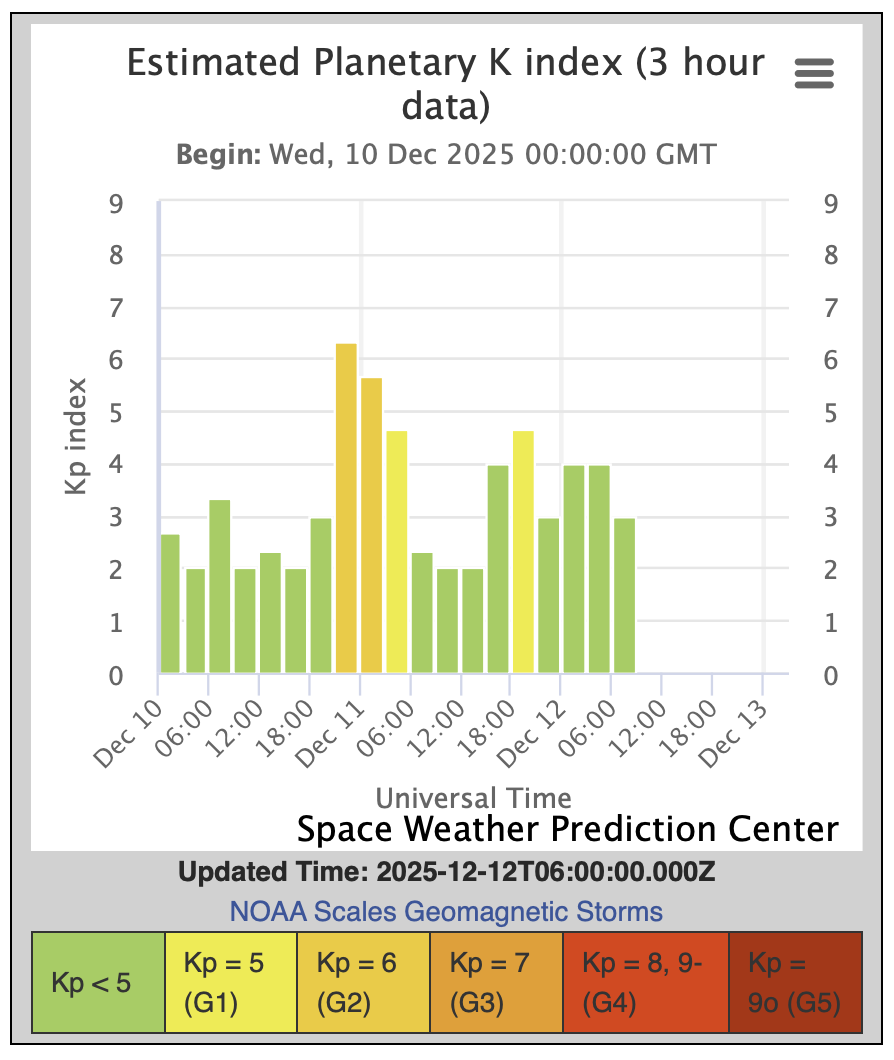
- Earth’s magnetic field: Geomagnetic conditions ranged from quiet to active, with storm levels reaching Kp = 2–5. A G1 (minor) geomagnetic storm developed around 18 UTC on December 12 and persisted until approximately 03 UTC on December 13. At the time of this report (11 UTC on December 13), Kp has returned to 2.
What’s ahead? Sun–Earth forecast
- Flare activity forecast: As the most magnetically complex regions rotate to the far side of the sun, the probability of M-class flares has dropped to about 45%, with only a 5% chance of X-class flares. Overall moderate-to-high activity is expected to decline as AR4294 has fully departed and AR4296 nears the western limb.
- Geomagnetic activity forecast:
- December 13: Unsettled-to-active conditions are expected, with a chance for isolated G1 (minor) storm periods driven by recurrent negative-polarity fast solar wind from a coronal hole, combined with CIR and transient effects. Aurora watchers should remain alert.
- December 14: Unsettled-to-active (Kp=3-4) geomagnetic conditions may persist.
- December 15: Conditions are expected to trend toward unsettled (Kp=3) as fast solar wind influences gradually weaken.


Sun news December 12: Geomagnetic storm struck again last night
The strange week for aurora-watching continued over the past day, as Earth’s magnetic field stayed unsettled under the combined influence of lingering solar ejecta and shifting solar wind conditions. After a surprising G2 (moderate) geomagnetic storm on December 10, another overnight surge pushed activity back to storm levels, briefly reaching G1 (minor) overnight last night. This renewed disturbance was driven by enhanced solar wind flowing through a changing magnetic sector and reinforced by a co-rotating interaction region (CIR). Auroral displays were largely confined to high latitudes: Alaska, northern Canada, Iceland, and northern Scandinavia, including cities like Reykjavik, Tromsø, and Fairbanks. With a coronal hole high-speed stream rotating into a more geoeffective position (a position where it is capable of affecting Earth, the sun–Earth connection remains lively, keeping aurora watchers on alert!
Past 24 hours: The details
(11 UTC December 10 – 11 UTC December 11)


- Flare activity: The sun itself remained moderately active over the past day. A pair of M-class flares erupted from regions near the southwest limb, and we also had 11 C-class (common) flares. So total flare production was 13 flares over the past day. Adding visual drama, a long-lived prominence along the southeast limb put on a striking display: twisted magnetic fields formed a tornado-like structure before flinging part of its plasma into space.
- Strongest flare: An M2.0 flare from AR4296 at 5:05 UTC on December 12, producing an R1 (minor) radio blackout that affected an area over the Indian Ocean, off the northeast coast of Australia.
- Second M-class flare: An M1.1 flare from AR4294 at 5:44 UTC on December 12, also causing an R1 (minor) radio blackout over the Indian Ocean, east of Australia.
- Lead flare producer: AR4294 still is the lead flare producer before departing this time with eight total flares: one M and seven Cs.
- Other notable C-class flares: C4.5 at 15:21 UTC (AR4294), C5.0 at 15:29 UTC (AR4294), C9.7 flare almost an M flare at 15:46 UTC (AR4294), all these flare produced on December 11.
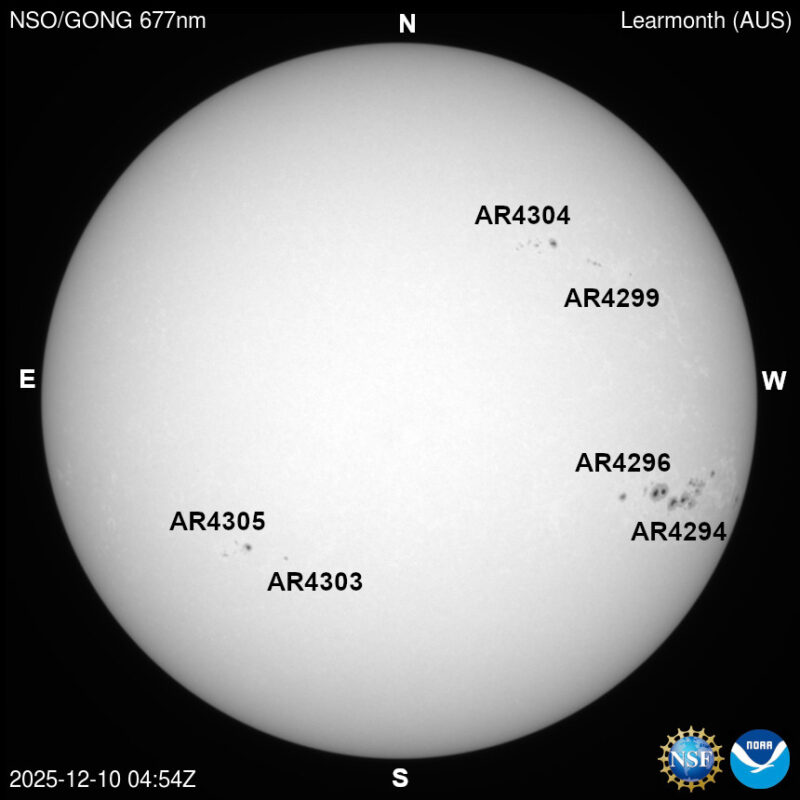
- Sunspot regions: The sun shows five active regions on the Earth-facing side, three with complex magnetic structures.
- AR4294 (beta-gamma-delta) was the top flare producer of the period. Although it has now rotated off the western solar limb, its activity may still reveal itself through prominences rising along the edge of the Sun.
- AR4296 (beta-delta) produced one of the two M flares today, the strongest one. It will soon rotate out of view.
- AR4299 (beta) will also soon rotate out of view.
- AR4304 (beta) lost its gamma configuration and remained stable with no flares produced.
- AR4305 (beta-gamma) retained its magnetic complexity and produced one C flare.
- There is a newcomer on the Earth-viewed solar disk now numbered AR4307 located in the southeast quadrant near the solar central meridian.
- Blasts from the sun? No coronal mass ejections (CMEs) were detected in available coronagraph imagery.
- Solar wind: Solar wind speeds ranged from 420 km/s to a peak of 450 km/s with a peak of 500 km/s at 2:40 UTC this morning then declined to 416 km/s by 10 UTC today. The interplanetary magnetic field (IMF) is at 9 nT. The Bz component remained southward almost the whole period. It remained southward at the time of this writing.
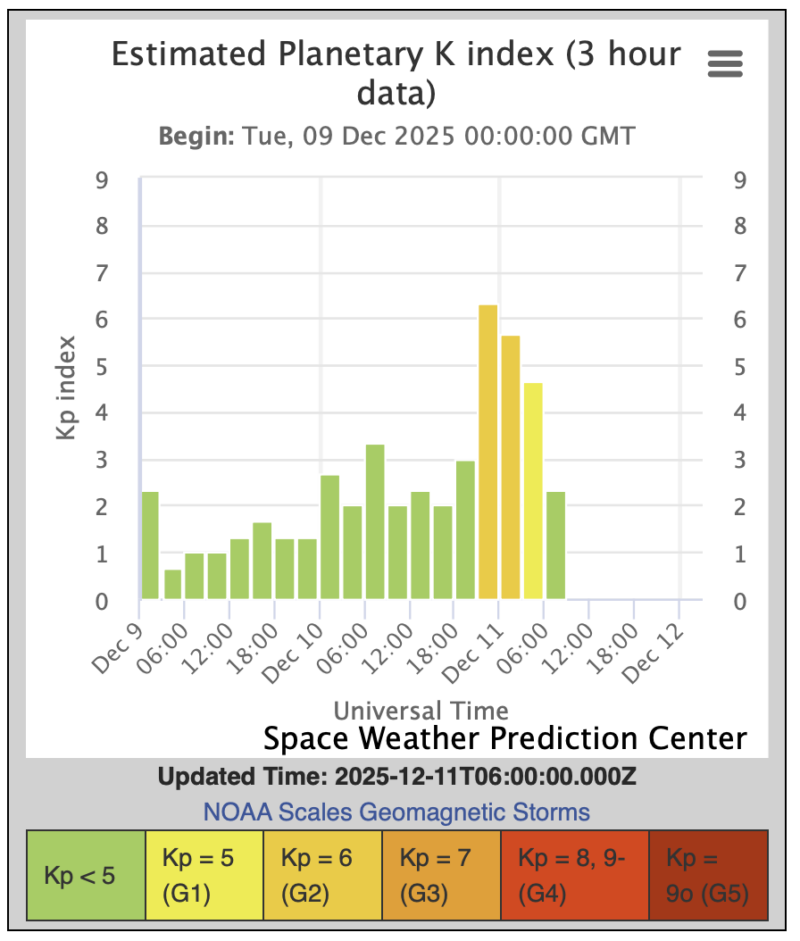
- Earth’s magnetic field: Conditions ranged from quiet to active, with storming levels of Kp = 2-5. An isolated G1 (minor) storm started around 18 UTC on December 11. At the time of this report, Kp = 3.
Sun news December 11: Surprising geomagnetic storm last night
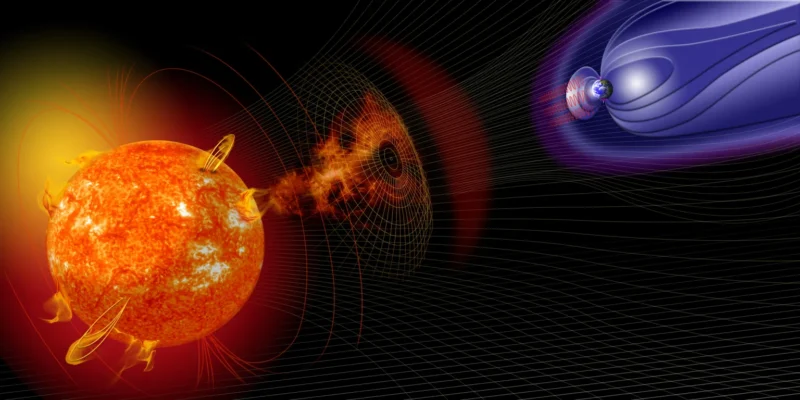
It’s been a strange week for aurora watching! After the major geomagnetic storm anticipated on Tuesday night failed to materialise, expectations for auroras were low. But last night, our star provided a surprise G2 (moderate) geomagnetic storm, bringing auroras as far south as Oregon and Illinois. This storm was driven partly by a knot of solar winds known as a co-rotating interaction region, and partly by an unknown blast of sun-stuff. Was this the December 6 coronal mass ejection (CME), which was expected to provide the storms on Tuesday? No; this has already passed Earth. But it might have been a delayed portion of that CME, or a different CME, or another space weather effect entirely … it’s hard to say!
Past 24 hours: The details
(11 UTC December 10 – 11 UTC December 11)
- Flare activity: Flare production dropped to 11, down from 31 yesterday, but the sun remained at moderate levels with two M-class flares and nine C-class flares.
- Strongest flare: An M4.4 flare from AR4294 at 22:08 UTC on December 10, producing an R1 (minor) radio blackout over the sunlit hemisphere.
- Second M-class flare: An M1.6 flare from AR4294 at 13:43 UTC on December 10, also causing an R1 (minor) radio blackout.
- Lead flare producer: AR4294 dominated activity again with eight total flares: two Ms and six Cs. Flare production will likely decrease as AR4294 approaches the southwest limb and rotates out of view.
- Other notable C-class flares: C3.4 at 15:05 UTC (AR4294), C3.7 at 19:28 UTC (AR4296), C4.9 at 23:05 UTC (AR4294). On December 11: C2.0 at 02:51 UTC (AR4294), C1.7 at 06:15 UTC (AR4296), C2.4 at 09:29 UTC (AR4294), and C5.0 at 09:38 UTC (AR4299).
- Sunspot regions: The visible disk contains five numbered active regions, four of which show complex magnetic structures.
- AR4294 (beta-gamma-delta) remained the top flare producer. Instability in its main spot continues to drive flaring. It is now approaching the southwest limb and will soon rotate to the far side, likely reducing activity.
- AR4296 (beta-delta) regained its delta configuration and produced two C flares. It remains the largest sunspot region on the disk and will also soon rotate off the southwest limb.
- AR4298 (alpha), producer of the X1.1 flare on December 8, has now rotated to the far side.
- AR4299 (beta) decayed but still produced a notable C5.0 flare.
- AR4304 (beta-gamma) and AR4305 (beta-gamma) retained their magnetic complexity but produced no flares.
- Blasts from the sun? No coronal mass ejections (CMEs) were detected in available coronagraph imagery.
- Solar wind: Solar wind speeds rose from 370 km/s to a peak of 486 km/s at 21 UTC during the G2 (moderate) storm, then declined to 405 km/s by 10 UTC today. The interplanetary magnetic field (IMF) strengthened from 7 nT to 19 nT. The Bz component remained southward during the first half of the period and dropped sharply southward during the G2 storming, enabling auroral activity.
- Earth’s magnetic field: Conditions ranged from quiet to active, with storming levels of Kp = 2-6. The surprise G2 (moderate) storm started around 21 UTC, and was followed by a G1 (minor) period. At the time of this report, Kp = 2.


Sun news December 10: Impressive flurry of 31 flares in 24 hours
Many aurora hunters were disappointed last night, with the anticipated geomagnetic storms failing to materialise. There’s a small chance the coronal mass ejection (CME) arrival was delayed, but the forecast no longer looks promising. However, excitement continues on our star, where we observed an impressive 4 M-class flares and 27 C-class flares over the past day. The underlying driver of this activity is a magnetically complex cluster of sunspot regions in the solar southwest, where AR4294 and its neighbors continue to emerge and interact, opening the door for further eruptions. Our star remains restless, so stay tuned!
Past 24 hours: The details
(11 UTC December 9 – 11 UTC December 10)
- Flare activity: Solar activity continued at moderate-to-high levels with 4 M-class flares and 27 C-class flares for an impressive total of 31.
- Strongest flare: An M1.9 flare from AR4294 at 7:37 UTC on 10 December, producing an R1 (minor) radio blackout over the sunlit hemisphere.
- Other M-class flares: M1.5 flare from AR4294 at 15:14 UTC (Dec 9), M1.5 from AR4296 at 23:27 UTC (Dec 9); M1.2 from AR4294 at 4:22 UTC (Dec 9). All M-class flares provoked corresponding R1 (minor) radio blackouts.
- Lead flare producer: Once again, the prolific sunspot region AR4294 was the lead flare producer of the period with 23 flares: three Ms and 20 Cs.
- Other notable C-class flares: C4.0 at 11:15 UTC (AR4294), C6.0 at 12:06 (A4294), C4.8 at 13:25 UTC (AR4294), C5.6 at 13:35 UTC (unnumbered region in the southwest), C4.0 at 21:09 UTC (AR4298), C5.1 at 21:42 UTC (AR4294), C4.0 at 0:08 UTC (AR4294), C4.5 at 0:46 UTC (AR4294), C5.6 at 1:10 UTC (AR4294), C7.8 at 1:25 UTC (AR4294), C8.0 at 2:47 UTC (AR4294), C6.5 at 3:13 UTC (AR4294), C9.5 almost an M flare at 3:24 UTC (AR4294), C4.1 at 5:03 UTC (AR4296).
- Sunspot regions: The Earth-facing solar disk is currently populated with six numbered active regions, three of them showing complex magnetic structures.
- AR4294 (beta-gamma-delta) remained the dominant flare producer. It shows high instability, hence its prolific activity. It’s now approaching the southwest horizon and will soon depart to the far side of our star.
- AR4296 (beta) lost its delta component. It is now the largest sunspot region. It produced one of the four M flares of the day.
- AR4298 (alpha), the producer of the X1.1 flare on December 8, decayed to a simple alpha configuration and produced only one C flare.
- AR4299 (beta) lost its gamma-delta component and produced no flares.
- There are two newcomers: AR4304 (beta-gamma), which produced two C flares, and AR4305 (beta-gamma), which produced one C flare.
- Blasts from the sun? No coronal mass ejection (CMEs) were observed in available coronagraph imagery.
- Solar wind: Solar wind averaged around 370 km/s in the first half of the past day and increased to an average of 400 km/s in the second half. It was at 395 km/s at 10 UTC this morning. The interplanetary magnetic field (IMF) dropped from 12 nT to 7 nT. The Bz component remained southward for the whole period, which is favorable for auroras.
- Earth’s magnetic field: Earth’s magnetic field was quiet-to-unsettled during the period at Kp = 1-3. The anticipated geomagnetic storms did not arrive, or may perhaps be delayed. At the time of this report, Kp = 3.



Sun news December 9: Auroras to light up high latitudes tonight
Auroras are poised to return to high-latitude skies tonight, as Earth prepares for impact from a fast-moving blob of solar material launched on 6 December. This coronal mass ejection (CME) impact could drive G3 (strong) geomagnetic storming, with auroras potentially visible at the latitudes of Seattle, Minneapolis and northern England, or even as far south as London if conditions are favorable. Stay tuned.
Past 24 hours: The details
(11 UTC December 8 – 11 UTC December 9)
- Flare activity: Solar activity settled to moderate levels with 25 flares in total: 9 M-class and 16 C-class.
- Strongest flare: An M3.1 flare from AR4294 at 21:17 UTC on 8 December, producing an R1 (minor) radio blackout over the sunlit hemisphere.
- Other M-class flares: M1.1 from AR4294 at 13:05 UTC (Dec 8); M1.2 from AR4299 at 22:28 UTC (Dec 8); M1.0 from AR4299 at 00:58 UTC (Dec 9). AR4294 produced five additional M-class flares on 9 December: M1.2 at 1:38 UTC, M1.0 at 7:29 UTC, M1.3 at 7:39 UTC, M1.6 at 7:47 UTC, and M1.2 at 8:05 UTC. All M-class flares triggered corresponding R1 (minor) radio blackouts.
- Lead flare producer: AR4294 dominated the period with 20 flares: seven M-class and 13 C-class events.
- Other notable C-class flares: C5.2 at 12:36 UTC (AR4294); C4.8 at 14:06 UTC (AR4299); C4.7 at 15:53 UTC (AR4299); C8.1 at 1:52 UTC (AR4294); C6.7 at 2:10 UTC (AR4294); C8.9 at 7:02 UTC (AR4294).
- Sunspot regions: Seven numbered active regions populated the Earth-facing disk, with several maintaining complex magnetic structures.
- AR4294 (beta-gamma-delta) continued to grow in its leading and intermediate spots and remained the dominant flare producer.
- AR4296 (beta-delta) strengthened its delta component and is the second-largest region on the disk. It produced no flares during the past day.
- AR4298 (beta), the region responsible for the X1.1 flare on December 8, produced only one C2.8 flare.
- AR4299 (beta-delta) lost its gamma component and produced an M-class and a C-class flare.
- The remaining regions — and a newly emerged unnumbered region in the northwest — showed minimal evolution and produced mostly low-level C-class flares or remained quiet.
- Blasts from the sun? A major halo CME from the M8.1 flare on December 6 continues to dominate geomagnetic forecasts, with several earlier CMEs also en route.
- Solar wind: Solar wind averaged around 350 km/s over the past day, with a peak of 462 km/s at 9 UTC this morning. The interplanetary magnetic field (IMF) peaked near 9 nT at 10 UTC before declining to 8 nT. The Bz component remained entirely southward the whole period, which is favorable for auroras.
- Earth’s magnetic field: Earth’s magnetic field was quiet during the period at Kp = 0-2. No geomagnetic storms occurred. At the time of this report, Kp = 2.
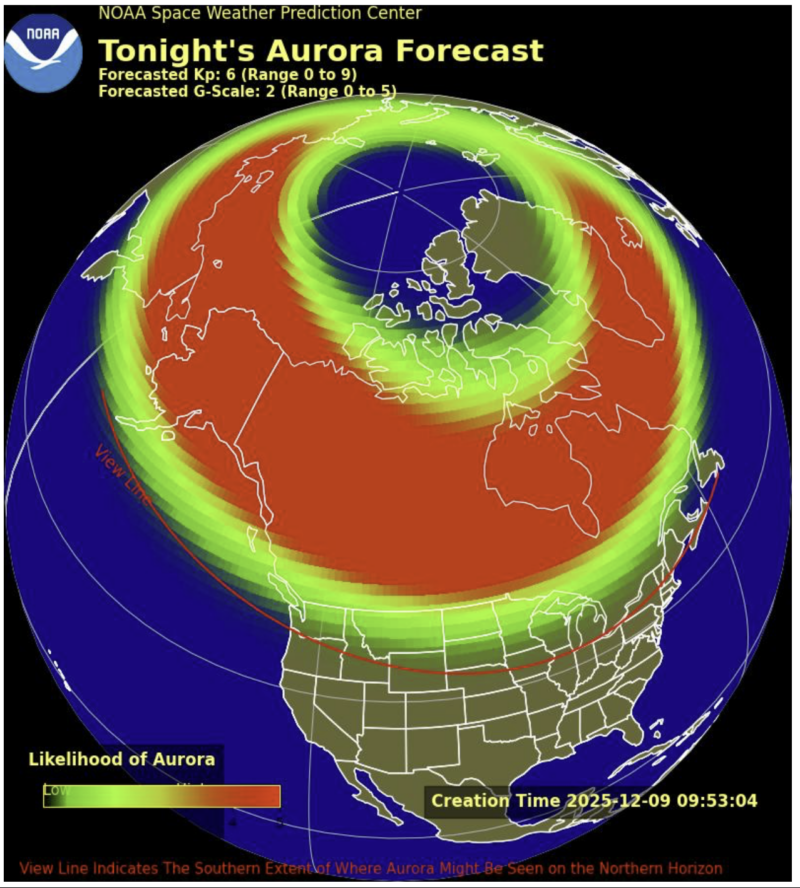

Sun news December 8: X1.1 flare this morning, auroras possible tonight!
Our star erupted with a powerful X1.1 flare from sunspot region AR4298 at 4:49 UTC this morning, rocketing solar activity to very high. And more excitement is on the cards tonight! Multiple coronal mass ejections (CMEs) are currently racing toward Earth. The strongest of these — which came from the M8.1 (moderate) flare on Saturday — produced a full-halo signature in coronagraphs, suggesting it was fired directly our way, and is expected to arrive between 4 and 8 UTC on December 9. That’s late Monday night into early Tuesday for those in North America. Forecasts call for G2-G3 (moderate-strong) geomagnetic storms, with a very small chance of reaching G4 (severe) levels. If we’re lucky, auroras may be visible far from the poles, including the northern United States (for example, and possibly Chicago), London and Paris. Clear skies!
Past 24 hours: The details
(11 UTC December 7 – 11 UTC December 8)
- Flare activity: Solar activity surged to very high levels, with 24 flares observed during the period.
- Strongest flare: The X1.1 flare from AR4298 at 4:49 UTC on December 8. This powerful eruption triggered an R3 (strong) radio blackout across the Indian Ocean.
- Other M-class flares: M2.5 from AR4299 at 23:56 UTC on December 7, triggering an R1 (minor) radio blackout; M2.1 from AR4294 at 0:33 UTC on December 8, also causing R1 conditions; and M1.8 at 6:40 UTC on December 8.
- Lead flare producer: AR4294 was the most active region, responsible for 5 flares including the M2.1 and multiple C-class events.
- Other notable C (common) flares: C8.0 at 8:50 UTC; C6.7 at 22:40 UTC; C6.4 from AR4298 at 20:41 UTC; C6.2 at 4:17 UTC; and C5.4 from AR4294 at 21:18 UTC on December 7. The remaining 15 C-class flares ranged from C2.5 to C4.1, distributed among AR4294, AR4296 and AR4298.
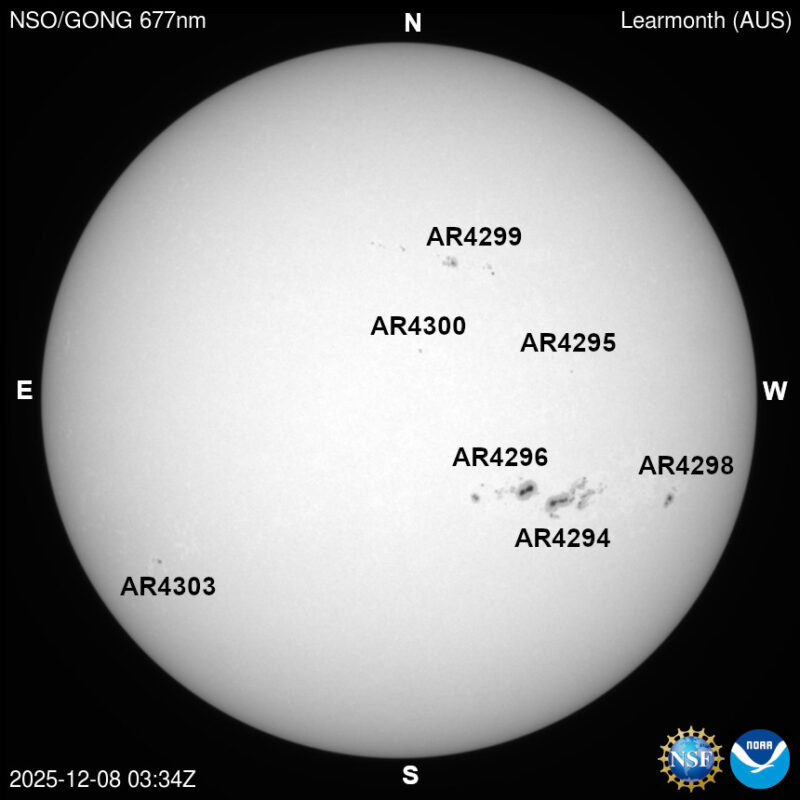
- Sunspot regions: The Earth-facing solar disk currently displays 8 numbered active regions, with several maintaining magnetically complex configurations.
- AR4294 (beta-gamma-delta) continued to develop and remained the largest region on the visible disk. This magnetically complex region produced the M2.1 flare and was the top flare producer with 5 events, including multiple C-class flares.
- AR4296 (beta) was the second-largest region on the disk and produced several C-class flares, including a C3.7 at 22:55 UTC and a C3.6 at 2:47 UTC.
- AR4298 unleashed the powerful X1.1 flare at 4:49 UTC and also produced a C6.4 flare at 20:41 UTC on December 7, demonstrating significant eruptive potential.
- AR4299 (beta-gamma-delta) produced the M2.5 flare at 23:56 UTC on December 7, marking its continued activity.
- The remaining regions — AR4297, AR4300, AR4301 and a newly emerged unnumbered region in the northwest — showed only minor changes and produced mostly low-level C-class activity or remained quiet.
- Blasts from the sun? A significant halo coronal mass ejection (CME) erupted on December 6, with multiple earlier CMEs also en route to Earth.
- The halo CME erupted at 21:12 UTC on December 6, associated with an M8.1 flare that peaked at 20:39 UTC. Analysis shows:
- Leading edge analysis: Three model runs predict Earth arrival between 4:09 and 4:41 UTC on December 9, or late Monday night to early Tuesday morning in the U.S. Kp indices are forecast to reach 6–8, indicating G2–G3 (moderate-strong) geomagnetic storm potential, with auroras possibly visible as far south as Toronto, Chicago, Boston, London, northern France, and Germany.
- Shock front analysis: One model run predicts earlier shock arrival at 0:14 UTC on December 9, creating initial disturbance conditions before the main CME material arrives.
- An earlier CME from 7:09 UTC on December 5 has two model runs predicting Earth arrival around 8:00 UTC on December 8, with Kp indices potentially reaching 3–5, suggesting unsettled to G1 (minor) conditions.
- Two CMEs from December 4 have model runs predicting arrivals between 4:00 and 6:00 UTC on December 8, with Kp indices reaching 2–4, indicating mostly quiet to unsettled conditions with possible minor enhancements.
- Additional CMEs from December 5 and 6 are also approaching, with arrivals predicted for December 9–10, though these are expected to produce only minor-to-moderate geomagnetic effects (Kp 2–5). There is a small chance that peak conditions could briefly approach G4 (severe) levels if the CME arrives with an especially strong and sustained southward Bz, but this outcome is considered unlikely.
- The halo CME erupted at 21:12 UTC on December 6, associated with an M8.1 flare that peaked at 20:39 UTC. Analysis shows:
- Solar wind: Solar wind speeds decreased from approximately 550 km/s to around 400 km/s by the end of the period, reflecting the waning influence of a negative polarity coronal hole high-speed stream and possible onset of a weak blast of sun-stuff that left the sun on December 4. The interplanetary magnetic field (IMF) showed a steady upward trend beginning after 11 UTC yesterday, peaking around 10 nT at 13 UTC before declining. The Bz component remained entirely positive (northward) throughout the period, which is unfavorable for auroras.
- Earth’s magnetic field: Earth’s magnetic field ranged from quiet to active levels during the period, with Kp values reaching 3 due to waning negative polarity coronal hole influences. No geomagnetic storms occurred during this period. At the time of this report, disturbance remains at quiet-to-unsettled levels.


The sun in recent days


Earlier sun images


Sun images from our community


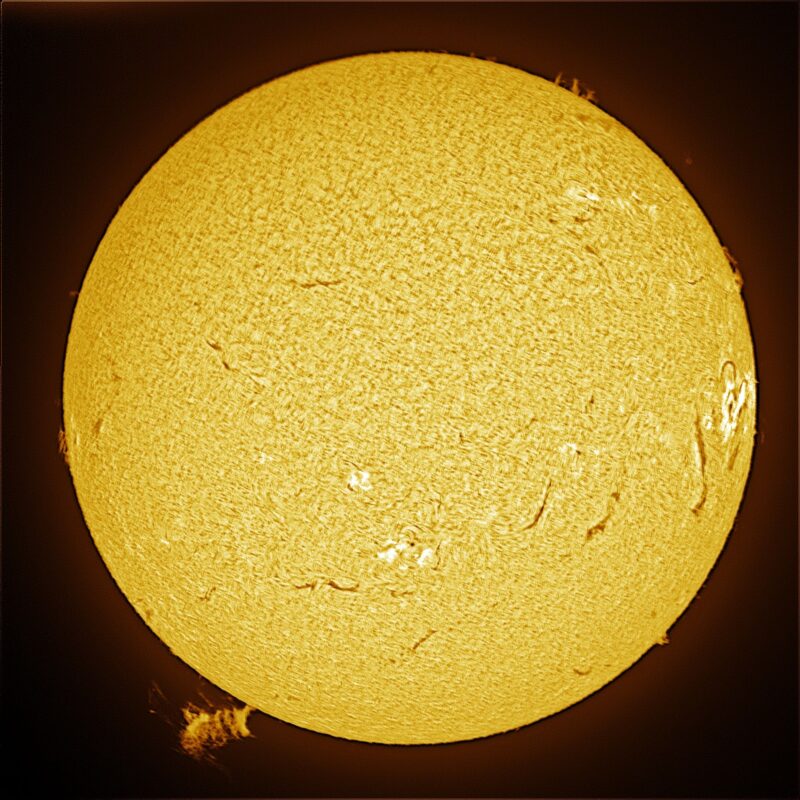
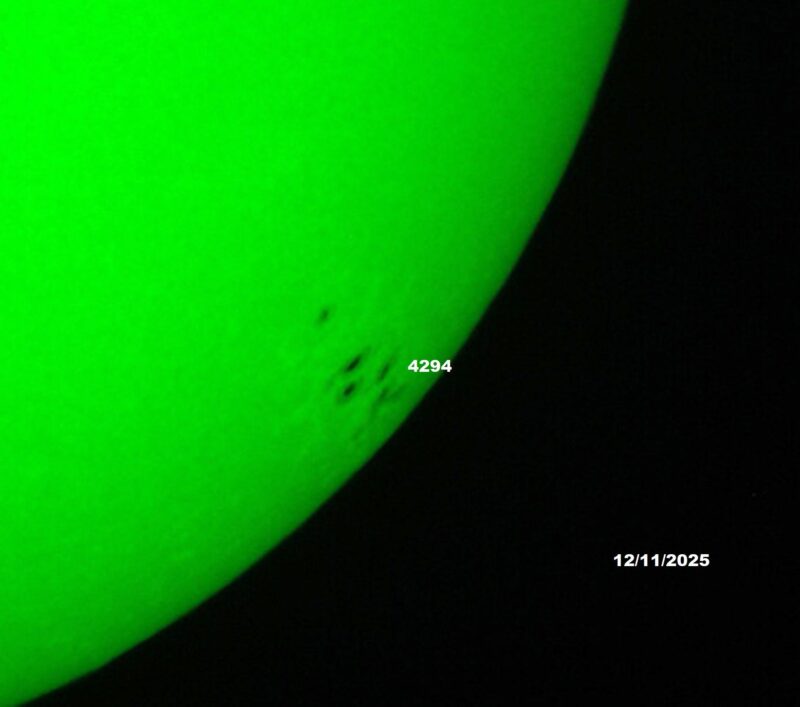

We sometimes feature sun images obtained using hydrogen-alpha filters. Read why.
Bottom line: Sun news December 12: Auroras flared again with G1 geomagnetic storms. Sun activity moderate with two back-to-back M flares.
Discover more from GTFyi.com
Subscribe to get the latest posts sent to your email.