55 Cancri e: JWST Reveals a Shocking Atmosphere on the ‘Diamond Planet


55 Cancri e, formally named Janssen, is a fascinating and extreme exoplanet located approximately 41 light-years from Earth in the constellation Cancer. Classified as a super-Earth, it is significantly more massive and larger in diameter than our own planet but is primarily rocky in composition. It orbits its Sun-like host star, 55 Cancri A (Copernicus), at an astonishingly close distance, completing a full revolution in less than 18 hours. This extreme proximity results in surface temperatures hot enough to melt rock, earning it the moniker of a “lava world.” For years, it was speculated to be a carbon-rich “diamond planet,” but recent groundbreaking observations from the James Webb Space Telescope (JWST) have challenged old theories and revealed a startling new reality: this scorching hellscape is shrouded in a substantial, dynamic atmosphere, fundamentally changing our understanding of planetary survival in the most hostile cosmic environments.
Also Read-What is Underwater Archaeology, and What Secrets is it Unlocking in 2025?
This blistering world represents a frontier in exoplanetology, pushing the boundaries of our knowledge about planetary formation, evolution, and the sheer diversity of worlds that exist beyond our solar system. The study of 55 Cancri e is not just an academic exercise; it’s a deep dive into the physics and chemistry that govern planets under conditions we can barely imagine. Its existence and newly discovered features force scientists to rewrite their models of how rocky planets can form and whether they can hold onto an atmosphere when subjected to the full, unrelenting fury of a nearby star. The ongoing research into Janssen promises to unlock crucial secrets about the early, molten stages of terrestrial planets, including our own Earth.
| Feature | Data / Information | Professional Fields Involved |
|---|---|---|
| Official Name | Janssen | Exoplanetology, Astrophysics |
| Catalogue Name | 55 Cancri e | Astronomy, Data Science |
| Planet Type | Super-Earth | Planetary Science, Geology |
| Mass | Approximately 8.08 times that of Earth | Celestial Mechanics, Physics |
| Radius | About 1.95 times that of Earth | Geophysics, Computational Modeling |
| Density | Roughly 5.86 g/cm³ | Material Science, Geochemistry |
| Orbital Period | ~17 hours, 41 minutes | Orbital Dynamics, Astrophysics |
| Host Star | 55 Cancri A (Copernicus) | Stellar Astronomy, Heliophysics |
| Distance from Earth | ~41 light-years | Astrometry, Observational Astronomy |
| Surface Temperature | Dayside estimated at ~2,000°C (~3,600°F); Nightside ~1,300–1,400 °C (~2,400 °F) | Climatology, Thermodynamics |
| Key Discovery | Confirmed presence of a substantial, secondary atmosphere rich in CO or CO₂, likely from volcanic outgassing (JWST, 2024). | Atmospheric Science, Spectroscopy |
| Authentic Reference | For more detailed data and the latest mission updates, visit the official NASA Exoplanet Exploration website. |
The Fiery Genesis of a Super-Earth: Unveiling 55 Cancri e’s Discovery.
The story of 55 Cancri e begins not with a flash of light through a telescope eyepiece, but with the meticulous analysis of stellar wobbles. The planet was first detected in 2004 by a team of astronomers led by Barbara McArthur of the University of Texas at Austin. They used the radial velocity method, a technique that measures the tiny gravitational tug an orbiting planet exerts on its host star, causing it to “wobble” back and forth from our perspective. For years, its existence was inferred only through these subtle stellar movements, its true nature shrouded in mystery. The initial calculations suggested a planet with a mass around 14 times that of Earth and an orbital period of 2.8 days. However, subsequent observations and refinements were destined to reveal a far stranger and more extreme world.
The real breakthrough came in 2011 when the planet was observed making a transit—passing directly in front of its star from our viewpoint. This transit event, detected by the Spitzer and MOST space telescopes, was a game-changer. It allowed astronomers to measure the planet’s radius for the first time by analyzing the slight dimming of the starlight as Janssen passed by. With both mass (from radial velocity) and radius (from the transit), scientists could calculate its density, providing the first solid clues about its composition. The new data painted a shocking picture: the orbital period was not 2.8 days, but a blisteringly fast 18 hours, and its density was consistent with a rocky, terrestrial world. This combination of a massive rocky body on an ultra-short-period orbit immediately cemented 55 Cancri e as a prime target for future study and an object of immense scientific fascination. It belongs to a star system, 55 Cancri, which is a veritable cosmic neighborhood, featuring at least five confirmed planets orbiting the primary star, Copernicus. This system provides a rich laboratory for studying planetary dynamics and formation, but Janssen remains its most bizarre and compelling member.
Is 55 Cancri e Really a Planet Made of Diamonds? Debunking the Glittering Myth.
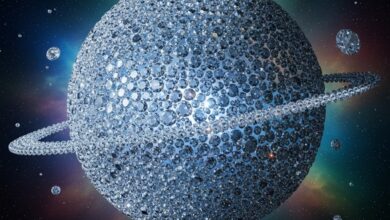
For over a decade, 55 Cancri e was popularly and famously known as the “diamond planet.” This tantalizing hypothesis, first proposed in a 2012 study, captured the public imagination like few other exoplanetary discoveries. The theory was rooted in the chemical composition of its host star, Copernicus, which was observed to have a much higher carbon-to-oxygen ratio than our Sun. Planetary systems are thought to form from the same protoplanetary disk of gas and dust as their parent star, so it was logical to assume that planets within the 55 Cancri system would also be carbon-rich. Under the immense pressures and temperatures predicted for a planet as massive as Janssen, this abundance of carbon could theoretically lead to the formation of vast layers of diamond and graphite in its mantle and crust.
Imagine a world where mountains were carved from pure diamond and plains were vast seas of graphite. This was the vision that the “diamond planet” theory offered. The model suggested that the planet’s core was still iron, but it was surrounded by layers of silicon carbide, graphite, and a thick, planet-spanning crust of diamond. This idea was scientifically plausible based on the initial data and our understanding of high-pressure chemistry. It fueled countless articles, documentaries, and discussions, making 55 Cancri e a celebrity in the exoplanet catalogue.
However, as scientific instruments grew more powerful and our models more sophisticated, this glittering hypothesis began to lose its shine. Subsequent analyses of the host star’s composition yielded more conventional, Sun-like carbon-to-oxygen ratios. Furthermore, refined measurements of the planet’s thermal emissions and transit data did not align perfectly with the predictions of a carbon-dominated world. While the presence of some carbon and even diamonds deep within its interior cannot be entirely ruled out, the prevailing scientific consensus has shifted dramatically. The latest evidence, particularly from the James Webb Space Telescope, strongly suggests that 55 Cancri e is more of a silicate-rich world, much like Earth and the other rocky planets in our solar system, albeit a much, much hotter version. The “diamond planet” theory now serves as a powerful lesson in the scientific process: an exciting, data-driven hypothesis that was ultimately superseded by more precise and compelling evidence. The reality of 55 Cancri e has turned out to be even more fascinating than the myth.
A World of Two Faces: The Brutal Reality of Tidal Locking on 55 Cancri e.
The extreme environment of 55 Cancri e is largely a consequence of a phenomenon known as tidal locking. Because it orbits so incredibly close to its star, the gravitational pull from Copernicus is immense and uneven across the planet’s surface. Over eons, this gravitational friction has slowed Janssen’s rotation until it stopped, relative to its orbit. The result is that the same hemisphere permanently faces the star, just as the same side of our Moon always faces Earth. This creates a planet of two starkly different and permanent realms: a dayside locked in an eternal, scorching noon, and a nightside trapped in an endless, sweltering twilight.
A Glimpse into a Molten Hellscape.
The dayside of 55 Cancri e is a true vision of hell. With the star Copernicus forever fixed in the sky, surface temperatures are estimated to soar above 2,000 degrees Celsius (3,600 degrees Fahrenheit). This is far hotter than the melting point of most rock-forming minerals. Consequently, the entire dayside is believed to be a single, planet-spanning magma ocean. It is a churning, bubbling sea of molten silicate rock, where waves of lava crash against shores that are themselves liquid.
Any primordial atmosphere the planet once had would have been blasted away by the intense stellar radiation and solar wind long ago. However, the magma ocean itself would not be silent. The extreme heat would cause the rock to literally boil, creating a tenuous, vaporized rock or “silicate vapor” atmosphere. This thin envelope would be composed of elements like silicon, iron, aluminum, and oxygen, constantly replenished by the seething ocean below while being simultaneously stripped away by the star’s energy. It’s a violent, dynamic cycle of vaporization and atmospheric loss, creating conditions unlike anything found in our solar system.
A Realm of Perpetual Twilight.
On the opposite side of the planet lies the permanent nightside. While it is shielded from the direct glare of the star, it is by no means a cold and frozen wasteland. Heat is expected to be transported from the scorching dayside to the nightside, likely through the thin atmosphere and potentially through subsurface magma flows. Early observations from the Spitzer Space Telescope suggested a surprisingly efficient heat distribution, leading to theories that a thick atmosphere could be carrying thermal energy around the planet.
The latest findings from JWST have confirmed that the nightside is indeed incredibly hot, with temperatures around 1,300–1,400 °C (about 2,400 °F). While cooler than the dayside, this is still hot enough to keep rock molten. This suggests that the magma ocean may extend across the entire planet, though it might be more sluggish and viscous on the cooler nightside. Alternatively, some models propose that the nightside could feature a crust of solidified rock with extensive volcanic activity, where heat from the interior and the dayside periodically breaks through. The nightside of 55 Cancri e remains a realm of scientific debate, a dark and enigmatic world whose true nature is only just beginning to be illuminated by our most powerful telescopes.
What the James Webb Space Telescope (JWST) Finally Uncovered.
For years, the biggest question surrounding 55 Cancri e was whether it could sustain any kind of atmosphere. Given its searing heat and proximity to its star, most models predicted that any atmospheric gases would be quickly stripped away into space. The planet was widely believed to be a bare rock. In a groundbreaking study published in May 2024, the James Webb Space Telescope turned this assumption on its head. Using its powerful infrared instruments, a team of scientists made a definitive detection: 55 Cancri e has a substantial secondary atmosphere.
This discovery is monumental. It represents the first time a robust atmosphere has been confirmed around a rocky exoplanet in such an extreme environment. The JWST did not find a thin, vaporized rock atmosphere as some had theorized. Instead, it found a thick, gaseous envelope that is likely rich in carbon dioxide (CO₂) or carbon monoxide (CO). This atmosphere is not a remnant from the planet’s formation (a primordial atmosphere) but is a secondary atmosphere—one that has been generated and replenished over time from the planet’s interior. The source of these gases is almost certainly the planet’s hyperactive geology. The endless magma ocean is constantly outgassing, releasing trapped volatiles from the planetary mantle into the air, a process analogous to volcanic activity on Earth, but on a planetary scale. This outgassing is vigorous enough to counteract the atmospheric stripping by the star, creating a stable, albeit hellish, atmospheric system.
How Webb Peered into Janssen’s Soul.
The discovery was made possible by JWST’s incredible sensitivity to infrared light. The science team used a technique called secondary eclipse photometry. They measured the combined light from the star and planet, and then measured just the light from the star as the planet passed behind it. The difference between these two measurements reveals the thermal emission—the heat glow—coming directly from the planet’s dayside.
The instruments MIRI (Mid-Infrared Instrument) and NIRCam (Near-Infrared Camera) analyzed this light, spreading it out into a spectrum, like a rainbow. Different gas molecules absorb specific wavelengths (colors) of light, leaving a unique “barcode” or absorption signature in the spectrum. The data from 55 Cancri e showed a spectrum that was inconsistent with bare rock. A barren, molten rock surface would have a different temperature profile and spectral signature than a planet shrouded in gas. The data strongly indicated the presence of a thick veil of molecules that was absorbing some of the heat and re-radiating it at specific infrared wavelengths, pointing directly to a CO or CO₂-rich atmosphere. The temperature measured was also several hundred degrees cooler than predicted for a bare rock surface, which is exactly what one would expect if a gaseous blanket was trapping and redistributing heat.
The Source of 55 Cancri e’s Mysterious Gases.
The confirmation of a secondary atmosphere has profound implications. It means 55 Cancri e is not a dead, static world but a geologically dynamic planet. The atmosphere we see today is a direct product of the planet’s molten interior. Trapped gases within the mantle are continuously bubbling up through the magma ocean and escaping to the surface. This process is the only plausible explanation for how the atmosphere can exist, as it must be constantly replenished to survive the star’s relentless onslaught.
This makes Janssen an extraordinary natural laboratory. It provides a window into a stage of planetary evolution that terrestrial worlds like Earth, Venus, and Mars went through billions of years ago when they too were covered in magma oceans. By studying the interplay between the molten surface and the outgassed atmosphere on 55 Cancri e, scientists can gain invaluable insights into the processes that shaped our own world and determined its ultimate fate. It helps us understand how a planet’s geological engine can build an atmosphere from scratch, a crucial step in the journey toward potential habitability, even if Janssen itself is unimaginably hostile to life.
What Does the Discovery of an Atmosphere on 55 Cancri e Really Mean?
The detection of a thick atmosphere on 55 Cancri e is more than just a record-breaking observation; it’s a discovery that fundamentally alters the scientific landscape of exoplanetology. For years, theories of atmospheric retention suggested that small, hot, rocky planets orbiting close to their stars were doomed to be airless husks. The intense radiation and stellar wind were thought to be insurmountable forces, capable of sandblasting any gas envelope into the void of space. Janssen has proven these theories incomplete. It demonstrates that under the right conditions, a planet’s own internal geological activity can fight back, pumping out enough gas to create and sustain a significant atmosphere even in the most hellish of environments.
This finding opens up an entirely new category of exoplanets for atmospheric study. There are likely countless other lava worlds throughout the galaxy, and now we know that at least some of them may harbor these dynamic, volcanically-sourced atmospheres. The James Webb Space Telescope and future observatories can now search for these worlds, confident that they are not just staring at bare rock. Each new detection will provide another data point, helping us understand the complex relationship between a planet’s mass, its composition, its distance from its star, and its ability to hold onto an atmosphere. This research could ultimately help us pinpoint the “sweet spot” for planetary atmospheres and, by extension, narrow the search for habitable worlds. It’s a critical piece of the puzzle in our quest to understand where, and how, life might arise in the cosmos.
Frequently Asked Questions (FAQ) about 55 Cancri e.
Q: Could we live on 55 Cancri e?
A: Absolutely not. 55 Cancri e is one of the most inhospitable environments imaginable. The dayside is a permanent ocean of molten lava with temperatures hot enough to vaporize rock. The atmosphere, while a fascinating discovery, is likely composed of toxic gases like carbon monoxide or carbon dioxide at crushing pressures. There is no liquid water, and the intense radiation from its nearby star would be lethal to any known form of life.
Q: How hot is 55 Cancri e?
A: It’s incredibly hot, but the temperature varies across the planet due to its tidal locking. The permanent dayside, which always faces the star, reaches temperatures of approximately 2,000°C (about 3,600°F). The permanent nightside is cooler but still scorching, with recent JWST data suggesting temperatures in the range of 1,300–1,400 °C (about 2,400 °F).
Q: What is a super-Earth?
A: A super-Earth is a class of exoplanet with a mass higher than Earth’s but substantially below that of our solar system’s ice giants, Uranus and Neptune. The term refers only to the planet’s mass and does not imply anything about its surface conditions or habitability. Super-Earths like 55 Cancri e can be rocky, ocean worlds, or gas-enveloped planets.
Q: How did 55 Cancri e get its name ‘Janssen’?
A: In 2015, the International Astronomical Union (IAU) held a public contest called NameExoWorlds to give proper names to a selection of exoplanets and their host stars. The Royal Netherlands Association for Meteorology and Astronomy submitted the winning names for the 55 Cancri system. The star was named Copernicus after the famous astronomer, and its five planets were named after other prominent historical scientists: Galileo, Brahe, Lipperhey, Janssen, and Harriot. Janssen is named after Zacharias Janssen, a Dutch spectacle-maker who is sometimes credited with inventing the first optical telescope.
Q: What’s next for studying 55 Cancri e?
A: The recent discoveries from the James Webb Space Telescope are just the beginning. Scientists are eager to use the telescope for further observations to more precisely determine the exact chemical composition of Janssen’s atmosphere. By gathering more detailed spectra over longer periods, they hope to map temperature variations across the planet and even look for signs of changing weather or volcanic plumes in its thick, gassy shroud. This ongoing study will continue to refine our models of how atmospheres behave on extreme lava worlds.
Conclusion: 55 Cancri e – From a Glittering Myth to a Geologically Dynamic World
The scientific journey of understanding 55 Cancri e is a powerful testament to human curiosity and technological advancement. This remarkable exoplanet has transitioned in our minds from a data point, to a mythical “diamond planet,” and finally to its current, scientifically-backed identity as a dynamic lava world with a living, breathing atmosphere sustained by a molten heart. The fantastical image of a glittering jewel has been replaced by something far more profound: a geologically active planet that is rewriting our textbooks on planetary science.
The confirmation of its atmosphere by the James Webb Space Telescope is not an end point but a spectacular new beginning. Janssen now serves as a crucial benchmark, an extreme case study that helps us comprehend the volatile youth of rocky planets across the universe, including our own. It reminds us that the cosmos is filled with worlds that defy our expectations and challenge our assumptions. As we continue to point our most advanced instruments toward this scorching super-Earth, we are not just studying a distant planet; we are piecing together the universal story of planetary formation, survival, and evolution.
Valuable References.
To ensure the authenticity and accuracy of this article, information has been sourced from leading scientific institutions and peer-reviewed publications. For further reading and verification, please consult the following resources:
- NASA’s Official Press Release on the JWST Discovery: “NASA’s Webb Finds Signs of Possible Atmosphere on Rocky Exoplanet”. NASA. May 8, 2024.
- The Primary Scientific Paper in Nature: Bello-Arufe, A., Zhang, M., Malsky, I. et al. “A secondary atmosphere on the rocky exoplanet 55 Cancri e”. Nature, 629, 315–319 (2024).
- European Space Agency (ESA) Article on the Discovery: “Webb finds atmosphere on rocky exoplanet”. ESA. May 8, 2024.
- NASA’s Exoplanet Exploration Program Profile for 55 Cancri e: “55 Cancri e In-Depth”. NASA Science.
- Original “Diamond Planet” Hypothesis Paper: Madhusudhan, N., Lee, K. K. M., & Mousis, O. (2012). “A Possible Carbon-rich Interior in Super-Earth 55 Cancri e”. The Astrophysical Journal Letters, 759(2), L40.
Disclaimer:
The information provided in this article is for general informational and educational purposes only. All information is provided in good faith, however, we make no representation or warranty of any kind, express or implied, regarding the accuracy, adequacy, validity, reliability, availability, or completeness of any information. The field of astrophysics and exoplanetary science is rapidly evolving, and the details presented here are based on research and data available as of mid-2024. For the most current and definitive scientific findings, readers are encouraged to consult primary research papers and official announcements from space agencies like NASA and ESA.
Discover more from GTFyi.com
Subscribe to get the latest posts sent to your email.