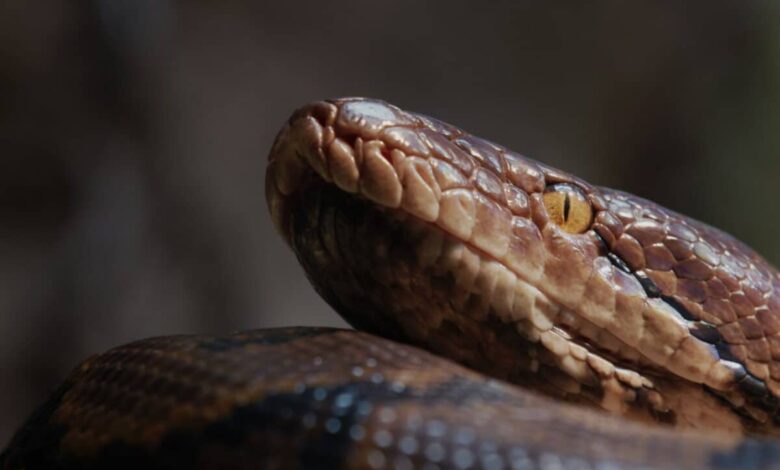
Scientists in western India have uncovered fossil remains of a gargantuan prehistoric snake that may have been one of the largest ever to slither across the planet. Dubbed Vasuki indicus, the snake is estimated to have reached up to 15 meters in length, and weighed around a tonne. The find places it in the same league as Titanoboa, previously thought to be the undisputed heavyweight of ancient snakes.
The fossil, discovered in a lignite mine in Gujarat’s Panandhro region, includes 27 vertebrae, some of them still in their original anatomical alignment. According to the study, published in Scientific Reports, the remains date back around 56 million years and shed new light on the types of giant reptiles that roamed post-dinosaur Earth.
A Swamp Ambush Predator With Python-like Traits
Unlike some of the more agile reptiles we think of today, Vasuki indicus wasn’t built for speed. Researchers believe it was a slow-moving ambush predator, lurking in the marshes, waiting for unsuspecting prey to wander too close.
“Considering its large size, Vasuki was a slow-moving ambush predator that would subdue its prey through constriction like anacondas and pythons. This snake lived in a marshy swamp near the coast at a time when global temperatures were higher than today,” said Debajit Datta, a postdoctoral researcher at the Indian Institute of Technology Roorkee and lead author of the study.
As noted in the study, published in Scientific Reports, the fossilized vertebrae,measuring up to 11 cm wide, indicate a broad, cylindrical body, possibly around 44 cm across. That’s a body thick enough to knock down saplings or wedge itself between boulders. There’s no skull yet, which makes it harder to pin down certain behaviors, but the consensus is that Vasuki didn’t rely on venom. Instead, it would have crushed its prey in a slow, suffocating grip.

Titanoboa Finally Gets Some Competition
For over a decade, Titanoboa cerrejonensis has dominated discussions about prehistoric snakes. Discovered in a Colombian coalmine in 2009, that snake was estimated to be about 13 meters long and weigh more than a tonne.
“The estimated body length of Vasuki is comparable to that of Titanoboa, although the vertebrae of Titanoboa are slightly larger than those of Vasuki. However, at this point, we cannot say if Vasuki was more massive or slender compared to Titanoboa,” explained Sunil Bajpai, a paleontologist at IIT Roorkee and co-author of the study.

According to The Guardian, the sheer possibility of a second giant snake from a different continent and ecosystem complicates what was once a pretty straightforward superlative.
There’s still a lot we don’t know. Whether Vasuki was more massive or more slender than Titanoboa remains unclear. But the fact that such a snake existed in India, not South America, suggests that these enormous constrictors may have been more widespread than previously believed.
Scientists Unearth Ancient Snake Fossil So Huge It Makes Titanoboa Look Small
Discover more from GTFyi.com
Subscribe to get the latest posts sent to your email.