A cool cosmic coincidence kicks off 2026! The first full moon of the year – a supermoon – will coincide with Earth’s closest approach to the sun, known as perihelion, on and around January 2–3. EarthSky will livestream on this rare alignment of Earth, the moon and the sun at noon CST (18 UTC) on December 31, 2025. Watch in the player above or on YouTube.
Rare alignment of Earth, moon and sun in early January
The year 2026 begins with a cool alignment in our solar system. Our little family of Earth, sun and moon will be at their closest to each other in the first days of the year.
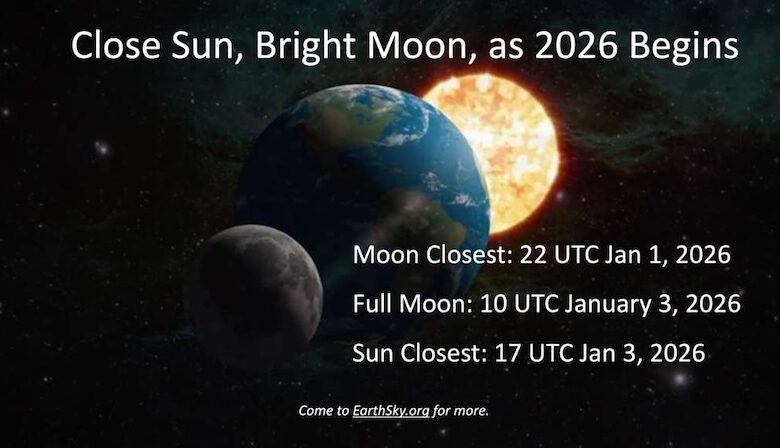
The moon reaches perigee, or its closest point to Earth in its elliptical orbit, at 21:43 UTC (3:43 p.m. CST) on January 1, 2026. The full moon for January 2026 is at 10:03 UTC (4:03 a.m. CST) on January 3. That’s close enough to perigee that the moon is considered a supermoon. And the date when Earth is closest to the sun in its elliptical orbit – or perihelion – is 17:16 UTC (11:15 a.m. CST) on January 3. On that date we are 0.9833021 astronomical units (AU) from the sun.
It’s not too often that a full moon closest in its orbit to Earth – a supermoon – coincides with when Earth is closest to the sun. This close family pairing doesn’t come along very often.
Other pairings of sun, moon and Earth
The next time a supermoon coincides with Earth at perihelion is in January 2045. The moon will be at full phase at 10:20 UTC (4:20 a.m. CST) on January 3, 2045. At that time, the moon is approximately 356,773 km (221,688 miles) from Earth, according to Fred Espenak. That puts it within 90% of its closest point to Earth.
And also from Fred Espenak, on January 3, 2045, but at 14:56 UTC (8:56 a.m. CST), Earth will be closest to the sun for the year – at perihelion – at a distance of 0.9832653 AU. That’s 3677 km (2295 miles) less than Earth’s mean perihelion distance.
And when did it happen last? Well, that was much longer ago.
Back in 1912, the January full moon was a supermoon. That’s because the full moon occurred at 13:29 UTC (7:29 a.m. CST) on January 4, 1912. At that time, the moon was 356,380 km (221,444.3 miles) away. And the moon was closest to Earth, at perigee, just minutes later. That was at 13:34 UTC (7:34 a.m. CST) on January 4, when it was a touch closer, at 356,379 km (221443.6 miles) distant. So when was perihelion, or Earth’s closest point to the sun, in 1912? It was at 10:44 UTC (4:44 a.m. CST) on January 3. At that time, Earth was 0.9832088 AU from the sun. That’s 12,128 km (7,536 miles) less than Earth’s mean perihelion distance.

An alignment with a titanic pull
A supermoon can cause king tides. These higher-than-usual tides can cause destruction along the shore and reshape the beach. And, in fact, two scientists at Texas State University said in 2012 that the supermoon in January 1912 coinciding with Earth at perihelion could have helped sink the Titanic, which happened in April of that year. As LiveScience reported:
… these events caused extreme tides that could have dislodged icebergs and flung them into southbound ocean currents.
LiveScience goes on to say:
If the astronomers’ calculations are correct, then January 4, 1912, was a truly unusual night. First, the moon’s perigee, or closest approach to Earth, was the most extreme in 1,400 years, and this close approach came within six minutes of the time when the moon was full. Full moons coinciding with lunar perigee have been dubbed “supermoon” events. Second, the moon and sun were aligned that night, causing their gravitational pulls on the Earth to combine and leading to an abnormally high tide, called a “spring tide.” And lastly, Earth’s perihelion had occurred the day before, so the sun’s gravitational pull on Earth was unusually strong that night, too, the researchers argued.
However, most scientists are skeptical of such a connection. The exact journey of the iceberg and how it got into the path of the Titanic will probably forever remain a mystery.
Bottom line: There will be a rare alignment of Earth, the moon and the sun in early January. Read more and watch a video.
Via:
Discover more from GTFyi.com
Subscribe to get the latest posts sent to your email.