Researchers Discover the Largest Dinosaur Footprints Ever Found, Big Enough to Swallow a Grown Adult Whole

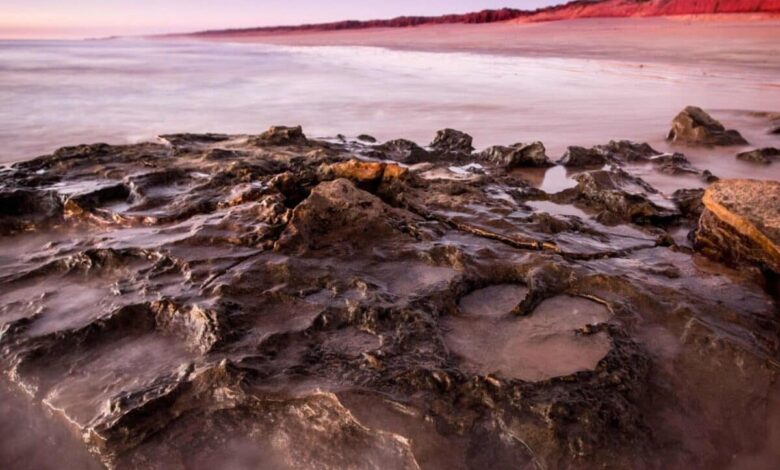
Deep in the sandstone cliffs of Western Australia’s remote Kimberley region, researchers have uncovered dinosaur footprints of unprecedented scale, some extending over 1.7 meters in length. Etched into the tidal flats over 130 million years ago, these giant impressions were left by sauropods, among the largest animals to ever walk the Earth. Scientists from the University of Queensland report that the site offers much more than just size, it contains an extraordinary range of 21 different dinosaur track types, making it one of the richest and most varied fossil tracksites ever found.
A Collection Of Tracks Hidden In Plain Sight
The vast array of tracks was found in a remote section of the Kimberley coast, where the rock formations record a time when the area was a river delta,130 million years ago. Dinosaurs once crossed wet sandy flats between forested patches, leaving behind tracks that hardened and survived through deep time. According to the findings, published in theMemoir of the Society of Vertebrate Paleontology, the tracks are embedded in sandstone, scattered along a stretch of coast that can only be examined when the tide retreats.
The diversity of tracks came as a surprise. Out of thousands of impressions found, at least 150 could be confidently assigned to 21 distinct track types, said Steve Salisbury, a vertebrate palaeontologist at the University of Queensland. These include prints from sauropods, ornithopods, various armored dinosaurs, including stegosaurs, never before recorded in Australia, and several theropods.

The Largest Footprints On Record
Among the most striking discoveries were the sauropod tracks, some stretching to 1.7 meters in length. Salisbury explained that:
“most people would be able to fit inside tracks that big, and they indicate animals that are probably around 5.3 to 5.5 meters at the hip, which is enormous.”
These prints now surpass the previous record, a 1.06-meter-long track discovered in Mongolia and reported in 2016. The size and quality of the prints contribute to the site’s global significance. He also referred to the site as the “Cretaceous equivalent of the Serengeti,” due to its concentration and variety of dinosaur life preserved in fossil form.

Science Followed The Elders’ Lead
The region’s paleontological importance might have gone unstudied if not for the intervention of the Goolarabooloo people, who had long been aware of the ancient footprints embedded along the coast. When the area was selected in 2008 as a potential site for a liquid natural gas processing precinct, local Indigenous leaders contacted scientists to assess what was at risk.
“Dinosaur tracks have been known through that area, probably for thousands of years. They form part of the song cycle,” said Salisbury, referring to traditional stories and cultural maps passed down through generations.
That outreach led to an extensive scientific study involving researchers from James Cook University and other institutions. The team spent over 400 hours documenting the tracks with Indigenous representatives on-site.
Discover more from GTFyi.com
Subscribe to get the latest posts sent to your email.


