
Scientists are preparing robotic systems to pave the way for the first human steps on Mars and to ensure smoother missions on the Moon, according to recent revelations shared during the American Geophysical Union (AGU) meeting in Louisiana.
Preparing Mars Astronauts With Real-Time Space Weather Dashboards
One of the most critical challenges facing human exploration of Mars is exposure to solar radiation. Researchers are developing tools originally used for Earth-based space weather forecasting to serve astronauts on the Martian surface. A key innovation comes from NASA’s Goddard Space Flight Center, where heliophysicist Gina DiBraccio and her team have extended a decision-support dashboard to incorporate data from multiple Mars missions. The dashboard integrates inputs from the MAVEN orbiter, the Curiosity and Perseverance rovers, and other planned sources to give crews real-time visibility into space weather activity.
“It’s really one of the first steps of tools that astronauts will be able to use to understand and assess space weather from the surface of Mars,” DiBraccio said during the AGU briefing. This system would run on a tablet, helping astronauts anticipate events like solar flares and decide when protective measures are necessary. The long-term goal is to create a seamless, all-in-one risk-monitoring tool, part of a larger framework to make long-duration Martian missions viable. Such tools could become mission-critical as NASA’s Artemis program extends its reach toward Mars.
Mapping Martian Radiation Through A Full Solar Cycle
Understanding the behavior of cosmic radiation on Mars over time is essential for safe surface operations. At the AGU conference, Shannon Curry, principal investigator of the MAVEN mission from the University of Colorado Boulder, unveiled a newly completed dataset covering the full solar cycle from 2014 to 2025. This catalog details the frequency, magnitude, and duration of space weather events, providing crucial insights for mission planners.
“This really informs, over a full solar cycle, what we can expect to see, and when we can expect to see it,” Curry explained. The MAVEN data has shown that even though Mars has a thinner atmosphere, some forms of radiation can still penetrate to the surface, especially during periods of high solar activity. These findings, as reported by Space.com, form the backbone of predictive models aimed at shielding future astronauts and sensitive electronics on Mars. Data-driven awareness of radiation levels is no longer optional—it’s becoming a prerequisite for survival.
The Search For Lunar Water Remains A Patchwork Of Data
As NASA’s Artemis program targets the Moon’s south pole for future human landings, finding usable water on the lunar surface has become a top priority. But while signs of frozen water have been detected in craters and shaded regions, the exact locations remain elusive. Bethany Ehlmann, director of the Laboratory for Atmospheric and Space Physics (LASP), described the challenge bluntly: the datasets do not agree on the details.
“The challenge right now is that the datasets don’t actually agree exactly where the water is,” Ehlmann said. “We know broadly it’s in the south pole, we know broadly there are few craters of interest,” she added. “But it’s like saying, ‘There is water in the city of New Orleans — somewhere.’” To close this information gap, NASA selected a new imaging spectrometer in July that will function as “enhanced eyes” in orbit, mapping mineral content and ice deposits with higher precision. The instrument will help astronauts identify viable sample collection zones—one more step toward sustainable lunar habitation.
Dust: The Oldest Nemesis Of Lunar Missions
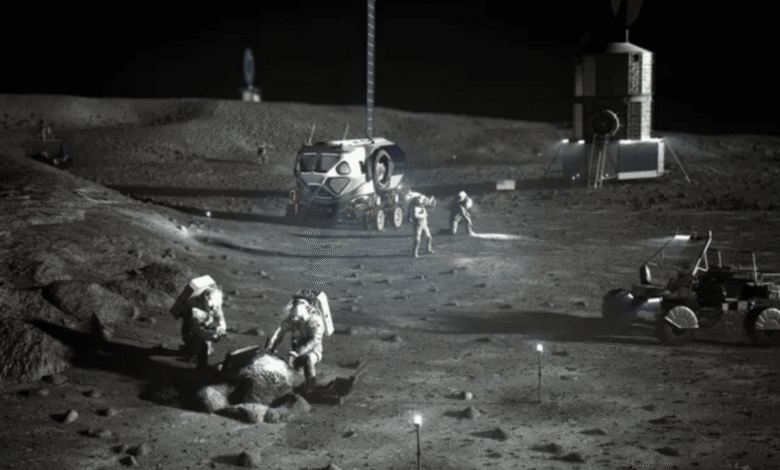
From Apollo 17 to Artemis IV, one technical issue continues to vex lunar exploration: dust. Lunar dust is sharp, electrostatically charged, and capable of damaging equipment and endangering astronaut health. Veteran Apollo astronauts identified it as a major operational barrier. As Gene Cernan, commander of Apollo 17, put it: “I think dust is probably one of our greatest inhibitors to a nominal operation on the moon. I think we can overcome other physiological or physical or mechanical problems except dust.”
That sentiment is still relevant today. At AGU, Xu Wang of the University of Colorado Boulder introduced the DUSTER project, a $24.8 million initiative set to deploy on Artemis IV. This rover-based suite will assess dust and plasma interactions at the Moon’s surface. Wang’s team is also developing the Compact Electrostatic Dust Analyzer (CEDA), which is designed to survive even hard landings and operate from orbit or on the surface. “Dust is everywhere on the moon,” Wang said. “You can’t go around it. You have to deal with and live with it.” Dust mitigation strategies are now at the heart of long-term lunar mission planning.
Coordinating Human And Robotic Exploration As A Single Strategy
Beyond specific tools and datasets, the AGU briefing underscored a deeper shift in space exploration philosophy: robots and humans are not in competition, they are collaborators. Missions like MAVEN, Perseverance, and upcoming Artemis landings are part of an integrated strategy, where robotic systems act as scouts, safety monitors, and scientific surrogates for human explorers.
“It’s really not a question of robotic exploration or human exploration,” said Ehlmann. “It is an ‘and’ — it’s robotic and human exploration and how we do these best together.” The dual-role model is becoming the standard for space agencies. Robotic missions gather crucial environmental data, while human presence enables adaptive science and long-term objectives. This combined approach allows NASA and its partners to reduce risk, refine strategies, and expand our footprint across the solar system, from Artemis to the Red Planet.
Discover more from GTFyi.com
Subscribe to get the latest posts sent to your email.