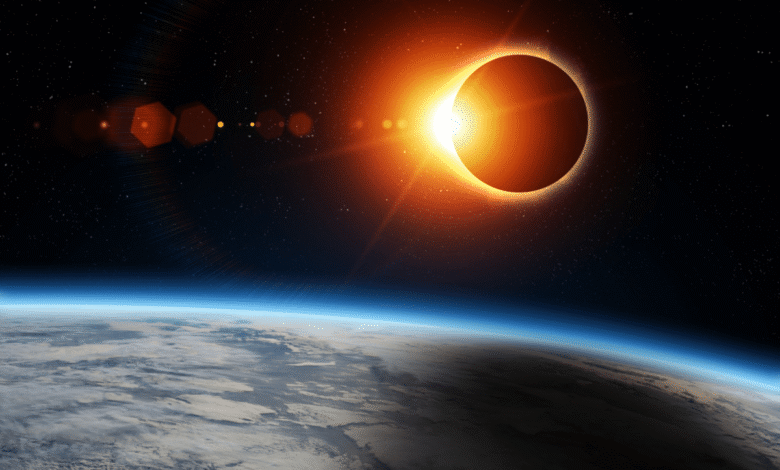

Skywatchers worldwide can anticipate a convergence of rare celestial phenomena, including three solar eclipses, a vivid blood moon, and a handful of other notable sky events such as planetary alignments, bright meteor showers, and uncommon lunar configurations.
Three Total Solar Eclipses Within 710 Days
At the core of this upcoming cycle is a rare sequence of three total solar eclipses occurring in less than two years. According to Forbes, this pattern has not been seen since 2008 to 2010. It begins on August 12, 2026, when a total solar eclipse will be visible across parts of Greenland, Iceland, and northern Spain. The Moon will completely block the Sun, casting a wide shadow and delivering several minutes of mid-day darkness to observers.
A year later, on August 2, 2027, a total eclipse lasting up to 6 minutes and 22 seconds will pass over Luxor, Egypt, extending across North Africa, the Middle East, and parts of southern Europe. This will be the longest total eclipse remaining in the 21st century. Then, on July 22, 2028, the cycle concludes with a total eclipse over Australia and New Zealand, including Sydney, where totality hasn’t occurred since 1857.
Ring Of Fire Eclipses Will Cross Four Continents
The annular solar eclipses, commonly referred to as “ring of fire” events, will complement the total eclipses. During these events, the Moon is too far from Earth to fully obscure the Sun, resulting in a blazing ring of sunlight around the lunar silhouette.
This series begins on February 17, 2026, with a relatively limited eclipse. The most striking events arrive on February 6, 2027, visible from Chile, Argentina, and West Africa, followed by another on January 26, 2028. During the latter, a dramatic ring will appear over the Galápagos Islands, Ecuador, and Brazil, before ending near Spain at sunset. This final annular eclipse will last an astonishing 10 minutes and 27 seconds, making it one of the longest in modern memory.
A Striking Blood Moon Will Color The Night Red
In addition to solar eclipses, 2026 will also feature a total lunar eclipse, popularly called a blood moon. During this event, the Moon passes through Earth’s shadow, causing its surface to appear deep red or orange due to atmospheric scattering of sunlight. These eclipses are not only visually impressive but are culturally significant across civilizations.
Although the precise date of the 2026 blood moon is yet to be finalized by some regional calendars, astronomers project it will be visible across North and South America, Western Europe, and parts of Africa, depending on weather and location. The blood moon offers a poetic counterpoint to the daylight eclipses, showing how both the Sun and Moon will dominate the skies in alternating displays.
Planetary Alignments Will Create Rare Naked-Eye Shows
2026 is also forecast to include noteworthy planetary alignments, where Venus, Jupiter, Mars, and Saturn may appear unusually close together in the night sky. These alignments are rare and allow for naked-eye viewing or binocular tracking, especially just before dawn or after sunset. No telescopes are required to appreciate their symmetry.
In mid-2026, Venus and Jupiter will experience a close conjunction, with both planets occupying less than a single degree of the sky. Another multi-planet alignment is expected later in the year, allowing viewers in low light-pollution areas to witness a lineup of five visible planets stretched across the horizon.
Solar Eclipses, Blood Moons, Planet Alignments: 2026’s Astronomical Events You Don’t Want to Miss!
Discover more from GTFyi.com
Subscribe to get the latest posts sent to your email.