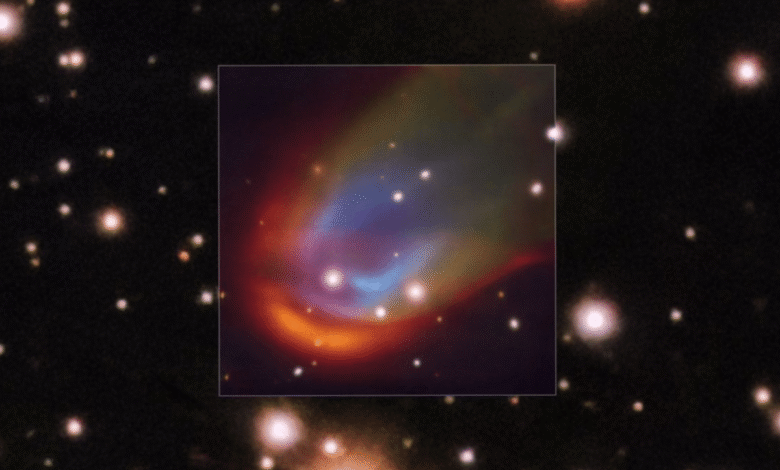

A mysterious, rainbow-like glow has been spotted shimmering around a dead star just 731 light-years from Earth. The phenomenon surrounds the white dwarf RXJ0528+2838, an otherwise quiet stellar remnant that appears to defy the known laws of stellar evolution. This puzzling display, recently detailed in Nature Astronomy, suggests that even the faint embers of long-dead stars can produce astonishing bursts of activity, forcing scientists to rethink how such remnants shape and interact with their cosmic environments.
A Dead Star That Refuses To Stay Quiet
When a star like our Sun reaches the end of its life, it sheds its outer layers, leaving behind a white dwarf, a dense, cooling core roughly the size of Earth. These stellar remnants typically fade quietly, lacking the energy to drive powerful outflows or glowing nebulae. Yet RXJ0528+2838 appears to defy this rule. Instead of silence, it emits a vivid, multicolored glow, forming a striking bow shock that stretches across space like a cosmic rainbow.
Astronomer Simone Scaringi of Durham University described the team’s astonishment at this revelation:
“We found something never seen before and, more importantly, entirely unexpected. The surprise that a supposedly quiet, diskless system could drive such a spectacular nebula was one of those rare ‘wow’ moments.”
The nebula’s shape and the light it emits, rich in hydrogen, oxygen, and nitrogen, suggest an energetic process that has been active for about a thousand years. Yet, scientists have found no clear mechanism to explain it. Unlike other binary systems, RXJ0528+2838 shows no evidence of an accretion disk that would typically feed material into such an outflow.
The Mystery Of The Missing Disk
In most binary systems, a white dwarf’s companion star contributes matter through a disk-like structure spiraling toward the dense remnant. As the gas flows inward, collisions and magnetic turbulence generate heat and drive stellar winds. RXJ0528+2838, however, is different; it has a companion star, but no such disk is visible.
The research team proposes that an unusually strong magnetic field may be rerouting the flow of gas, channeling it directly from the companion star onto the white dwarf’s poles. This could allow matter to escape along magnetic field lines, creating outflows powerful enough to generate the glowing bow shock without the need for a disk.
Astronomer Krystian Ilkiewicz from the Nicolaus Copernicus Astronomical Center in Poland explains:
“Our observations reveal a powerful outflow that, according to our current understanding, shouldn’t be there. Our finding shows that even without a disc, these systems can drive powerful outflows, revealing a mechanism we do not yet understand. This discovery challenges the standard picture of how matter moves and interacts in these extreme binary systems.”
The implications of this are profound. If confirmed, this mechanism could reshape our understanding of magnetically dominated accretion and stellar evolution in binary systems.
A Challenge To Stellar Physics
The discovery, published in Nature Astronomy, marks a rare example of a quiet, aging system showing signs of intense activity. The white dwarf’s radiant halo may serve as a new kind of laboratory for studying plasma dynamics in extreme gravitational and magnetic environments.
Until now, such bow shocks were associated with fast-moving, mass-losing stars or explosive outbursts. RXJ0528+2838 breaks this mold by showing sustained activity without any recent thermonuclear eruptions. For astrophysicists, this means something fundamental about energy transfer and stellar magnetism remains unexplained.
Follow-up observations using instruments such as ESO’s Very Large Telescope and Pan-STARRS could help determine whether the outflow’s structure evolves over time or if similar phenomena exist around other nearby white dwarfs. Either outcome could mark the beginning of a new chapter in our understanding of stellar remnants and their hidden power.
Discover more from GTFyi.com
Subscribe to get the latest posts sent to your email.


