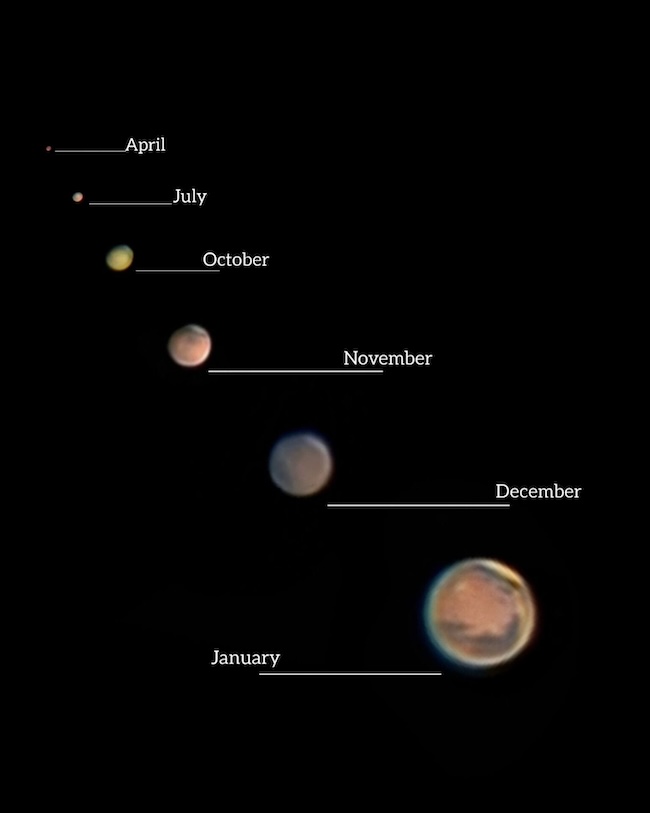
- Mars can appear bright or faint in our sky depending on its distance from Earth. It’ll spend 2026 becoming bright again, as Earth catches up to it in orbit around the sun. Mars will be at its brightest again in February 2027.
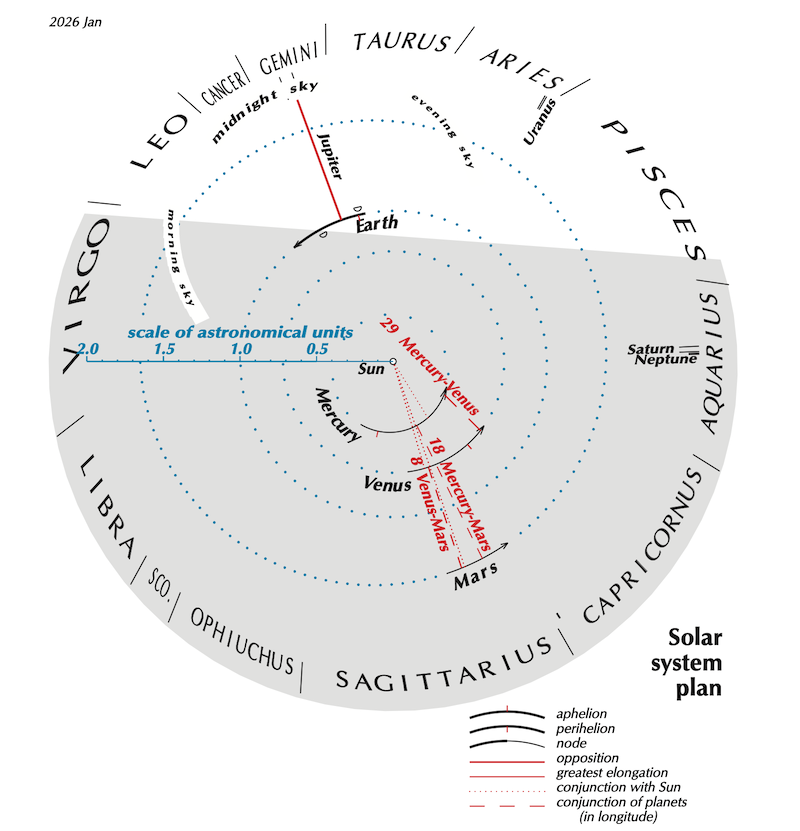
- Mars’ superior conjunction, when it’s most behind the sun from Earth, falls on January 9, 2026. Afterwards, Mars will emerge into the morning sky around April or May for the Northern Hemisphere, and maybe as soon as late February for the Southern Hemisphere.
- By the last few months of 2026 – with Earth hot on its heels in orbit around the sun – Mars will be rapidly brightening, moving over into the evening sky and racing toward its opposition on February 2027.
Mars in 2026
How to see Mars in the sky: Once Mars emerges into the morning sky (late February 2026 for Southern Hemisphere, April or May 2026 for the Northern Hemisphere), it will shine fairly brightly, but not brightly enough to be noticeable. Mars will hang – reddish, somber, not very bright – in the eastern predawn sky for many months of 2026. As the year progresses, Mars will start to brighten and move higher in the sky. Earth will again be catching up to Mars in the race of the planets. And, as a result, Mars will be shifting over into our evening sky. By the time Mars passes close to Jupiter – around November 15, 2026 – it’ll be a sight to behold near the giant planet!
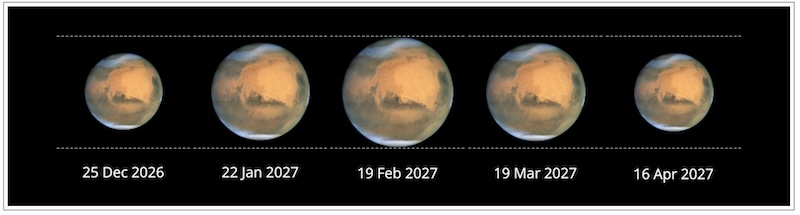
Next opposition for Mars will be February 19, 2027. Mars will be in front of Leo the Lion at its 2027 opposition.
Next Mars-Earth closest distance will be February 20, 2027. Mars will be about 63 million miles (101 million km) from Earth on that date. Hence 2027 is what’s known as an aphelic opposition of Mars. That is, the planet will reach its aphelion, or farthest point from the sun, on March 2, 2027. So Mars will be about as far from Earth as it can be at this 2027 opposition. Note: Mars reaches opposition about every 26 months, or about every two Earth years.
Sometimes, Mars is bright
Mars’ dramatic swings in brightness (and its red color) are why the early stargazers named Mars for their god of war.
Sometimes the war god rests. And sometimes he grows fierce! These changes are part of the reason Mars is so fascinating to watch in the night sky.

Want to follow Mars? Bookmark EarthSky’s monthly night sky guide.
Mars isn’t very big
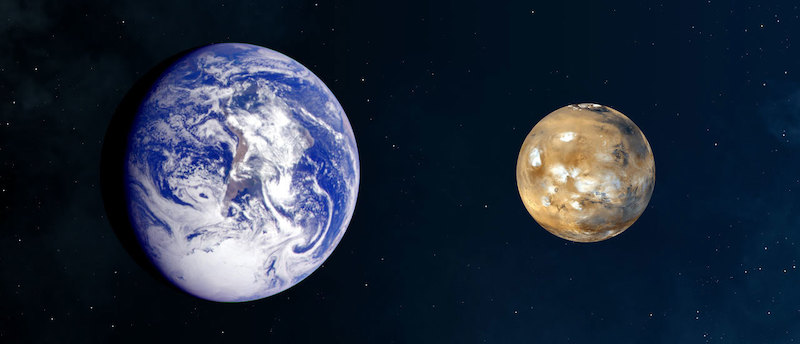
To understand why Mars varies so much in brightness in Earth’s sky, first realize that it isn’t a very big world. It’s only 4,219 miles (6,790 km) in diameter, making it only slightly more than half Earth’s size (7,922 miles or 12,750 km in diameter).
On the other hand, consider Mars in contrast to Jupiter, the biggest planet in our solar system. Jupiter is 86,881 miles (140,000 km) in diameter. As an illustration, more than 20 planets the size of Mars could be lined up side by side in front of Jupiter. Basically, Jupiter always looks bright, because it’s so big.
Not so for little Mars, however. Rather, its extremes in brightness have to do with its nearness (or lack of nearness) to Earth.
Future Martian oppositions
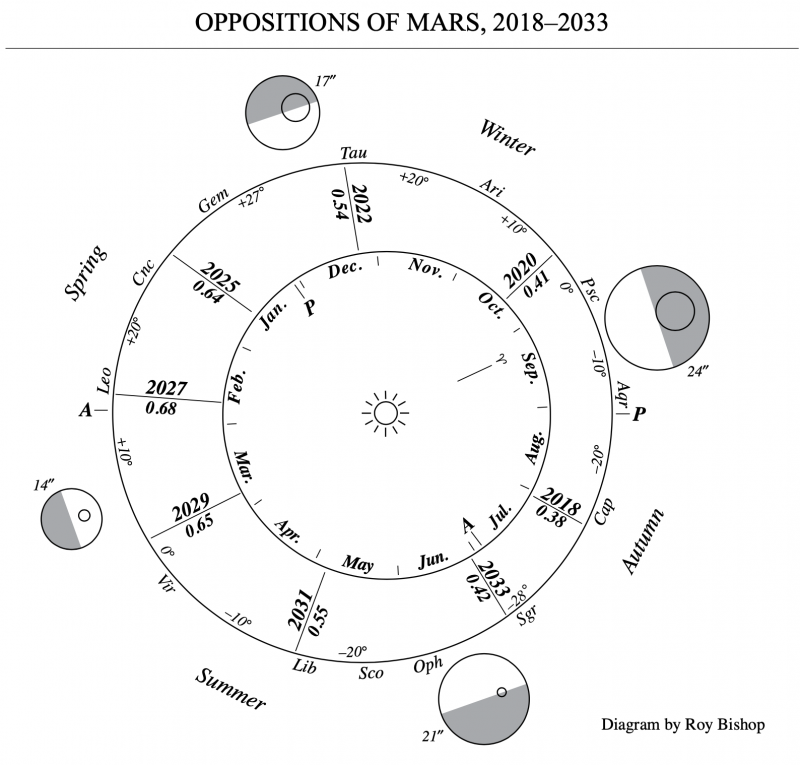
As mentioned above, the next opposition of Mars – when will appear at its brightest in Earth’s sky for that two-year period – will be February 2027. At the 2027 opposition, Mars will not be as big and bright as it was in 2025. Check out the chart at C. Seligman’s Mars oppositions page that lists all oppositions of Mars from 1995 to 2037.
EarthSky Community Photos

Seeing red
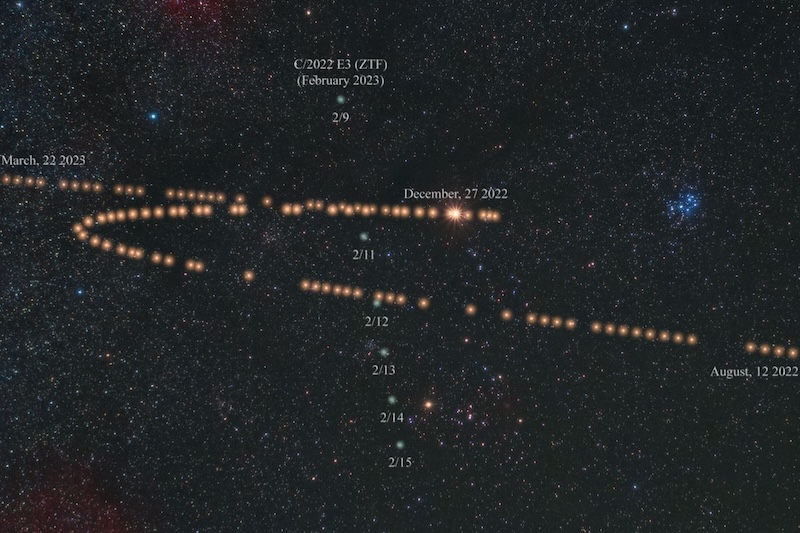
Mars appears as a reddish light in the sky and, therefore, is often called the red planet. Other obvious red dots in the sky are reddish-orange Aldebaran and the famous red supergiant Betelgeuse. So, it is fun to contrast Mars’ color and intensity of red with that of Aldebaran or Betelgeuse.
And then there is red Antares. Antares is Greek for rival of Ares (Ares being the Greek name for Mars). Antares is sometimes said to be the anti-Mars due to its competing red color. For a few months every couple of years Mars is much brighter than Antares. Also, every couple of years Mars passes near Antares, as if taunting the star. Mars moves rapidly through the heavens and Antares is fixed to the starry firmament.
What makes them red?
Surface temperature is what determines the colors of the stars. The hottest stars are blue and the coolest stars are red. In fact, from hottest to coolest, the colors of stars range from blue, white, yellow, orange and red. And while the colors of stars might be hard to detect, some stars – like Aldebaran, Antares and Betelgeuse – are noticeably colorful.
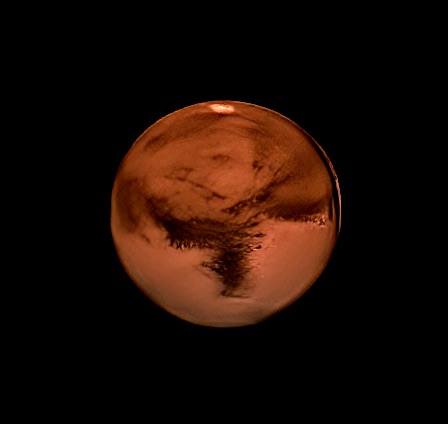
On the other hand, Mars appears red for a different reason. It’s red because of iron oxide in the dust that covers this desert world. Iron oxide gives rust and blood their red color. Rovers on Mars sampled the Martian dust and determined it contains three colors: reds, browns and oranges. So those three colors are what you may see when you gaze upon Mars.
Do you see red when you look at Mars, Aldebaran, Antares and Betelgeuse? Are they the same color? Do you see any other colors of stars?
Bottom line: In 2026, Mars will emerge in the morning sky around April and be visible in the morning sky the rest of the year. Its next opposition – when it will be at its brightest – is in February 2027.
Moon and Mars! Fav photos of December 7 occultation
Photos of bright Mars in 2018, from the EarthSky community
Photos of bright Mars in 2020, from the EarthSky community
Discover more from GTFyi.com
Subscribe to get the latest posts sent to your email.