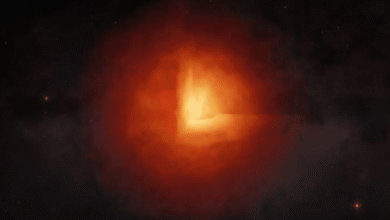
It’s important to understand the role of dark matter in shaping the cosmos you see around you. While it’s not directly observable, dark matter exerts a profound influence, acting as the invisible framework that governs the structure of the universe. As you explore this enigmatic component, you’ll uncover how it accounts for a significant portion of the universe’s total mass and plays a pivotal role in galaxy formation and movement. This post will guide you through the latest advancements in mapping dark matter’s hidden architecture, revealing the complexities of our universe’s mysterious fabric.

The Nature of Dark Matter
As you investigate into the essence of dark matter, you’ll discover its enigmatic presence shaping the universe around you. This elusive substance, which doesn’t emit, absorb, or reflect light, remains largely hidden from your senses. Its gravitational effects, however, influence the motion of galaxies and the structure of the cosmos, illustrating that its impact is anything but negligible.
History of Dark Matter Research
After the pioneering work of Fritz Zwicky in the 1930s, who first proposed the existence of dark matter to explain galaxy cluster dynamics, the journey of dark matter research has evolved dramatically. Various studies, including the rotation curves of galaxies and the cosmic microwave background, progressively revealed the vast and mysterious constituents of the universe, allowing you to piece together the fundamental intricacies of dark matter.
Properties and Composition
After numerous investigations, scientists have identified several distinct properties of dark matter. Its primary characteristic is that it does not interact with electromagnetic forces, making it invisible to direct observation. Furthermore, it constitutes approximately 27% of the universe’s total mass-energy content, while its composition is still largely unknown, leading to ongoing debates about its particle nature.
Research into dark matter’s properties and composition continues to unveil astonishing insights about the universe. You will learn that it likely comprises WIMPs (Weakly Interacting Massive Particles), axions, or sterile neutrinos, each posing unique challenges to uncover. Additionally, its non-interactive nature complicates detection efforts, yet the implications on cosmic structure lead to profound understanding of gravitational formation. Thus, your curiosity can drive this quest for knowledge as the exploration of dark matter remains a pivotal aspect of modern astrophysics.
Observational Techniques
While exploring dark matter’s elusive nature, scientists employ various observational techniques to uncover its effects on the universe. These methods allow you to examine cosmic structures and gravitational effects that indicate the presence of dark matter, shedding light on its hidden architecture. Through advanced technology and analysis, researchers are piecing together a more complete picture of the universe’s composition.
Gravitational Lensing
Along your journey to understand dark matter, gravitational lensing reveals how massive objects bend light from distant galaxies. This phenomenon allows you to indirectly measure the presence of unseen mass, enabling scientists to map the distribution of dark matter across vast cosmic distances.
Cosmic Microwave Background
Any exploration of dark matter’s influence must include the cosmic microwave background (CMB), the oldest light in the universe. This faint radiation serves as a relic from the Big Bang, providing you insight into the early universe’s conditions, including the fluctuations that led to the formation of structures influenced by dark matter.
And as you investigate deeper into the CMB, you’ll find that it carries important information about the universe’s initial growth and the distribution of matter at that time. The subtle temperature variations in the CMB map out density fluctuations, which align closely with the theoretical models of dark matter. By analyzing these minute fluctuations, you gain a deeper understanding of how dark matter shaped galaxies and cosmic structures, providing evidence that underpins your knowledge of the universe’s evolution.
Mapping Dark Matter
Even in the vast expanse of the cosmos, dark matter weaves an intricate web, influencing the formation and evolution of galaxies, clusters, and larger structures. Mapping dark matter is imperative for understanding the universe’s architecture as it remains undetectable through conventional means. Scientists utilize advanced techniques, such as gravitational lensing, which allows you to infer the presence of dark matter by observing its effects on visible matter. By performing these mappings, you can unlock the secrets of how dark matter shapes the universe.
Large Scale Structure of the Universe
Against this backdrop, the large-scale structure of the universe emerges as a tapestry woven from galaxies and clusters held together by dark matter’s gravitational force. You will find that these structures often align along vast filaments, creating a pattern that reveals the hidden influence of dark matter on cosmic scales. The clustering of galaxies indicates how dark matter not only affects individual galaxies but also organizes them into vast networks.
Dark Matter Halos
Dark matter halos are the gravitational envelopes surrounding galaxies, and they play an integral role in the universe’s structure. You should note that these halos can contain significantly more mass than the visible matter they encase, suggesting a profound impact on galaxy formation and stability.
For instance, dark matter halos are thought to dominate the mass of galaxies, providing the necessary gravitational pull to retain stars and gas. These halos are not uniform; they vary in size and density, influencing how galaxies interact and form. Your understanding of these halos enables you to grasp why some galaxies may be more prone to collisions while others remain isolated. Studies focus on mapping these halos to uncover how dark matter orchestrates the dynamics within the universe, emphasizing its foundational role in cosmic structure.
The Impact on Galaxy Formation
For centuries, the formation of galaxies has puzzled astronomers, but dark matter offers a vital framework for understanding their development. Its unseen mass provides the gravitational scaffolding necessary for galaxies to form, influencing their structure and distribution throughout the universe. By mapping dark matter’s presence, researchers can unveil the complex relationships between various galaxies and the underlying cosmic web that shapes them.
Role in Galaxy Evolution
One of the pivotal ways dark matter influences the universe is through its role in galaxy evolution. Dark matter halos serve as the backbone for galaxies, facilitating the merging and interactions that lead to the diverse array of galactic structures we observe today. This process not only affects the size and shape of galaxies but also impacts their stellar populations and the rate of new star formation.
Interaction with Baryonic Matter
To grasp the significance of dark matter, you must consider its interaction with baryonic matter, the ordinary matter that makes up stars, planets, and life itself. Dark matter’s gravitational field binds baryonic matter, enabling galaxies to acquire gas and dust needed for star formation. This interplay ensures the continued growth and evolution of galaxies, showcasing dark matter’s vital role in cosmic development.
Considering the profound implications of dark matter’s interaction with baryonic matter, you will find that it plays a fundamental role in the lifecycle of galaxies. Without dark matter, the processes of galaxy formation and evolution could be drastically different, leaving a barren universe with minimal star formation. Dark matter’s gravitational influence drives the gas to accumulate, ignite star formation, and facilitate mergers, leading to the vibrant and dynamic cosmic entities we observe. This relationship underlines the importance of dark matter in shaping not only the structure of galaxies but also the emergence of complex environments suitable for life.
The Cosmic Web
Many people may not realize that the universe is organized into a vast, intricate structure known as the cosmic web. This colossal framework comprises clusters, filaments, and voids, all interlinked by gravity and dominated by unseen forces. As you explore this web, you’ll uncover how galaxies and dark matter intertwine, shaping the cosmos into a tapestry that reveals the underlying principles of existence. Understanding the cosmic web allows you to glimpse the monumental scale of the universe and your place within it.
Structure and Formation
Across the universe, the cosmic web’s structure emerges from the gravitational pull of dark matter. Over billions of years, matter begins to clump together, forming knots that give rise to galaxies and galaxy clusters. As these structures evolve, they create vast voids that separate them, contributing to the tapestry of the cosmos. The formation of this intricate network highlights the dynamic interactions between matter and energy and illustrates how celestial bodies navigate this colossal framework.
Dark Matter Filaments
About 80% of the matter in the universe is dark matter, predominantly distributed along vast, thread-like structures known as filaments. These filaments are the highways of the cosmic web, facilitating the movement and interaction of galaxies and galaxy clusters. They act as gravitational guides, with their gravitational wells drawing in regular matter, effectively shaping the formation of celestial bodies.
Formation of dark matter filaments occurs through the aggregation of dark matter over cosmic time, where gravitational forces lead to the compression of matter along these strands. As you research deeper into these filaments, you will discover that they can harbor some of the universe’s most massive structures, such as galaxy clusters, that act as beacons of knowledge in the fabric of the universe. These filaments are not only vital to understanding cosmic architecture, but they also help you to appreciate the complexity of structure formation, underscoring your part in the grand cosmic narrative.
Current Research and Discoveries
Now, the field of dark matter research is more dynamic than ever, as scientists utilize cutting-edge technology and collaborative efforts to unlock its mysteries. Investigations are underway to identify its particles and understand how it influences cosmic structures, with exciting new findings emerging regularly. You might be intrigued to know that various international experiments, from underground labs to observatories, aim to pinpoint dark matter’s elusive characteristics, shaping our comprehension of the universe.
Experiments and Observations
Any new quest to unveil the secrets of dark matter involves a combination of observational strategies and experimental designs. Scientists are employing advanced detection techniques and astronomical surveys, such as the Large Hadron Collider and the Vera C. Rubin Observatory, to gather data that could corroborate or challenge existing theories about dark matter’s properties.
Emerging Theories
Before solidifying your understanding of dark matter, you should consider the numerous emerging theories that challenge traditional viewpoints. Astronomers and physicists are exploring alternative explanations for dark matter effects, including modifications to gravity, new particle candidates, and even the possibility of dark energy interplay, all of which could reshape our understanding of the universe.
With ongoing research, you will discover that these theories emphasize both the complexity and mystery surrounding dark matter. Theories such as MOND (Modified Newtonian Dynamics) propose adjustments to gravitational laws at large scales, while supersymmetry suggests the existence of lightweight particles beyond the Standard Model. As you probe deeper, the search for the invisible hand of dark matter may not only challenge established concepts but could also pave the way for significant advancements in our comprehension of fundamental physics.
Summing up
Summing up, your understanding of dark matter’s invisible hand in shaping the universe’s hidden architecture invites you to appreciate the complexity of cosmic structures. By recognizing how this enigmatic substance interacts with visible matter, you gain insights into the universe’s formation and evolution. As you explore these intricate relationships, you strengthen your grasp of astrophysics and its implications for our understanding of reality itself. Embracing the mysteries of dark matter not only enriches your knowledge but also sparks curiosity about the vast cosmos that surrounds you.
Discover more from GTFyi.com
Subscribe to get the latest posts sent to your email.