
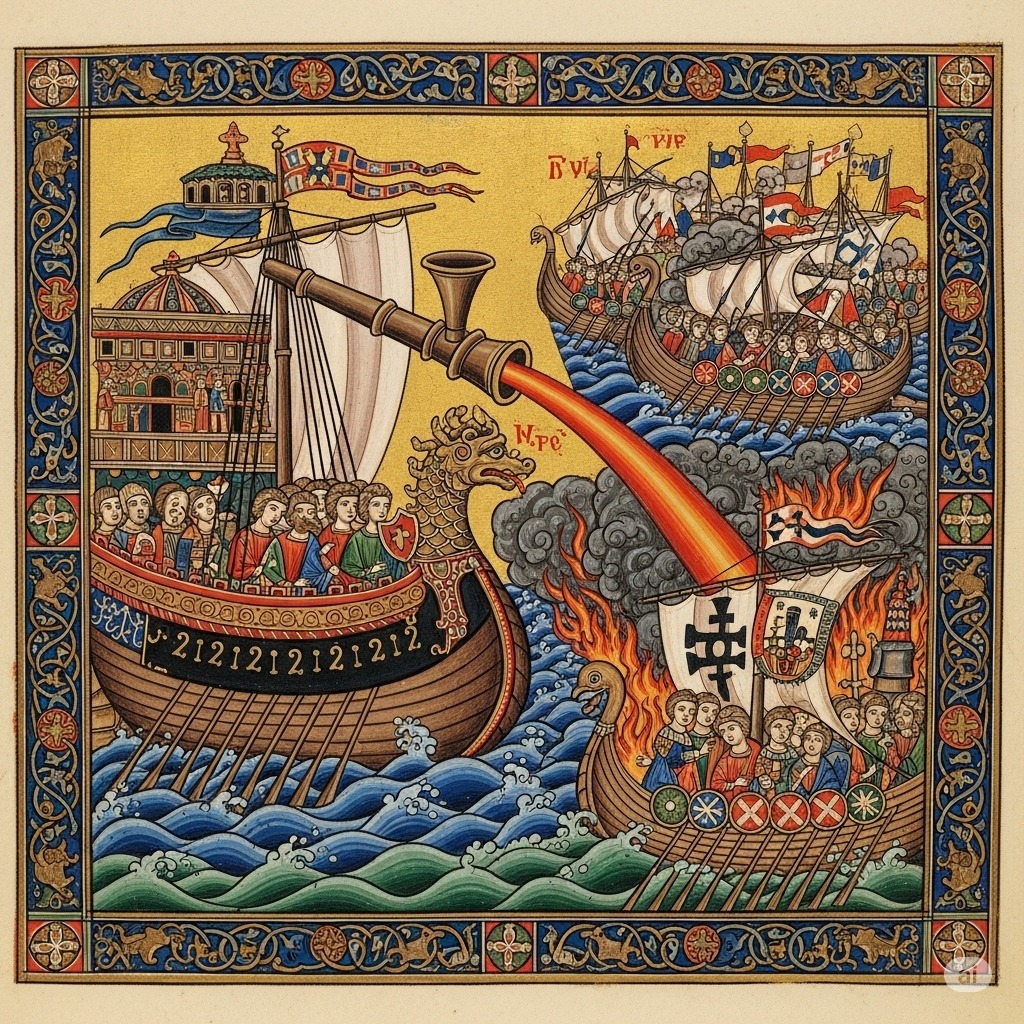
The air off the coast of Constantinople in 678 AD hangs thick with the brine of the Sea of Marmara and the metallic tang of fear. On the horizon, a forest of masts appears—the vast Umayyad Caliphate’s fleet, come to conquer the jewel of the Eastern Roman Empire. For the defenders of the city, the odds are impossible, the siege a foregone conclusion. But as the Arab ships draw closer, Byzantine dromons surge forward, not with archers or catapults, but with something new, something terrifying. From bronze-clad siphons mounted on their prows erupts a torrent of roaring, liquid flame. It’s a scene from a nightmare. The fire clings to wood, to flesh, to the very surface of the water, burning with an unholy vigor that dousing only seems to enrage. The screams of the attackers are lost in the inferno. The Caliphate’s fleet is annihilated, not by swords or spears, but by a weapon that defies the laws of nature.
Also Read-3I/ATLAS: A Comprehensive Scientific Monograph on the Third Interstellar Visitor
This was the world’s first horrifying introduction to Greek fire. For over five centuries, this chemical superweapon was the shield and sword of the Byzantine Empire, a state secret so profound, so jealously guarded, that when the empire finally crumbled, the secret died with it. It has since become the holy grail of lost inventions, a puzzle that has tantalized historians, chemists, and military technologists for centuries. We have split the atom and mapped the human genome, yet we cannot say with certainty what this ancient concoction was. The central question remains as potent today as it was a thousand years ago: What was Greek fire made of, and why, with all our modern knowledge, can’t we definitively recreate it? The answer is a tangled story of chemistry, secrecy, and the profound fragility of knowledge itself.
A Weapon That Rewrote History.
To understand the desperation to recover the Greek fire formula, one must first grasp its monumental impact. This wasn’t just another battlefield tool; it was a geopolitical game-changer. In an age of wood and sail, a weapon that could burn on water was the equivalent of a nuclear deterrent. It secured the survival of an empire and redrew the map of the Western world.
The Savior of an Empire.
The story of Greek fire is inseparable from the story of Byzantine survival. Its invention is traditionally credited to a Christian refugee from Syria, a chemist and engineer named Kallinikos of Heliopolis, who fled the Muslim conquest and brought his knowledge to Constantinople around 672 AD. The timing was providential. The Byzantine Empire was reeling, having lost vast territories to the lightning-fast expansion of the Caliphate. Constantinople itself, the “Queen of Cities,” was in the crosshairs.
It was during the first and second Arab sieges of Constantinople (674-678 and 717-718) that Greek fire announced its strategic importance. The Byzantine navy, though often outnumbered, used the incendiary to devastating effect, incinerating entire fleets. The Arab chroniclers, the very victims of the weapon, wrote of it with a kind of terrified awe. They called it a sorcery, a divine punishment. And why does this matter? Because the successful defense of Constantinople twice halted the Caliphate’s westward expansion into Europe from the east. Had the city fallen in the 7th or 8th century, the history of Europe—its religion, its culture, its political development—would be unrecognizably different. Greek fire didn’t just save a city; it arguably preserved the nascent idea of “Christendom.” This singular piece of Byzantine military technology stands as one of history’s greatest “what ifs.”
The Anatomy of Terror.
The effectiveness of Greek fire wasn’t just in its chemical properties but in its brilliant weaponization and the psychological shock it induced. The Byzantines developed sophisticated delivery systems that represented a leap in military engineering. The primary device was the siphon or siphōn, a large bronze tube mounted on the bow of a warship. Manned by a crew of siphōnarioi, this device used a pump or bellows system to project the liquid fire. Imagine the scene: a gout of roaring flame, accompanied by a thunderous noise and thick, acrid smoke, shooting across the water. To enemy sailors, it must have seemed as if the Byzantines had tamed a dragon.

But that’s only part of the story. The Byzantines also created hand-held versions, the cheirosiphōn (“hand-siphon”), which essentially functioned as the world’s first flamethrowers. These were used in close-quarters combat, both on sea and during sieges, to clear walls and break enemy formations. There is also evidence of clay pots filled with the substance, used as primitive grenades that would shatter on impact.
This multi-pronged deployment created an atmosphere of pure terror. The fire was notoriously difficult to extinguish; sources claim sand and vinegar were sometimes effective, but water was useless. It adhered to surfaces, meaning it stuck to the hulls of ships and the bodies of sailors. The psychological impact cannot be overstated. It was a weapon that caused not just death, but an agonizing, inescapable one. This instilled a deep-seated fear in Byzantium’s enemies, a dread that often routed forces before battle was even fully joined. It was the ultimate force multiplier, allowing smaller Byzantine forces to dominate much larger ones through sheer technological and psychological superiority.
The Unraveling of a Secret.
The very effectiveness of Greek fire guaranteed its secrecy. The formula was a state secret on par with the Manhattan Project’s nuclear designs. The knowledge was compartmentalized, entrusted to a select few families of technicians, the kallinikoi (named after its inventor), who passed the secret from father to son. Production was likely confined to a single, heavily guarded arsenal in Constantinople. The penalty for revealing the secret was undoubtedly death. This obsessive secrecy is precisely why the formula is lost to us today.
Whispers in the Texts.
Our knowledge of Greek fire comes from a frustratingly small collection of primary sources that describe its effects in vivid detail while remaining stubbornly silent on its composition. The Byzantine princess and historian Anna Komnene, writing in the 12th century in her work The Alexiad, provides one of the most famous descriptions:
“This fire is made by the following arts. From the pine and certain other such evergreen trees, inflammable resin is collected. This is rubbed with sulfur and put into tubes of reed, and is blown by men using it with violent and continuous breath. Then in this manner it meets the fire on the tip and catches light and falls like a fiery whirlwind on the faces of the enemies.”
While evocative, her account is more poetic than scientific. It mentions resin and sulfur—common components of ancient incendiary weapons—but omits the critical ingredient that made Greek fire unique: the substance that allowed it to burn on water and project with such force. Other chroniclers, like Theophanes the Confessor and Emperor Leo VI the Wise in his Tactica, offer similar descriptions of its power but guard the formula. Leo VI explicitly warns his son that the knowledge of its manufacture must “on no account be revealed.” They tell us everything about it, except for the one thing we truly want to know. The secret was kept so well that the texts designed to preserve Byzantine history are the very documents that obscure its greatest technological triumph.
What Was the Real Formula?
The quest to reverse-engineer the Greek fire formula from these tantalizing clues has produced a host of theories. Modern analysis suggests it was not a single, simple substance but a complex, multi-component chemical cocktail, likely a petroleum-based mixture. The Byzantines had access to natural surface seeps of crude oil (naphtha) in the Caucasus region and around the Black Sea. This would have provided the sticky, liquid fuel base.
The real debate centers on the additives—the “secret sauce” that gave the mixture its legendary properties. The leading theory is that the recipe included some combination of the following:
- Crude Oil (Naphtha): The primary fuel. It’s sticky, burns for a long time, and was readily available to the empire.
- Pine Resin or other Resins: These would act as a thickening and adhesive agent, making the fire cling to targets. This aligns with Anna Komnene’s account.
- Sulfur: A common incendiary component in the ancient world. It lowers the ignition temperature and produces noxious, suffocating fumes.
- Quicklime (Calcium Oxide): This is perhaps the most compelling candidate for the “magical” ingredient. Quicklime reacts exothermically with water, generating intense heat (up to 150 °C or 302 °F). If the liquid fire was projected and then came into contact with sea water, the quicklime reaction would create a flash of heat and steam, potentially igniting the petroleum mixture or at least contributing to its terrifying, seemingly water-fueled nature. This could be what sources meant when they said it “burned on water.”
- Saltpeter (Potassium Nitrate): This is the most controversial ingredient. Saltpeter is an oxidizer, meaning it provides its own oxygen supply. Its inclusion would allow the mixture to burn more intensely and perhaps even underwater or in oxygen-poor environments. It would also make the mixture more propulsive and explosive, pushing it closer to something like gunpowder. However, strong evidence for the Byzantines’ chemical knowledge of refined saltpeter in the 7th century is thin. While later Arab sources mention recipes with saltpeter, it’s unclear if these were true “Greek fire” or a different, later invention.
To visualize the debate, we can compare the leading candidates for the formula’s key components:
| Ingredient | Proposed Role in Formula | Evidence from Texts / Archaeology | Plausibility Score (1-5) |
|---|---|---|---|
| Crude Oil / Naphtha | Primary fuel source, sticky base | Descriptions of a “liquid fire”; access to natural seeps. | 5 |
| Pine Resin | Thickener, adhesive agent | Mentioned by Anna Komnene; used in other incendiaries. | 4 |
| Sulfur | Lower ignition temp, noxious fumes | Classic incendiary ingredient since antiquity. | 4 |
| Quicklime (CaO) | Heat generation on contact with water | Explains the “burns on water” phenomenon. | 5 |
| Saltpeter (KNO3) | Oxidizer (burns hotter/without air) | Highly debated. Would make it more explosive/propulsive. | 2 |
The most plausible reconstruction, therefore, is a pressurized, pre-heated mixture of light crude oil and pine resin, propelled from a siphon and ignited at the nozzle, with quicklime possibly contributing to its thermal reaction upon hitting the water. The secret lay not in a single magical ingredient, but in the sophisticated combination and weaponization of several.
Why Can’t We Just Make It? The End of a Formula.
If we have such a strong theoretical model, why can’t we just mix up a batch and confirm it? This question gets to the heart of what it means for a technology to be “lost.” The loss of Greek fire was not like misplacing a recipe book. It was the complete and utter collapse of the ecosystem of knowledge that produced it.
The Problem of Lost Knowledge.
Greek fire is the poster child for the phenomenon of lost inventions, but it’s not alone. History is littered with technological ghosts: flexible glass from Roman times, the true formula for Damascus steel with its distinctive wavy patterns, the full capabilities of the Antikythera mechanism. These losses highlight a crucial point: technology is more than just an artifact or a formula. It’s a system of human knowledge, skill, and industrial capacity.
The Byzantines didn’t just have a formula; they had a process. What were the exact refining techniques for the naphtha? At what temperatures were the ingredients mixed? In what order and in what ratios? How were the bronze siphons engineered to withstand the pressure and heat without exploding? What was the precise nozzle design that aerosolized the liquid so effectively? These are questions of craft, of engineering know-how—what the Greeks called techne. This is tacit knowledge, passed down through apprenticeship and practice, not easily committed to paper. Even if a spy had stolen a list of ingredients, they would not have stolen the secret of Greek fire. This is the critical distinction: we may be able to guess the recipe, but we can never recover the process.
The Fall of a City, The Death of a Secret.
The final nails in the coffin for the Greek fire formula were hammered in by history. The first blow came in 1204 with the Fourth Crusade. Western European crusaders, diverted from their mission to the Holy Land, instead sacked and occupied Constantinople. The great city was looted, its libraries burned, its workshops destroyed. In the chaos, the continuity of the state-controlled arsenal was shattered. The chain of knowledge, passed from father to son for fifteen generations, was likely broken forever.
While some form of incendiary weapon may have been used by the Byzantines after they reclaimed the city, it appears it was a weaker, less effective version. The true secret seems to have vanished in the ruin of 1204. By the time the Ottoman Sultan Mehmed the Conqueror stood before the walls of Constantinople in 1453, the city’s ultimate weapon was a ghost. The defenders faced Ottoman cannons—a new technology of fire and chemistry—with their own legendary fire nowhere to be found. When the city fell, the last remnants of the imperial structure that had birthed and guarded the secret were swept away, and the formula passed from a state secret into a historical mystery.
The Ghost in the Machine: Greek Fire’s Legacy.
Though the formula is lost, the idea of Greek fire has haunted the military imagination for centuries. It represents a quantum leap in the technology of destruction, a specter that would re-emerge in even more terrifying forms in the modern era.
From Byzantium to Napalm.
The lineage from ancient incendiary weapons to their modern counterparts is clear and chilling. The core concept—a liquid, adhesive fire agent—is the direct ancestor of the flamethrowers that debuted in the trenches of World War I and, most infamously, the napalm used by U.S. forces in Vietnam. Napalm, a jellied gasoline mixture, horrifically mirrors the descriptions of Greek fire: it sticks to surfaces, is difficult to extinguish, and causes unimaginable suffering.
What does this lineage tell us? It shows that the human drive to weaponize the elements, particularly fire, is a constant. But it also reveals a profound shift in scale and accessibility. The Greek fire formula was a guarded state monopoly. The knowledge behind napalm is a matter of basic organic chemistry, available to any state or non-state actor with a chemical industry.
One can visualize this grim progression. Imagine a conceptual graph plotting the “Destructive Power of Incendiary Weapons” on the Y-axis against “Time (600 AD to Present)” on the X-axis. The line would show a dramatic spike with the introduction of Greek Fire around 672 AD, creating a high plateau of military advantage that lasted for centuries. After its disappearance around 1204, that plateau would crumble. Then, a terrifyingly steep, near-vertical ascent would begin in the early 20th century, accelerating through two world wars and peaking with modern thermobaric weapons. This chart would not just illustrate technological change; it would map our ever-increasing capacity for calculated destruction, a capacity that makes the secrets of the Byzantines seem almost quaint by comparison.
The story of Greek fire, then, is more than a historical whodunit. It is a profound meditation on the nature of knowledge and power. Its creation speaks to human ingenuity in the face of existential threat. Its secrecy speaks to the value of information in a world of conflict. And its loss is a stark and enduring cautionary tale. It reminds us that technology, no matter how powerful, is inextricably bound to the culture and society that creates it. Knowledge is not self-sustaining. It requires institutions to protect it, masters to teach it, and a civilization stable enough to value it. When the civilization falls, it takes its wonders with it, leaving future generations to sift through the ashes, forever chasing the ghosts of a fire they can never hope to reignite.
Disclaimer: This article is a work of historical analysis and synthesis, intended for informational and educational purposes. The theories and potential formulas discussed are based on current scholarly research and historical texts. The exact composition of Greek fire remains a lost secret, and the information presented reflects the most credible academic hypotheses rather than definitive fact. The views expressed are those of the author, drawing on extensive research in the field.
Discover more from GTFyi.com
Subscribe to get the latest posts sent to your email.


