Scientists Uncover Two Colossal Structures Beneath Africa—and They May Not Be from This World

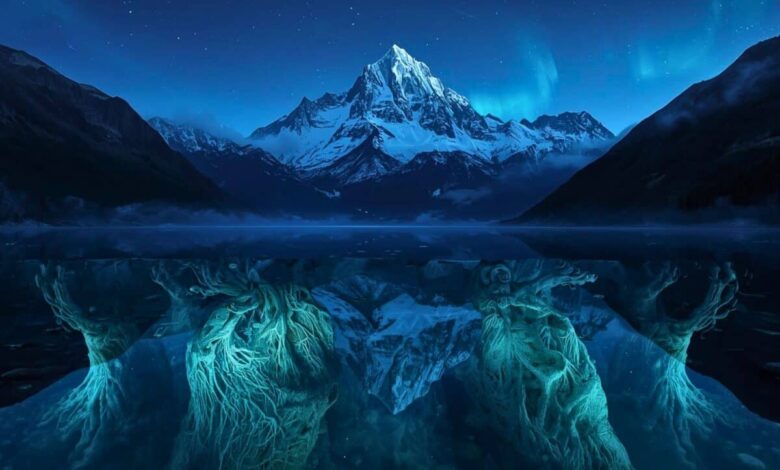
Far beneath Earth’s surface, two enormous structures lie hidden at the edge of the planet’s molten core. These formations, each thousands of kilometers wide, aren’t just geological oddities—they might be the remnants of an ancient planet that collided with Earth billions of years ago.
The structures are known as large low-shear-velocity provinces (LLSVPs), and their presence was first revealed by unusual patterns in seismic waves. These waves, triggered by earthquakes, slow down when they pass through the blobs, indicating a distinct composition compared to the surrounding mantle.
A leading theory gaining traction is that these masses are fragments of Theia, the hypothetical planet believed to have struck early Earth during the giant impact event that created the Moon. If true, these deep-Earth giants would represent a lost planetary body, embedded in Earth’s mantle for over 4.5 billion years.
What Seismic Waves Tell Us About Earth’s Interior
The LLSVPs were discovered using seismic tomography, a method that maps Earth’s internal structure by measuring how earthquake waves travel through different materials. Scientists noticed that waves slow significantly as they pass through two massive regions—one beneath Africa and another under the Pacific Ocean. This behavior suggests that the blobs are not only hotter than the surrounding rock but also denser and compositionally distinct.
These structures are immense. The one under Africa, often referred to as Tuzo, is estimated to rise 800 to 1,000 kilometers from the core-mantle boundary—roughly equivalent to stacking 90 Mount Everests. Combined, the two LLSVPs could make up 3% to 9% of Earth’s volume, a striking figure for something hidden so deep and out of reach.

A study in the Geophysical Journal International examined core-reflected seismic waveforms and confirmed that the boundaries of these LLSVPs are sharp, not gradual, suggesting they are chemically distinct structures rather than simply thermal anomalies.
The Theia Theory
The idea that these structures could be Theia’s mantle emerged from geophysical simulations and isotopic evidence. A 2021 study published in Nature Communications modeled how material from Theia, if it were about 2% denser than Earth’s mantle, could have survived the impact and settled deep within Earth. The resulting distribution of this material closely matches the size, shape, and location of today’s LLSVPs.
The giant impact hypothesis—widely accepted as the explanation for the Moon’s formation—proposes that a Mars-sized object struck Earth around 4.5 billion years ago. Most of the resulting debris formed the Moon, but portions of Theia’s mantle may have remained behind and migrated toward Earth’s lower mantle.
This theory aligns with seismic data, density estimates, and the Moon’s oxygen isotope ratios, which closely match those of Earth. The resemblance suggests a mixing of materials during the impact, supporting the idea that pieces of Theia are preserved not only on the Moon—but also deep within our own planet.
More Than Fossils—These Blobs May Shape Earth’s Surface
These ancient structures may not be geological fossils. Their influence appears to extend into Earth’s dynamic systems. The LLSVPs sit near the core-mantle boundary, a region that generates mantle plumes—columns of hot, buoyant rock that drive surface volcanoes such as those in Hawaii and Iceland.
A 2020 article in Progress in Earth and Planetary Science explored how thermochemical mantle structures like LLSVPs could persist for billions of years without mixing, due to density contrasts and mantle convection patterns. These long-lived anomalies may concentrate heat at their margins, triggering superplumes and volcanic chains at Earth’s surface.

This theory helps explain why many hotspot volcanoes are clustered above the edges of the LLSVPs. The African blob, in particular, has been linked to tectonic processes and large-scale continental rifting, pointing to its role in shaping Earth’s surface features over geologic time.
A Planetary Mystery Still Buried
Despite decades of research, scientists have no direct way to study these deep-Earth masses. The Kola Superdeep Borehole, humanity’s deepest attempt at reaching Earth’s interior, stopped at 12 kilometers—just 0.2% of the distance to the core-mantle boundary. Everything known about LLSVPs comes from indirect imaging, gravity models, and simulations.
Alternative explanations persist. Some researchers argue these structures could be accumulated oceanic crust, subducted and trapped in the mantle over eons. Others propose they represent primordial heterogeneities—chemical leftovers from Earth’s early magma-ocean phase.
Still, the Theia-origin model offers the most comprehensive explanation across seismic behavior, material density, and isotopic parallels. Even mainstream science publications have spotlighted the growing consensus that Earth’s deep structure may contain more than just rock—it may hold the remnants of another planet entirely.
Scientists Uncover Two Colossal Structures Beneath Africa—and They May Not Be from This World
Discover more from GTFyi.com
Subscribe to get the latest posts sent to your email.