An updated schedule for the Artemis 2 mission to the moon
NASA said on January 9, 2026, that the final steps are underway for the first crewed Artemis mission to the moon. The space agency said it would begin the 4-mile trek from the Vehicle Assembly Building to Launch Pad 39B no earlier than January 17. This journey takes around 12 hours. Once the rocket and spacecraft reach the launchpad, testing will begin. By the end of January, we can expect a wet dress rehearsal, when teams load the rocket fuel and perform a countdown without the astronauts present.
So when can we expect the launch of Artemis 2, the first return of astronauts to the moon in decades? The earliest launch window is on February 6, 2026. For this mission to the moon, Earth and the moon have to be in specific alignments at launch time. Therefore, the possible dates of launch through April 2026 are as follows:
February 6, 7, 8, 10 and 11
March 6, 7, 8, 9 and 11
April 1, 3, 4, 5 and 6
What is the Artemis 2 mission to the moon?
No nation has sent humans anywhere near the moon since Apollo 17 in December 1972. All crewed missions since then have remained in low Earth orbit, meaning humans haven’t traveled to the moon’s distance in more than 50 years. But that’s about to change.
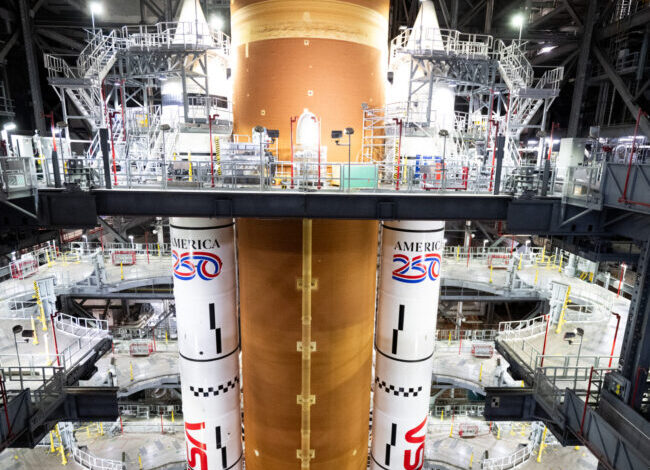
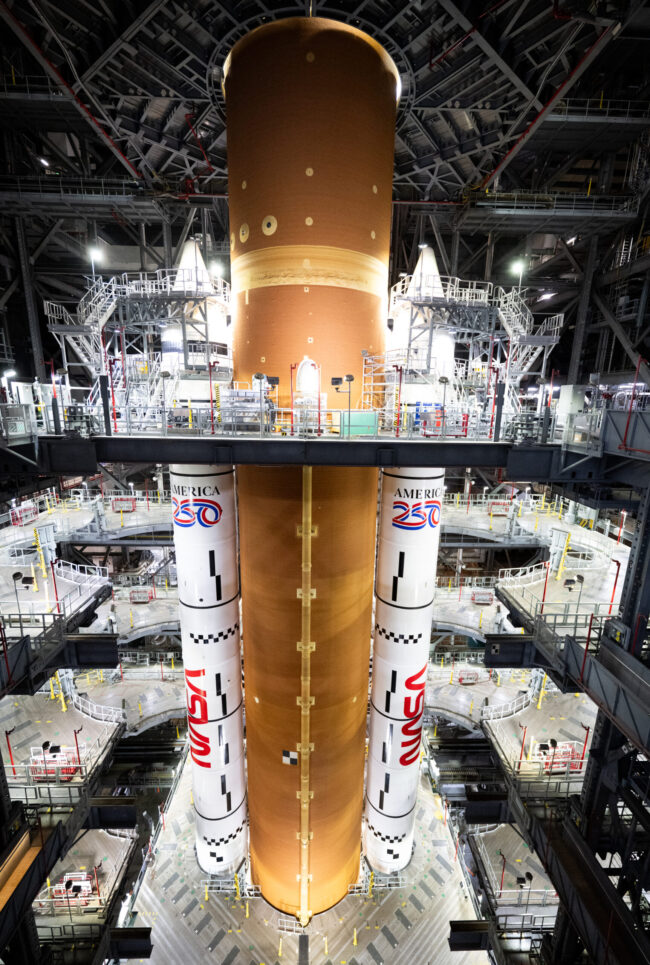
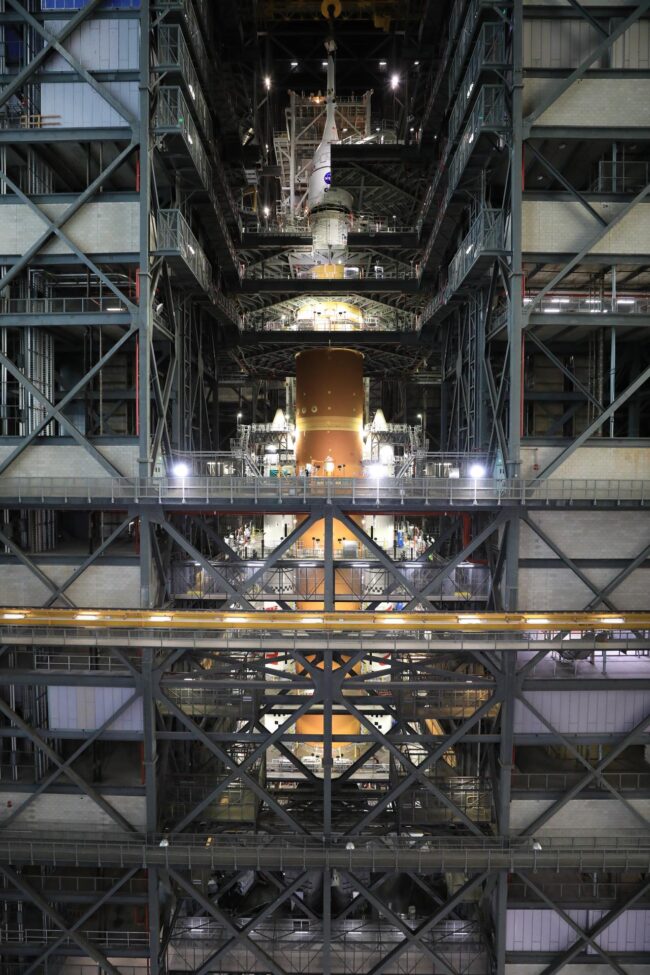
The Artemis 2 mission – a crewed flight around the moon – could launch as early as February 2026. On November 20, 2025, NASA announced that the spacecraft was fully stacked in the Vehicle Assembly Building (VAB) on Cape Canaveral at Kennedy Space Center in Florida and ready for dress rehearsal. NASA said:
In the coming weeks, engineers and the Artemis 2 crew will conduct the 1st part of a Countdown Demonstration Test at Kennedy, a dress rehearsal for launch day. The crew will don their Orion crew survival system spacesuits and venture to their rocket before being secured inside Orion, which the crew recently named Integrity, simulating the final moments of the countdown.
Because the rocket and spacecraft are not yet at the launch pad, the crew will board Orion inside the VAB. The test will serve as a final verification of the timeline for the crew and supporting teams on the ground. A second part of the test, preparing for an emergency at the launch pad, will occur after the rocket and spacecraft roll out to Launch Pad 39B.
The following mission, Artemis 3 – which will be the first mission to return humans to the moon’s surface since the Apollo missions of the 1960s and ’70s – was slated for September 2026. It has been delayed until at least mid-2027.
Integrity
The Artemis 2 crew said they chose the name Integrity because it:
… embodies the foundation of trust, respect, candor, and humility across the crew and the many engineers, technicians, scientists, planners, and dreamers required for mission success.
The name is also a nod to the extensive integrated effort – from the more than 300,000 spacecraft components to the thousands of people across the world – that must come together to venture to the moon and back, inspire the world, and set course for a long-term presence at the moon.

When will Artemis reach the moon?
The goal of Artemis is to return astronauts to the moon for the first time in more than 50 years. The program is in some sense a stepping-stone mission. Ultimate goals include a lunar base and human missions to Mars.
Artemis 1 successfully completed its mission in 2022 with an uncrewed test flight that orbited the moon. Artemis 2 will send a crewed mission around the moon. And Artemis 3 will return humans to the lunar surface.
And Artemis 4, another mission to take humans to the moon, was supposed to follow no earlier than September 2028. Of the four missions, Artemis 4 is the most ambitious. Its goals include:
- Multiple launches and spacecraft dockings in lunar orbit.
- Delivering an International Habitation (I-Hab) module to the Gateway space station in lunar orbit.
- Landing two astronauts on the moon, where they will spend a week collecting samples, conducting science experiments, rover operations, and moon walks.

The astronauts who will circle the moon with Artemis
The four Artemis 2 astronauts have already been chosen and were announced on April 3, 2023. They are Christina Hammock Koch, Victor Glover, Reid Wiseman and Canadian Jeremy Hansen. Learn more about them below.
Here they are. @SenBillNelson announces the #Artemis II crew, the next astronauts to fly around the Moon:@Astro_Christina@Astro_Jeremy@AstroVicGlover@Astro_Reid
We go together. https://t.co/XdUizg2Wye pic.twitter.com/6Yo4I2lKeJ
— NASA (@NASA) April 3, 2023
They’re going to the Moon! Introducing the #Artemis II astronauts:
Reid Wiseman (@astro_reid), Commander
Victor Glover (@AstroVicGlover), Pilot
Christina Koch (@Astro_Christina), Mission specialist
Jeremy Hanson (@Astro_Jeremy), Mission specialisthttps://t.co/Hy1110MOEi pic.twitter.com/SeETL5iURu— NASA’s Johnson Space Center (@NASA_Johnson) April 3, 2023
Christina Koch
Meet the first member of our #Artemis II Moon crew: mission specialist @Astro_Christina!
Christina Koch visited the @Space_Station in 2019, where she took part in the first all-woman spacewalk. She began her career as an electrical engineer at @NASAGoddard. pic.twitter.com/mi82SayXUm
— NASA (@NASA) April 3, 2023
Victor Glover
Our #Artemis II pilot is @AstroVicGlover!
Victor Glover is part of our 2013 class of @NASA_Astronauts and was the pilot for NASA’s @SpaceX Crew-1 mission. He’s logged 3,000 flight hours in more than 40 different aircraft, and will pilot @NASA_Orion around the Moon. pic.twitter.com/P0zJ8pwaeL
— NASA (@NASA) April 3, 2023
Reid Wiseman
…and rounding out our #Artemis II Moon crew: mission commander @Astro_Reid!
Reid Wiseman lived & worked aboard the @Space_Station as a flight engineer in 2014. He also commanded the undersea research mission NEEMO21, and most recently served as Chief of the @NASA_Astronauts. pic.twitter.com/AincR66wpf
— NASA (@NASA) April 3, 2023
Jeremy Hansen
Representing the @csa_asc on #Artemis II to the Moon is @Astro_Jeremy, from London, Ontario.
Jeremy Hansen was a fighter pilot before joining CSA, and currently works with NASA on astronaut training and mission operations. This will be Hansen’s first mission in space. pic.twitter.com/zIVetAQeFE
— NASA (@NASA) April 3, 2023
The vision of the Artemis program
Ultimately, the Artemis program aims to send the first humans back to the moon this decade. When they go, they’ll be aiming for the moon’s south pole, a place that scientists – as discovered in recent decades – has large amounts of water ice. Water contains oxygen, so processing it will make it possible for future astronauts to stay longer.
Someday, visionaries still hope, we will have a permanent presence on the moon, and we will go to Mars.
Indeed, such dreams are an integral part of humanity’s natural wanderlust in the 21st century. And so future historians might look back at our time – and at the Artemis missions – as the moment humanity took a true giant leap to space, maybe this time for good.
Are we going to BOTH the moon AND Mars? EarthSky’s Deborah Byrd spoke with Eric Berger – the senior space editor at Ars Technica – on March 24, 2025, about the Artemis mission, and about what we know so far about the plan to go to Mars. Watch the video in the player above or on YouTube.
Bottom line: NASA said on January 9, 2026, that the final steps were underway to send Artemis 2 to the moon. Get the possible launch dates here.
Read more: New NASA moon suit makes its debut
Ice on the moon is widespread, new study shows
Final steps begin for Artemis 2, a crewed launch to the moon
Discover more from GTFyi.com
Subscribe to get the latest posts sent to your email.