In a discovery that reads like science fiction, scientists have confirmed that human radio transmissions have formed an unexpected barrier in space. This artificial shield appears to influence the planet’s radiation environment, shaping the very boundaries of Earth’s near-space environment.
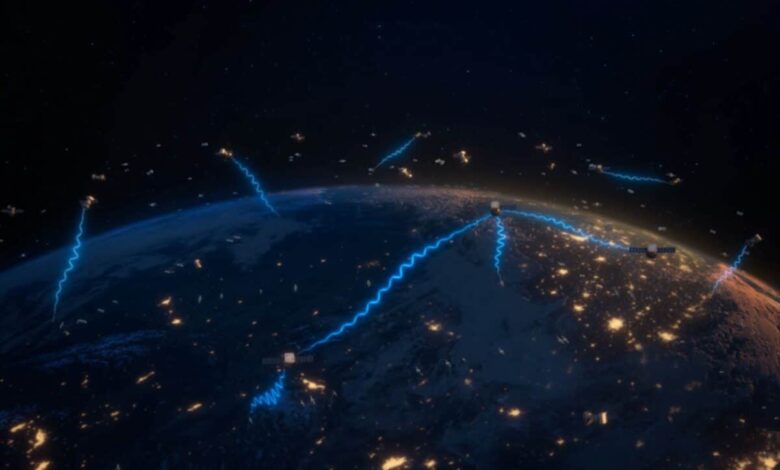
The finding emerged from observations made by NASA’s Van Allen Probes, which studied Earth’s radiation belts in unprecedented detail before their deactivation in 2019. What researchers uncovered was both accidental and extraordinary: emissions in the very low frequency (VLF) range, used in submarine communications, are interacting with charged particles high above the Earth, forming a detectable and surprisingly stable structure in space.
Human-made Radio Waves Are Altering the Van Allen Belts
NASA’s Van Allen Probes revealed that VLF signals, transmitted from ground-based sources—are leaking into space and interacting with high-energy particles. These signals, although not initially designed for this purpose, appear to be pushing the inner edge of the Van Allen belts farther from Earth.
According to a NASA statement, the region now occupied by this artificial barrier aligns almost exactly with the belts’ inner boundary. Phil Erickson, assistant director at the MIT Haystack Observatory, explained that:
“A number of experiments and observations have figured out that, under the right conditions, radio communications signals in the VLF frequency range can in fact affect the properties of the high-energy radiation environment around the Earth,”
These signals create a bubble-like structure that wasn’t observed in early measurements from the 1960s. The changes suggest a direct link between decades of radio transmissions and the current structure of Earth’s radiation belts.
The Invisible Bubble Reshapes Near-earth Space
The newly identified bubble isn’t visible or tangible in the traditional sense, but its effects are measurable. It functions as a kind of shield, nudging energetic particles away from Earth and changing how radiation behaves in near-Earth orbit. Although scientists caution against calling it a force field, its ability to block or redirect cosmic particles is significant.
As IFLScience notes, this barrier corresponds to the same zone where VLF signals have the strongest effect, offering a possible explanation for the belts’ altered shape. The phenomenon appears stable, and its boundary is consistent with the reach of radio emissions used in military and maritime communication. The implication: human technologies developed for entirely different purposes are now shaping the physical conditions of space.

Researchers Are Testing New Protective Applications
Although the creation of this barrier was unintentional, scientists are now considering whether VLF signals could be used more deliberately to shield sensitive equipment or even entire regions of Earth from harmful space weather.
“With further study, VLF transmissions may serve as a way to remove excess radiation from the near-Earth environment,” as explained by the United States space program.
It’s still too soon to say what this could be used for, but the discovery has sparked new discussion about how much we’re already shaping space without meaning to. This invisible shield, created by everyday communication tech, might one day help protect us, a curious twist in the story of human progress.
Earth Has a Hidden Space Barrier… And Humans Put It There by Accident
Discover more from GTFyi.com
Subscribe to get the latest posts sent to your email.