Science & Technology

See the Martian moon Phobos fly over a dust storm

The Martian moon Phobos photobombs this image of a dust storm flowing off the shield volcano Pavonis Mons on Mars. ESA’s Mars Express captured the shots you see here, and Andrea Luck cropped and processed them, sharing them on his Flickr page. Image via ESA/ DLR/ FUBerlin/ Andrea Luck (CC BY 4.0).

EarthSky’s 2026 lunar calendar is available now. Get yours today! Makes a great gift for the new year.

The Martian moon Phobos in sensational images

ESA’s Mars Express has been orbiting Mars since December 2003, and it still sends back sensational images, such as these shots of the Martian moon Phobos passing above the red planet’s surface. These images capture Mars and Phobos from June 2025, and ESA released the images in December 2025. The immensely talented Andrea Luck processed the images you see here.

These images capture some of Mars’ famous landscapes below orbiting Phobos. The trio of volcanoes in the image below sits on the Tharsis plateau region of Mars. The three enormous shield volcanoes you see, from top right to lower left, are Ascraeus Mons, Pavonis Mons and Arsia Mons. Together they’re known as Tharsis Montes. The video above shows a closeup of Pavonis Mons, the central volcano, as a dust storm blows off the slopes and Phobos passes high above. Part of Valles Marineris, the largest canyon in the solar system, also appears in the first image below.

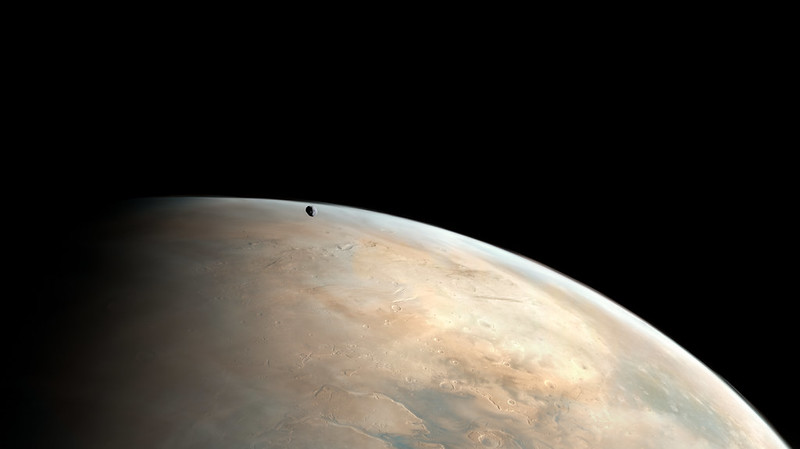
In the last image on this page, we get a view of Phobos near the limb of Mars with dark-colored terrain at lower right. This dark region is Kasei Valles. This is another huge canyon system that reaches a width of 300 miles (480 km) in some places. Compare that to the Grand Canyon, which is just 18 miles (30 km) wide at its widest. Just like the Grand Canyon, scientists believe the channels of Kasei Valles were carved by running water.

More images of Phobos over Mars
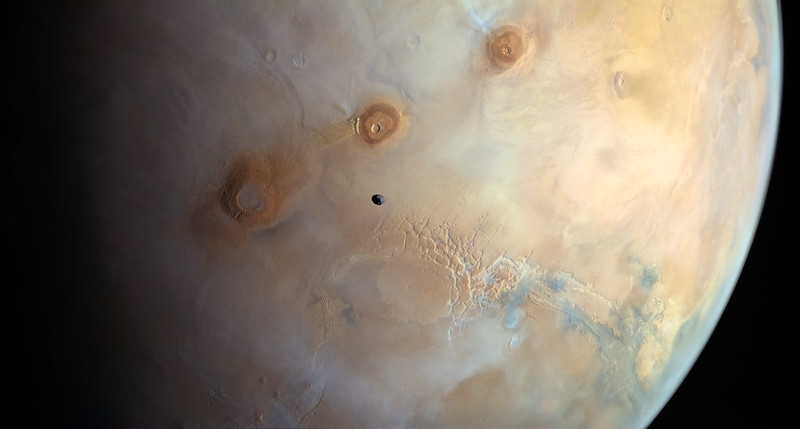
View looking down from orbit at cream-colored Mars with a line of 3 reddish volcanoes and a black dot, a moon in orbit.
ESA’s Mars Express captured a view looking down at 3 volcanoes on Mars as the moon Phobos passed by. The orangish domes are volcanoes in the Tharsis region. To the lower right of Phobos is the Noctis Labyrinthus (Labyrinth of the Night) and Valles Marineris, the largest canyon in the solar system. Image via ESA/ DLR/ FUBerlin/ Andrea Luck (CC BY 4.0).
A view of the horizon of Mars seen from orbit with the rocky Martian moon Phobos at the edge above the planet.
In this image from ESA’s Mars Express, we see the moon Phobos near the limb of Mars. On the surface of the red planet toward the bottom is Kasei Valles. This darker region shows vast valleys with a few scattered impact craters. Image via ESA/ DLR/ FUBerlin/ Andrea Luck (CC BY 4.0).

Bottom line: New images show the Martian moon Phobos as it passes over iconic landscapes on the red planet, including a trio of volcanoes and the largest canyon in the solar system.

Read more: Watch as Mars’ moons trade places in the sky

See the Martian moon Phobos fly over a dust storm


Discover more from GTFyi.com

Subscribe to get the latest posts sent to your email.

Alex Hayes

Alex Hayes is the founder and lead editor of GTFyi.com. Believing that knowledge should be accessible to everyone, Alex created this site to serve as a trusted resource for clear and accurate information.

Related Articles

Leave a Reply

Your email address will not be published. Required fields are marked *

Back to top button

Discover more from GTFyi.com

Subscribe now to keep reading and get access to the full archive.

Continue reading