
The Hyades: a nearby star cluster
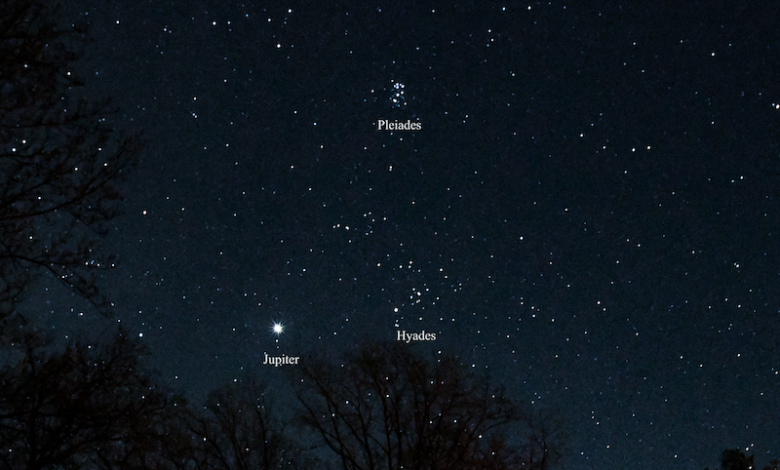
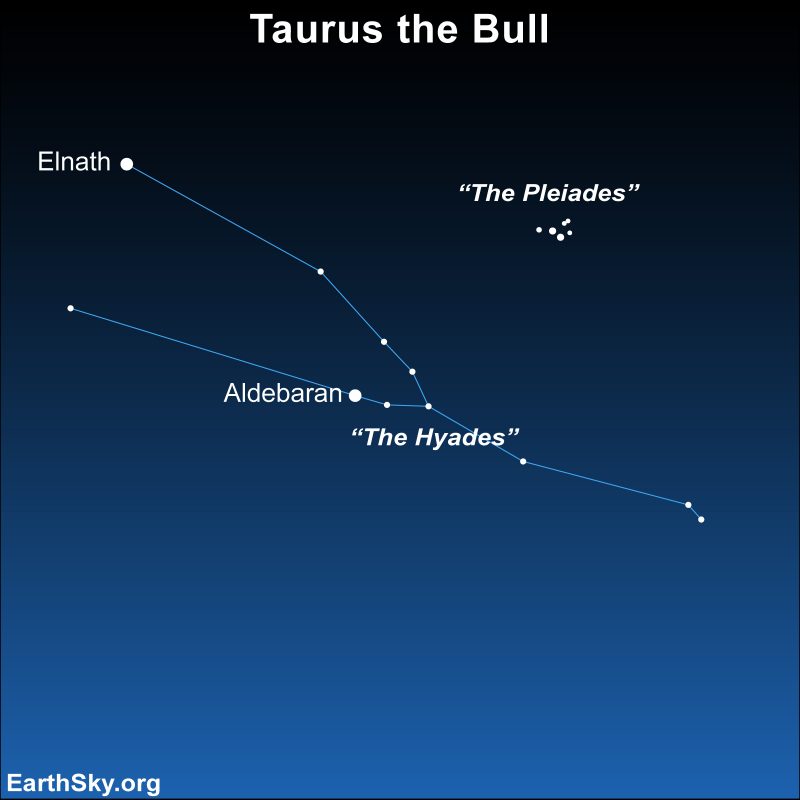
With the exception of the Ursa Major Moving Group, the Hyades cluster is the closest star cluster to Earth, at a distance of 150 light-years. This compact cluster with the distinctive shape of the letter V is very easy to spot in the night sky.
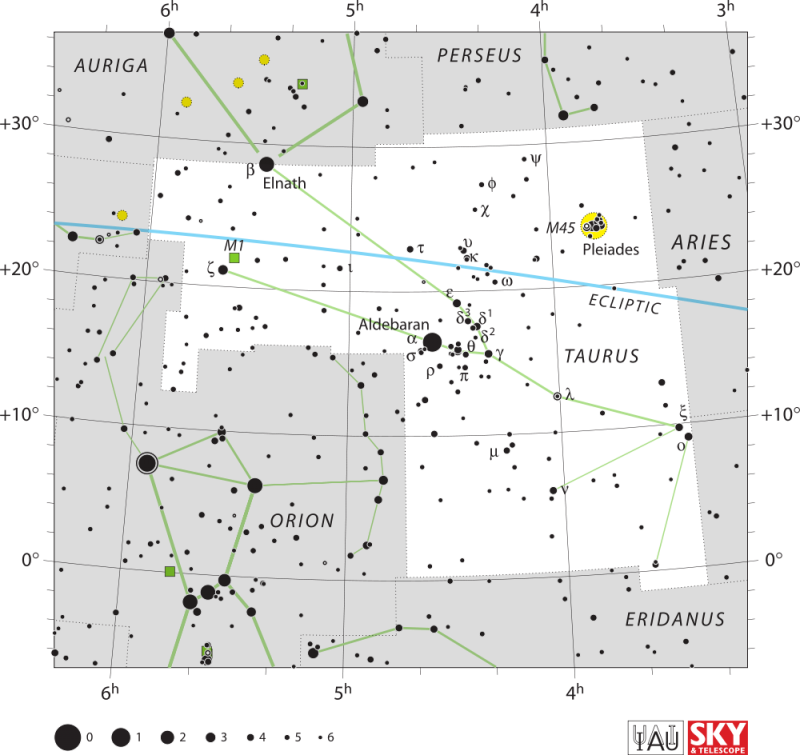
The V shape represents the Face of the Bull in the constellation Taurus. The bright star Aldebaran is part of the V. Aldebaran represents the Bull’s fiery red eye.
Finding the Hyades
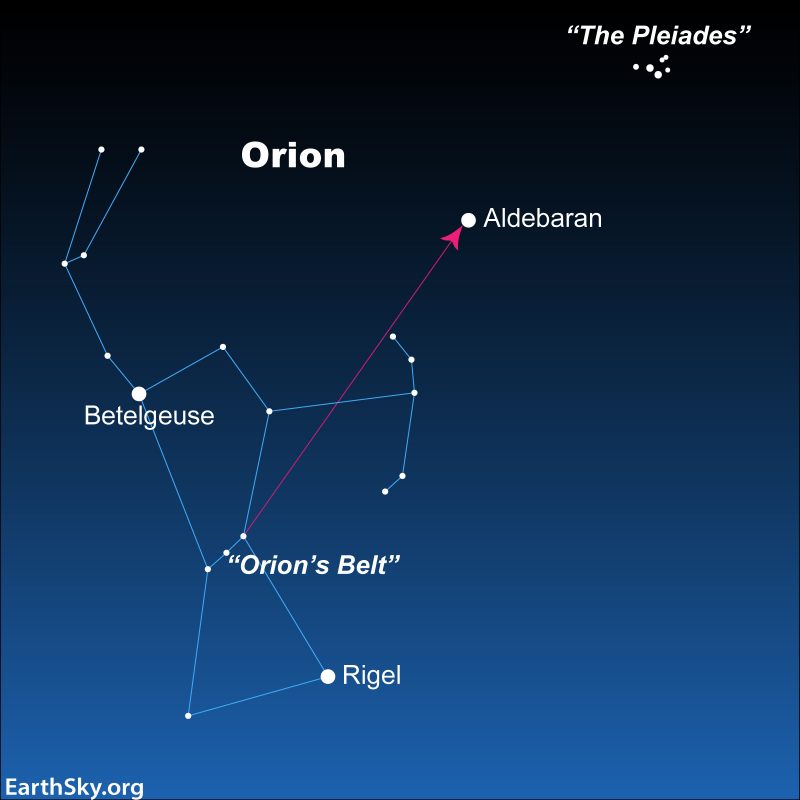
The Hyades cluster is easy to find by using Orion’s Belt, a compact and noticeable line of three blue-white stars in the constellation Orion the Hunter. Draw a line westward (generally toward your sunset direction) through the Belt stars, and you will come to the bright reddish star Aldebaran, the Bull’s fiery red eye.
Although Aldebaran isn’t a true member of the Hyades star cluster, this bright star is a great guide to this cluster. In fact, Aldebaran is only about 65 light-years distant. The actual cluster lies about 2 1/2 times farther off. This is what we call a “line-of-sight coincidence.”
Use binoculars or a telescope to see the Hyades star cluster
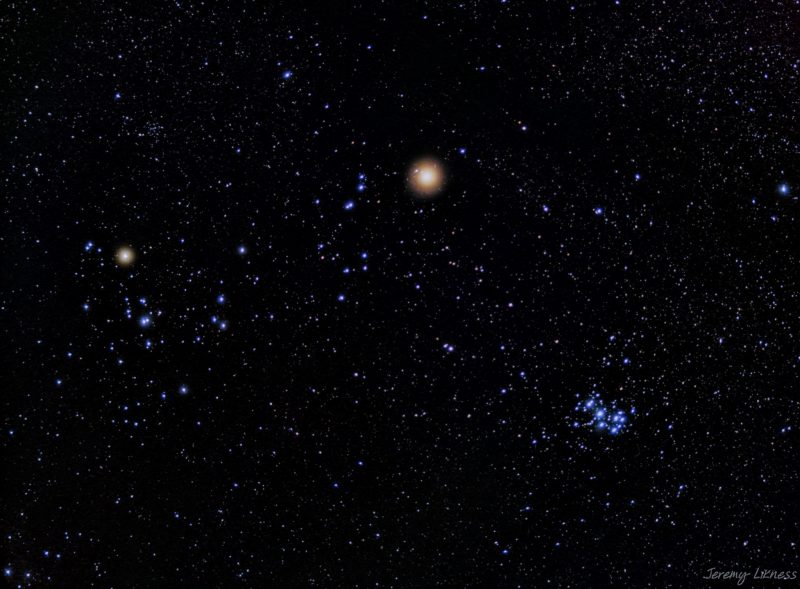
The V-shaped figure of stars (except Aldebaran) highlights the brightest of the Hyades’ few hundred stars. About a dozen or more Hyades stars are visible to the unaided eye in a dark country sky. Then if you use binoculars or a small telescope, dozens of the cluster’s stars pop into view. From the Northern Hemisphere, observers see the Hyades cluster best in the evening sky from around January to April. From the Southern Hemisphere, observers see the Hyades cluster best in the evening sky from December to February.
Additionally, the constellation Taurus the Bull is home to another bright star cluster: the Pleiades or Seven Sisters. In contrast to the Hyades, the Pleiades cluster is more distant, at some 430 light-years away. However, both the Hyades and Pleiades are easily visible to the unaided eye. Also, both are enhanced by viewing with binoculars.
History and mythology of the Hyades star cluster
According to sky lore, the teary Hyades are the daughters of Atlas and Aethra. The sisters are forever crying for their brother Hyas, who was killed by a lion or a boar. Plus, the Hyades are the half-sisters to the Pleiades, the daughters of Atlas and Pleione. The gods purposely kept Atlas’ daughters – the Hyades and the Pleaides – out of reach of Orion and his lustful pursuits.
So the gods transformed Hyas into the constellation Aquarius, and the lion that killed him into the constellation Leo. Then the gods placed Aquarius and Leo on opposite sides of the sky for Hyas’ protection. That’s why Aquarius and Leo do not appear in the same sky together. So as one constellation sets in the west, the other rises in the east, and vice versa.
Hyades science
Although the Hyades and Pleaides are half-sisters in mythology, science finds no close relationship in space between these two star clusters.
Astronomers find that the Pleiades are composed of hot blue-white suns in the heyday of youth. So that puts the age of the cluster at about 100 million years. In contrast, the cooler red giant and white dwarf stars found in the Hyades indicate a vastly older cluster over 600 million years old.
Interestingly, astronomers suspect an actual kinship between the Hyades cluster and the Beehive star cluster in the constellation Cancer the Crab. Even though these two star clusters are separated from one another by hundreds of light-years, they are akin in age and travel in a similar direction in space. Thus, astronomers believe that these clusters might have originated from the same gaseous nebula some 700 to 800 million years ago.
Is the Hyades cluster being destroyed?
Enjoying EarthSky? Sign up for our free daily newsletter today!
Bottom line: Look for the V-shape Hyades star cluster of Taurus the Bull in the evening sky. It represents the Face of the Bull and it’s beautiful in binoculars.
Read more: Lost sisters of the Pleiades are scattered across the sky
Discover more from GTFyi.com
Subscribe to get the latest posts sent to your email.