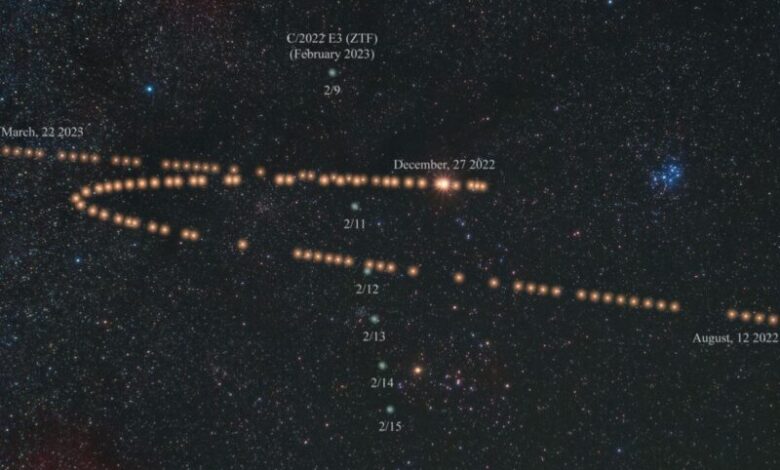
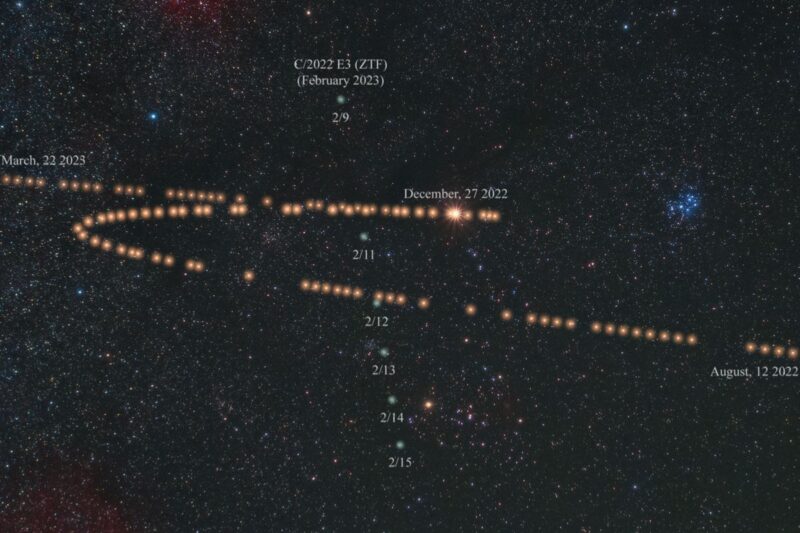
The retrograde or “backward” motion of an outer planet – like Jupiter, Saturn or Mars – is an illusion, a trick of perspective. Mars will begin its next retrograde – a milestone in the orbits of Earth and Mars around the sun – around January 10, 2027. At that time, Mars will be moving toward the west in front of the stars, in contrast to its regular eastward motion.
Some retrograde motion is an illusion

As measured against the fixed stars, planets typically appear to move eastward. But, sometimes, they seem to pause briefly in this eastward motion. They reach what astronomers call a stationary point. Then, for some months, the planet moves westward (backward) in front of the stars. Mars will reach its next stationary point on January 10, 2027. Astronomers (and astrologers) call a planet’s westward motion its retrograde motion.
Though it baffled ancient stargazers, we know now that this type of retrograde motion is an illusion.
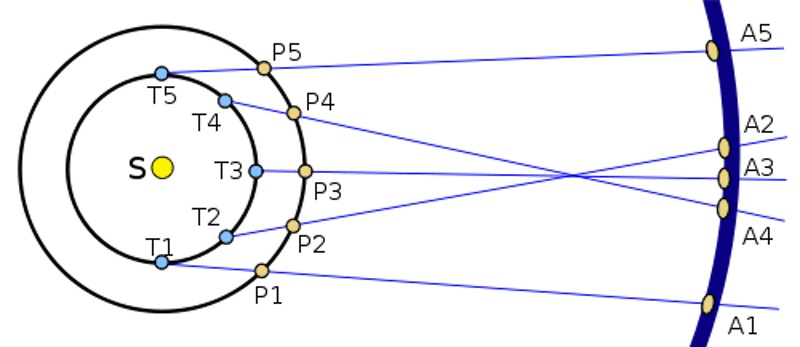
You can experience this illusion in an earthbound way, the next time you pass a car on the highway. As you approach a slower car, it’s clearly moving in the same direction you are. But, as you pull alongside and pass it – from your vantage point in the faster car – the slower car may appear to move backwards for a moment. Then, as you pull ahead of it, the car appears to resume its forward motion.
The same thing happens whenever Earth prepares to pass a slower-moving planet whose orbit is bigger than ours. Earth is due to pass between Mars and the sun on February 19, 2027. When we go between the sun and Mars (or another outer planet), these planets – all of which move more slowly than Earth in orbit – appear to reverse course in our sky.
Read more: Why is Mars sometimes bright and sometimes faint?
It baffled early astronomers
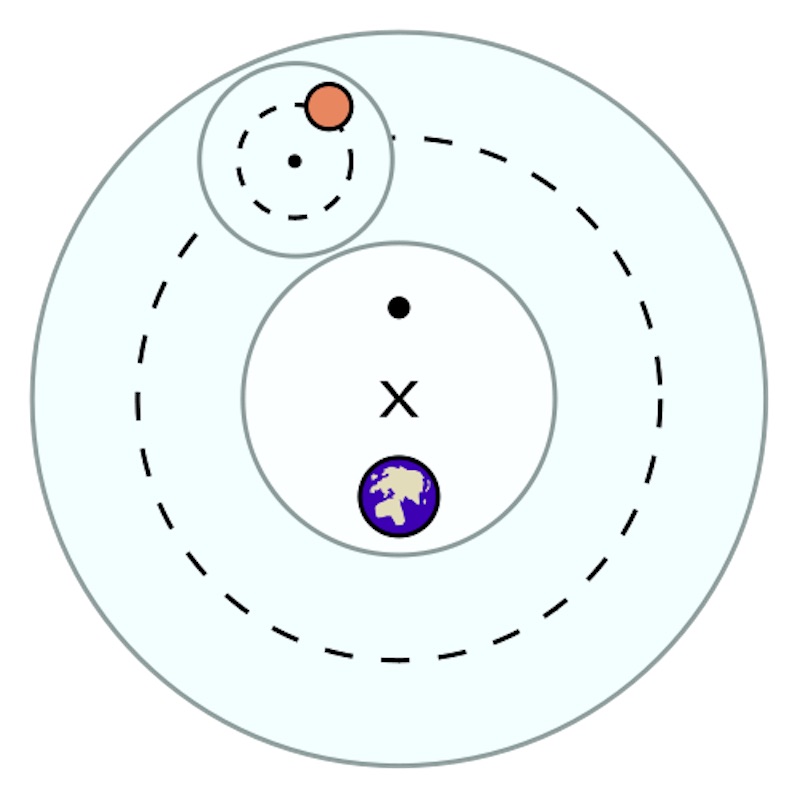
Early astronomers believed Earth lay at the center of the universe. And so they went to complicated lengths to attempt to explain retrograde motion in that Earth-centered universe. They theorized each planet not only orbited Earth, but also spun around a moving point on their orbit known as an epicycle.
Imagine whipping a ball on a length of string around your hand while you turned in place. That’s similar to the ancient view of retrograde motion.
When it became generally accepted that Earth and the other planets orbited the sun, suddenly retrograde motion made a lot more sense.
Retrograde motion on other worlds
If you could see the sky from another planet besides Earth, retrograde illusions would lead to your seeing some very strange phenomena. On Mercury, for example, the sun sometimes appears to move in retrograde. As Mercury speeds through its closest approach to the sun, its orbital speed overtakes its rotational speed. An astronaut on the surface would see the sun partially rise, then dip back below the horizon, then rise again before resuming its east-to-west trek across the sky. The result is that, once a year, Mercury gets two sunrises on the same day!
i am once again tapping the “this is how retrograde motion works” sign pic.twitter.com/ISDtoOyyiy
— Seven Machina Rasmussen (@toomanyspectra) April 22, 2024
Other retrograde motion is real
Astronomers also use the word retrograde to describe true backward motion among planets and moons.
Venus, for example, rotates or spins on its axis in the opposite direction from every other planet in the solar system. If the clouds ever parted, hypothetical Venusians would see the sun rise in the west and set in the east. Astronomers would say that Venus rotates in a retrograde manner.
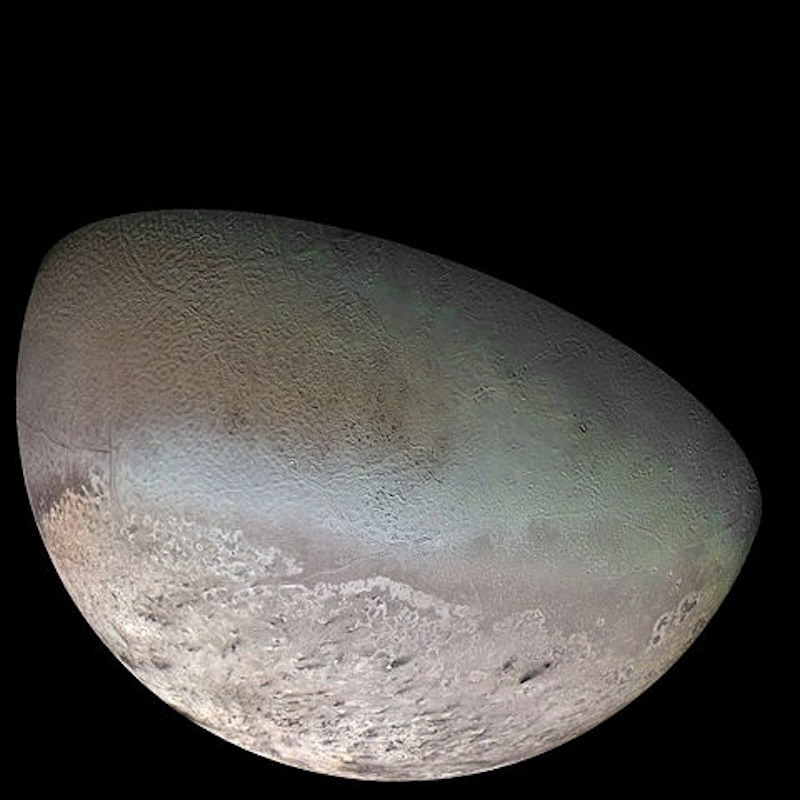
Some moons also have retrograde orbits around their planets. In other words, most of the large moons orbit in the same direction that their planet spins … but not Triton, for example, the largest moon of Neptune. It orbits opposite the direction of Neptune’s spin.
Among the smaller asteroid-like moons that swarm about the giant planets, many have retrograde orbits.
It’s the same word: retrograde. But now there’s no illusion. Whether speaking of a planet’s rotation – or its orbit – if it’s opposite what you’d expect, astronomers call it retrograde.
How does it happen?
According to modern astronomers, a true retrograde orbit for an orbiting moon most likely stems from a capture. Triton, for example, might have come out of the Kuiper Belt, the region of icy debris beyond Neptune. Perhaps a collision in the belt sent Triton careening inward toward the sun. A close encounter with Neptune could have slowed it down, forcing it to settle into a backward orbit.
In past decades, astronomers have also discovered planets in distant solar systems with retrograde orbits. These exoplanets orbit their suns in the opposite direction from how the star rotates.
It’s puzzling, because planets form out of debris disks that orbit young stars. And those orbiting disks share the star’s rotation. So how does a planet end up with a true backward orbit? The only way – some astronomers believe – is either by a near-collision with another planet, or if another star once passed too close to the system.
Either way, close encounters can disrupt the orbits of planets and set them on a backward path!
Bottom line: Mars won’t have any retrograde – or westward – motion in 2026. What is retrograde motion? An explanation, and bizarre examples on other worlds, here.
Read more: Why is Mars sometimes bright and sometimes faint?
Discover more from GTFyi.com
Subscribe to get the latest posts sent to your email.


