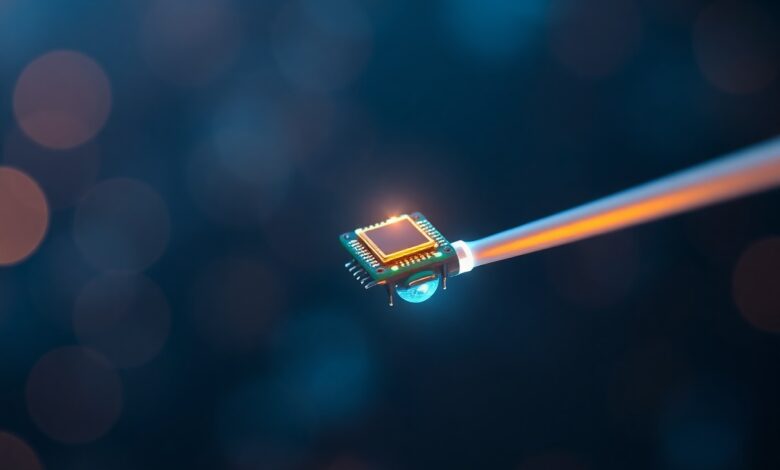
You are about to discover a groundbreaking innovation that could revolutionize computing: a tiny AI chip that is even smaller than a grain of salt. This remarkable chip integrates with a fiber optic tip to achieve light-speed processing, opening doors to unparalleled advancements in technology. With the potential to enhance a wide range of applications, from data centers to consumer electronics, this miniature marvel represents a significant leap forward in your computing experience. Stay tuned as we unpack the profound implications of this tiny revolution in artificial intelligence.
A Supercomputer on a Grain of Salt.
Imagine holding a single grain of salt on your fingertip. Now, imagine that speck contains the processing power of a supercomputer. This isn’t science fiction anymore. We are on the cusp of a computing revolution sparked by an AI chip so small it’s almost invisible, yet so powerful it operates at the speed of light.
This tiny marvel works by plugging directly into the tip of a fiber optic cable, turning data into light and back again in an instant. It’s a breakthrough that could redefine everything from the data centers that power our digital world to the smart devices we carry every day. Forget what you know about incremental upgrades; this is a fundamental leap forward. Let’s explore what happens when computing power becomes this small, this fast, and this revolutionary.
The End of the Old Race.
For fifty years, the tech world ran a single race, governed by Moore’s Law: cram more transistors onto a silicon chip every two years. It gave us the incredible progress we see all around us. But that race is over. We’ve hit a wall. When components get this small, the bizarre rules of quantum physics take over, and electrons start “leaking” through solid barriers. Worse, the chips get incredibly hot—too hot to function effectively.
So, the race changed. It wasn’t about just shrinking anymore; it was about thinking differently. Engineers began designing chips that didn’t just perform faster but did so while barely sipping power. They found a way to bridge the gap from our old electronic world to a new one, one that works with light itself.
It’s a scale that’s hard to wrap your head around. The first real computer, the ENIAC, was a 30-ton monster that filled a warehouse. Today, we’re talking about putting more power onto something you could easily lose in a salt shaker. The secret is swapping electrons for photons—particles of light. Electrons have mass and sludge through copper wires like cars in city traffic, generating friction and heat. Photons, on the other hand, are massless. They fly through fiber optic glass like cars on an empty, limitless highway, creating almost no heat and moving at the fastest speed possible.
This new approach is built on a foundation of brilliant innovations. We have transistors like FinFETs, which use a clever 3D design that acts like a “wraparound” grip on the flow of electricity, stopping the leaks that waste power. Scientists are also looking past silicon to “wonder materials” like graphene—a layer of carbon just one atom thick—that could conduct electricity with near-perfect efficiency. The ultimate goal is to build Photonic Integrated Circuits (PICs), essentially teaching a chip to think with light itself.
Why Light is the New Gold Standard.
Fiber optics are the unsung heroes of our connected world, and they are the key to unlocking this chip’s potential. By sending information as pulses of light through impossibly thin glass threads, data moves at mind-bending speeds.
What makes it so effective is the sheer volume of information that can be sent. Using a technique called Wavelength-Division Multiplexing (WDM), engineers can send a whole rainbow of data down a single glass thread at once, each color carrying a separate, massive data stream.
When you put fiber next to the old-school copper wiring we’ve relied on for a century, it’s not even a fair fight.
A signal in a fiber optic cable can travel for more than 50 kilometers before it even begins to fade. A copper cable is losing steam after just a few hundred meters. That’s why everything that matters—from international banking to the internet backbone—already runs on fiber. Now, that same power is coming directly to the chip.
AI That Lives on the Edge
This is where things get personal. For years, the AI we interact with has lived in the “cloud”—massive, distant data centers. When you ask your phone a question, the request travels hundreds of miles to a server, gets processed, and the answer is sent back. That delay, called latency, is small, but it’s there.
These new chips change the game by enabling “Edge AI.” The processing happens right where you are, on the device itself. The chip is so small and power-frugal that it can be embedded anywhere, making decisions in an instant without a trip to the cloud.
Suddenly, technologies that felt clumsy now feel fluid and natural. Think of augmented reality glasses that can overlay information on your world without any lag, or a translation device that works in real-time, making conversation effortless. This is what happens when AI breaks free from the cloud and lives on the edge. It’s the engine for truly autonomous cars that can react to a pedestrian faster than a human can blink, and for medical wearables that don’t just track your heart rate but can predict a cardiac event before it happens.
This power finds its way into the most critical places. In an operating room, a surgeon could use a “smart scalpel” that analyzes tissue on contact, instantly telling the difference between a tumor and healthy tissue. In the field, a drone could scan acres of farmland, identifying not just a struggling section, but a single diseased plant, allowing for targeted treatment that saves money and the environment.
Innovations in Semiconductor Technology.
Semiconductor technology has driven much of the shift towards smaller AI chips, enabling unmatched efficiency and performance. Innovations like strained silicon and advanced doping techniques have paved the way for chips that operate seamlessly at the nanoscale. These advancements enhance electron mobility and thermal performance, facilitating designers and engineers to create AI chips that are not only smaller but also significantly more powerful.
One significant breakthrough in semiconductor technology is the introduction of FinFET transistor designs, which allow for greater control over electrical currents compared to traditional planar transistors. This innovation results in improved power efficiency and increased speed for chip performance. Additionally, materials such as graphene and transition metal dichalcogenides are being explored for their potential to surpass silicon limitations, presenting exciting possibilities for future AI developments. Your devices could soon incorporate chips that harness these advanced materials, revolutionizing how you interact with technology.
The Science of Speed: How Fiber Optics Transform Computing.
Understanding the intricacies of fiber optics reveals how they enable remarkable computing speeds. This technology relies on the transmission of light through glass or plastic fibers, allowing data to travel at nearly the speed of light. The higher bandwidth and lower signal attenuation make fiber optics necessary in revolutionizing computing, providing opportunities for faster, more efficient data processing that traditional methods simply cannot match.
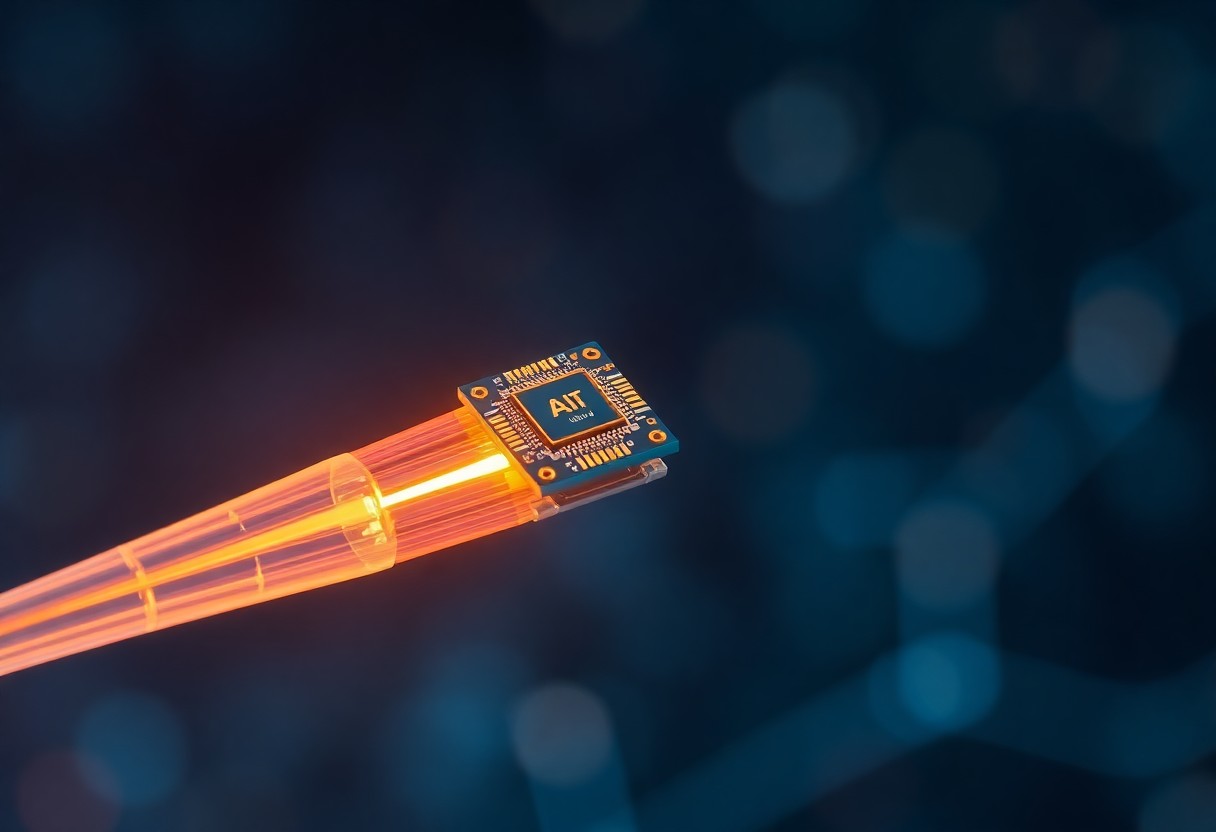
The Role of Light in Data Transmission.
Light plays a pivotal role in data transmission within fiber optic systems. When you send data, it is converted into light signals that travel through the core of a fiber. Modulation techniques dictate how these signals represent different data points, ensuring that large amounts of information can flow simultaneously without interference, resulting in incredible speed and clarity.
Comparing Fiber Optics to Traditional Wiring.
The advantages of fiber optics over traditional wiring are significant. Fiber optic cables, typically made of glass, can achieve transmission speeds up to 100 gigabits per second and support much longer distances without signal loss compared to copper cables. Furthermore, they exhibit resistance to electromagnetic interference, ensuring your data remains secure and intact as it travels.
Fiber Optics vs. Traditional Wiring.
| Feature | Fiber Optics |
|---|---|
| Speed | Up to 100 Gbps |
| Distance | Long distances without signal loss |
| Interference | Resistant to electromagnetic interference |
| Weight | Lightweight and thin |
Fiber optics’ ability to transfer data efficiently and securely positions it as a far superior option compared to traditional copper wiring. For instance, the average attenuation for fiber optic cables is less than 0.2 decibels per kilometer, which means you can send signals over long distances with minimal loss. In contrast, copper cable faces substantial weakening in signal strength, making it less viable for high-speed applications. This marked difference emphasizes why businesses and industries are increasingly opting for fiber optics, paving the way for a future where speed and efficiency are paramount.
A Glimpse of Tomorrow.
So what’s next on the horizon? While no one has a crystal ball, the path forward is focused on a few key ideas. We’ll see more “neuromorphic” chips designed to mimic the beautiful efficiency of the human brain. We’ll see chips stacked in three dimensions, like skyscrapers, packing impossible power into a tiny footprint.
The impact will ripple through every industry. Picture a factory that never has an unexpected breakdown because every machine can predict its own maintenance needs. Imagine financial markets where trading decisions are made and executed in microseconds. And consider the scientific breakthroughs possible when researchers can model everything from climate change to complex diseases at speeds we can barely comprehend today.
But with this incredible power comes a heavy dose of reality. We have to talk about the flip side. When every device is this smart, it raises urgent questions about privacy, security, and control. How do we prevent bias from being coded into these lightning-fast decision-making systems? Who is responsible when an autonomous system makes a mistake? These aren’t just technical problems; they are deeply human ones that we need to address with our eyes wide open.
This isn’t just another tech upgrade. The move from electron-based computing to light-based computing is a fundamental shift, as significant as the invention of the microchip itself. We are giving our technology the ability to process the world at the speed of thought, on a scale smaller than a grain of salt. The challenge, and the opportunity, is to wield that power wisely.
Final Words.
To wrap up, the development of an AI chip smaller than salt, capable of light-speed computing, marks a significant leap in technology that can transform your approach to data processing and machine learning. By harnessing the properties of fiber optics, this innovation promises to enhance efficiency and speed, offering unprecedented capabilities in computing. As you explore the potential applications and implications of this breakthrough, consider how it could impact your fields of interest and future technological advancements.
Discover more from GTFyi.com
Subscribe to get the latest posts sent to your email.