EarthSky’s 2026 lunar calendar is available now. Get yours today! Makes a great gift.
Hotspots for Category 6 storms are growing
Large, strong, rotating topical storms with low pressure centers have different names in different parts of the world: hurricane, typhoon and cyclone. But for all of them, their strength is rated by wind speed. In the Atlantic basin, hurricanes are rated by the Saffir-Simpson scale, with Category 1 storms being the most mild and Category 5 storms the most severe. However, some recent storms have been so strong they could have reached a theoretical Category 6, if such a category existed. And on December 16, 2025, researchers from the Department of Atmospheric Science at the National Taiwan University said the world’s hotspots for the most severe tropical storms are expanding.
At the annual meeting of the American Geophysical Union this week in New Orleans, I-I Lin from the Department of Atmospheric Science at the National Taiwan University said the warm waters that stir up the strongest hurricanes and typhoons extend well below the surface of the North Atlantic and Western Pacific Oceans. And Lin said:
These hotspot regions have expanded.
Why? Research from Lin’s team suggests human-caused climate change might be responsible for up to 70% of the growth of these hotspots. And many of these regions are near high population centers.
Wind strength for tropical cyclones
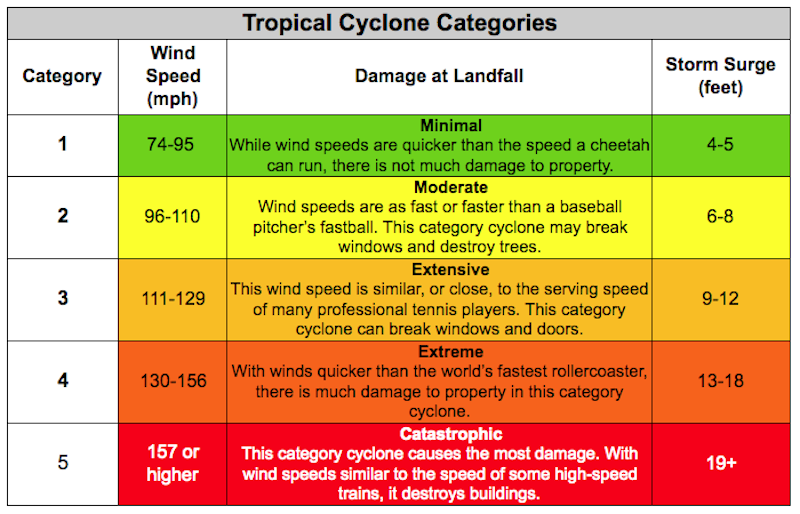
Tropical cyclones (the catchall name that includes hurricanes and typhoons) have five categories of strength. Meteorologists don’t consider a storm to be a cyclone, hurricane or typhoon until it reaches a threshold of 64 knots, or 74 mile-per-hour winds. Category 5 is for storms that have winds of 137 knots (or 158 miles per hour) or greater. The five categories are not precisely divided up, but, on average, you can think of them as being divided into a new category with every 20-knot (23-mile-per-hour) wind increase.
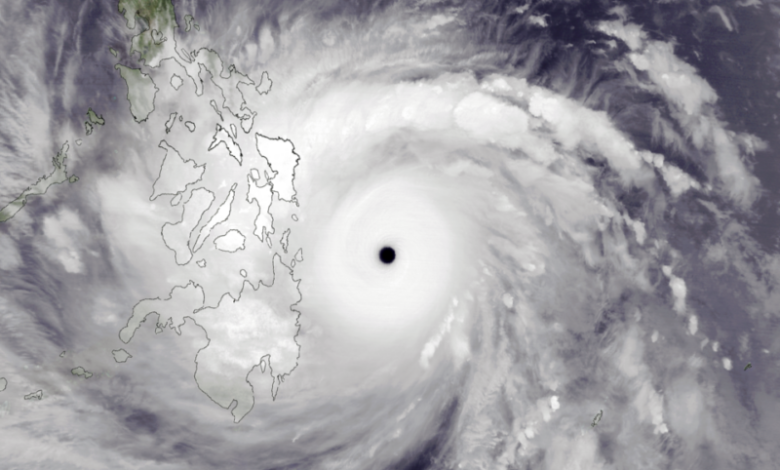
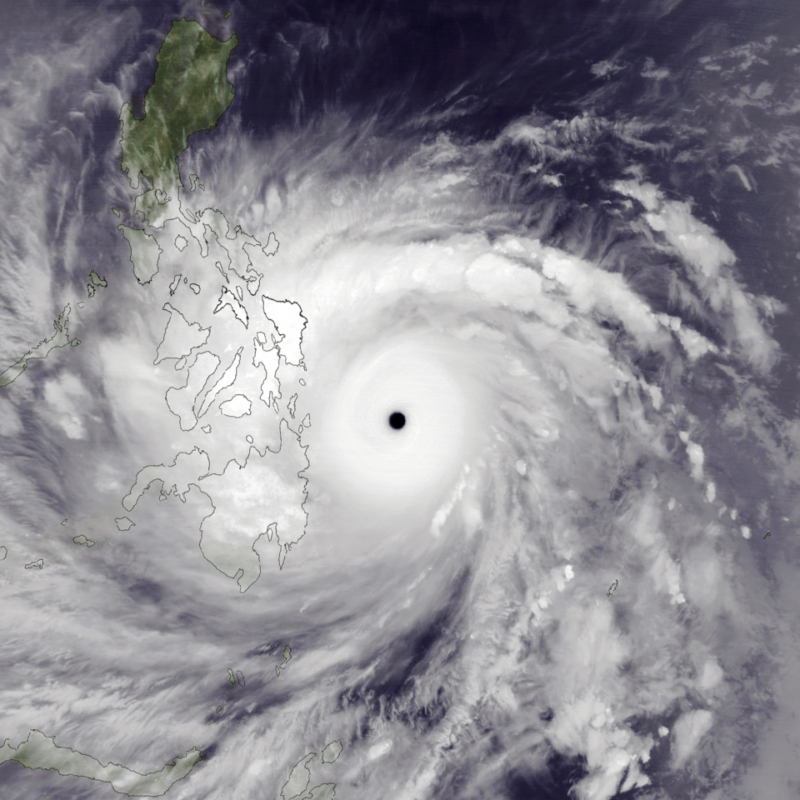
Yet some Category 5 storms, which begin at 157 miles per hour, have had sustained winds more than 50 miles per hour higher than the threshold. After Super Typhoon Haiyan in 2013, Lin and colleagues wrote a paper proposing a Category 6 for storms more than 160 knots (184 mph). Haiyan, which hit the Philippines, had wind speeds of 170 knots, or 196 miles per hour. And then there’s Hurricane Patricia. Patricia formed off the west coast of Mexico in 2015 and holds the record for maximum sustained winds. The winds reached 185 knots, or 213 miles per hour! It could easily have been a Category 7. As Lin said:
Patricia was the king of the world.
Read more: Stronger hurricanes require new Category 6, researchers say
New research into hotspots
Lin’s new research looks at these “Category 6” hotspots. First, she found that these types of storms are increasingly common. In nearly 30 years, between 1982 and 2011, there were eight tropical cyclones with winds of more than 160 knots. But in the decade spanning 2013 to 2023, there were 10 Category 6 tropical cyclones.
Second, she found that most of these Category 6 tropical cyclones were in specific hotspots. One is in the Western Pacific Ocean, east of the Philippines and Borneo. And another is in the North Atlantic around and to the east of Cuba, Haiti and Florida.
And third, the research of Lin and colleagues revealed that these hotspots are growing. The North Atlantic hotspot has expanded eastward, past the northern coast of South America. And it’s also expanded westward, into much of the Gulf. Meanwhile, the Western Pacific has grown as well.
Why are the Category 6 storms increasing, with hotspots expanding?
Tropical cyclones grow with the help of warm water. However, the winds of the storm also churn up the ocean, often bringing up cooler water from lower regions, which can help weaken storms. But now, in these hotspot areas, the deep water has also become warm. So when a storm churns the water, it doesn’t create a weakening effect.
Even so, Lin points out that not every storm in a hotspot will become a Category 6:
The hotspots are a necessary but not sufficient condition.
The researchers found the expanded hotspots are due in part to both global warming and natural variability. But they did find global warming has more of an edge. They estimated human-caused climate change is responsible for about 60 to 70% of the increased size in the hotspots. And, therefore, in the increased frequency of Category 6 storms.
Creating an official Category 6 could help alert the public to the dangers of incoming storms. Lin said:
We really think there is a need just to provide the public with more important information.
Bottom line: Researchers said that Category 6 storms – storms that are extremely strong Category 5 hurricanes on the current scale – arise in hotspots on the globe, and those spots are growing.
Read more: Looking back on the 2025 Atlantic hurricane season
Discover more from GTFyi.com
Subscribe to get the latest posts sent to your email.